
Thiruparankundram Murugan Temple: History, Legends & Hidden Mysteries
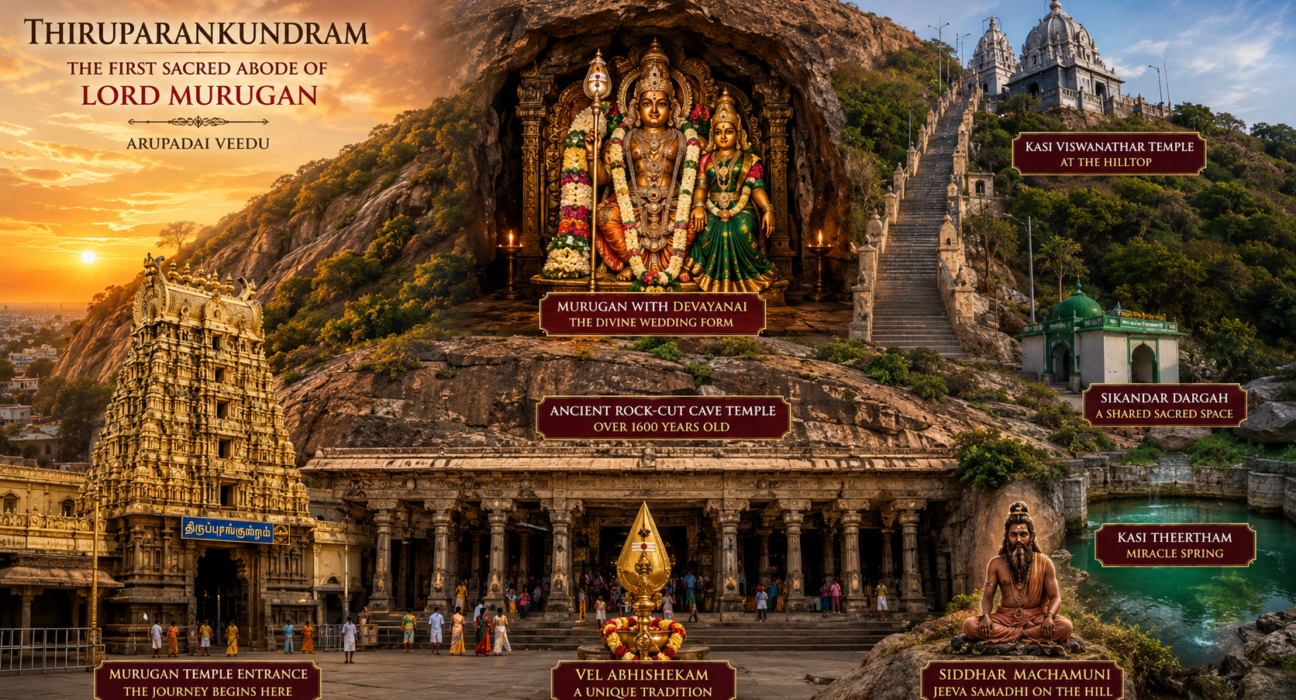
Thiruparankundram: The Sacred Hill Where Lord Murugan Began His Divine Mission
The First of the Six Sacred Abodes of Murugan
Among the countless temples dedicated to Lord Murugan across Tamil Nadu, one shrine holds a place unlike any other.
It is not merely an ancient temple.
It is not merely a pilgrimage centre.
It is the sacred place where, according to Hindu tradition, Lord Murugan began His divine mission after defeating the forces of evil.
This is Thiruparankundram—the first of the Arupadai Veedu (Six Sacred Abodes of Murugan), located on the southwestern outskirts of Madurai.
For centuries, saints, Siddhas, kings, poets, and millions of devotees have climbed this sacred hill seeking the grace of the Divine Commander of the celestial armies.
Yet Thiruparankundram is far more than a Murugan temple.
Within a single sacred hill lies an extraordinary spiritual landscape where Shaivism, Murugan worship, ancient cave architecture, sacred springs, Siddha traditions, and centuries of history converge into one of South India’s most remarkable pilgrimage sites.
A Temple Carved from a Living Mountain
Unlike many temples constructed stone by stone, Thiruparankundram is a rock-cut cave temple.
Rather than building upward, ancient craftsmen carved directly into the face of the mountain, transforming the living rock into a magnificent sanctuary.
Stepping inside feels less like entering a building and more like entering the mountain itself.
The cool stone walls, narrow passages, and naturally formed chambers create an atmosphere unlike any other Murugan temple in Tamil Nadu.
The cave itself seems to preserve the silence of centuries.
Every surface reflects the remarkable skill of ancient artisans who transformed solid granite into a masterpiece of sacred architecture.
This unique construction also explains one of the temple’s most distinctive traditions.
Murugan in His Wedding Form
At the heart of the cave temple, Lord Murugan is enshrined with Deivanai, the daughter of Indra.
Unlike the youthful ascetic form worshipped at Palani or the warrior who vanquished Surapadman at Tiruchendur, the Lord of Thiruparankundram appears in the divine form of a bridegroom.
According to temple tradition, this sacred hill became the site of Murugan’s celestial wedding after His victory over Surapadman.
For this reason, devotees experience not only the Lord’s power but also His grace as the Divine Householder.
The sanctum radiates a rare sense of peace, reminding pilgrims that every victory in life ultimately culminates in harmony and divine union.
Why No Abhishekam Is Performed for Murugan
One of the most fascinating customs at Thiruparankundram surprises first-time visitors.
Unlike many Murugan temples, the main deity does not receive Abhishekam (ritual bathing).
The reason is architectural rather than theological.
Since the deity is carved within the ancient cave structure, regular ritual bathing could gradually damage the historic rock-cut shrine.
Instead, a unique tradition developed over the centuries.
The ceremonial Vel (divine spear) of Lord Murugan receives the Abhishekam.
Among the Six Sacred Abodes, Thiruparankundram stands alone in giving such prominence to Murugan’s Vel.
This tradition reflects the profound symbolism of the spear—not merely as a weapon, but as the embodiment of divine wisdom, protection, and the victory of truth over ignorance.
The Sacred Hill Above the Temple
Many pilgrims complete their worship after visiting the cave temple below.
However, those familiar with Thiruparankundram’s deeper traditions know that the pilgrimage continues upward.
The hill itself is regarded as sacred.
A pathway climbing the rear side of the mountain leads devotees toward several ancient shrines located on the summit.
Among them are:
- Kasi Viswanathar Temple
- Valli Sunai (the sacred spring)
- Traditional sites associated with Siddha Machamuni, one of the revered Siddhas in Tamil spiritual tradition.
These shrines are not viewed as separate places of worship.
They are integral parts of the spiritual geography of Thiruparankundram, enriching the pilgrimage with layers of Shaivite, Siddha, and Murugan traditions.
The Sacred Journey Up the Hill
The ascent to the hilltop is itself an act of devotion.
Stone steps wind around the mountain, offering panoramic views of Madurai while gradually leading pilgrims toward the ancient Kasi Viswanathar shrine.
Along this path, one also encounters the Sikandar Dargah, a site that has coexisted with the surrounding Hindu pilgrimage route for generations.
For many years, devotees from different faiths visited their respective sacred places without significant conflict.
The hill thus became a unique example of how different traditions could share a common sacred landscape while maintaining their own forms of worship.
A Living Pilgrimage
For devotees of Lord Murugan, Thiruparankundram is not merely a destination.
It is a spiritual journey through multiple layers of sacred history.
Every step recalls a different chapter:
- The ancient cave temple.
- Murugan’s divine marriage.
- The sacred Vel.
- Kasi Viswanathar.
- Siddha traditions.
- Sacred springs.
- Centuries of uninterrupted worship.
Few temples in India combine so many spiritual traditions within a single sacred hill.
Perhaps this is why generations of saints—including Nakkirar, Arunagirinathar, and Kumaraguruparar—praised Thiruparankundram as one of the holiest abodes of Lord Murugan.
Their hymns continue to echo through the temple corridors, reminding every pilgrim that this hill is not merely a monument of the past—it is a living centre of devotion.
The Sacred Vel, Kasi Viswanathar, and the Spiritual Crown of the Holy Hill
For most devotees, worship at Thiruparankundram ends after receiving the blessings of Lord Murugan inside the magnificent rock-cut cave temple.
However, those familiar with the temple’s deeper spiritual traditions know that the pilgrimage is only half complete.
The true glory of Thiruparankundram extends beyond the cave shrine.
The sacred hill itself is revered as a living temple.
Its summit preserves ancient shrines, holy springs, Siddha traditions, and sacred pathways that have attracted seekers for centuries.
To understand Thiruparankundram fully, one must climb the mountain itself.
The Ancient Kasi Viswanathar Temple
Hidden atop the sacred hill stands the ancient Kasi Viswanathar Temple, one of the oldest and most revered shrines associated with Thiruparankundram.
Many devotees are surprised to discover that this Shaivite temple occupies such an important place within one of Murugan’s most celebrated abodes.
Yet this perfectly reflects Murugan’s identity.
Murugan is not separate from Lord Shiva.
He is the son of Shiva, born from His divine radiance.
Therefore, every pilgrimage to Murugan ultimately leads back to Shiva.
This sacred connection explains why countless devotees choose to visit both shrines during the same pilgrimage.
The journey from the cave temple below to the Kasi Viswanathar shrine above symbolizes the inseparable relationship between father and son, Guru and disciple, source and manifestation.
Why the Hill Is Considered Sacred
In Hindu tradition, sacred geography is never accidental.
A mountain itself can become an object of worship when divine events are believed to have unfolded upon it.
Thiruparankundram is one such hill.
The entire mountain is regarded as holy.
Ancient traditions associate it with Lord Shiva, Goddess Durga, Lord Murugan, Siddhas, sages, and numerous episodes narrated in the Kanda Puranam and Tamil devotional literature.
Unlike many temple hills that contain only a single shrine, Thiruparankundram preserves multiple sacred centres within the same landscape.
Every pathway, cave, and spring carries a story that has been passed down through generations.
The Sacred Vel Receives the Abhishekam
Among the Six Sacred Abodes of Murugan, Thiruparankundram follows a unique tradition.
Because the principal deity resides within the ancient rock-cut sanctum, ritual bathing (Abhishekam) is not performed directly upon the main idol.
Instead, the temple honours Murugan’s Vel, His divine spear.
Every Abhishekam offered to the Vel symbolizes worship of Murugan Himself.
The Vel represents far more than a weapon.
It symbolizes:
- Divine wisdom that destroys ignorance.
- Spiritual power.
- Protection of devotees.
- Victory over ego.
- The triumph of Dharma.
According to temple tradition, after defeating the demon Surapadman, Lord Murugan arrived at Thiruparankundram carrying His victorious Vel.
This sacred memory is preserved through the special reverence shown to the spear even today.
A Festival Found Nowhere Else
One of Thiruparankundram’s most distinctive annual traditions takes place during the last Friday of the Tamil month of Purattasi.
On this sacred occasion, Murugan’s Vel is ceremoniously carried from the cave temple to the Kasi Viswanathar Temple atop the hill.
There, elaborate Abhishekam is performed to the divine spear.
This remarkable ritual is unique among the Arupadai Veedu temples.
It beautifully expresses the spiritual unity between Lord Murugan and Lord Shiva.
Thousands of devotees gather to witness this sacred procession, seeing in it not merely a ritual but a celebration of Murugan’s divine victory and eternal connection to His Father.
The Sacred Spring of Valli Sunai
Near the summit lies another revered site known as Valli Sunai.
According to local tradition, this natural spring has been associated with Murugan’s divine consort Valli.
For generations, pilgrims have regarded its waters as sacred.
Many pause here during their ascent, offering prayers and reflecting amidst the peaceful surroundings of the hill.
The spring adds another layer to the spiritual richness of Thiruparankundram, where mythology and nature blend seamlessly.
The Presence of the Siddhas
Thiruparankundram is not remembered only through temple traditions.
The hill also occupies a respected place within the Siddha tradition of Tamil spirituality.
Traditional accounts associate the summit with Siddha Machamuni, one of the revered eighteen Siddhas.
Many devotees believe that Machamuni attained Jeeva Samadhi here after completing his spiritual mission.
Although historical evidence regarding Siddha sites often belongs to sacred tradition rather than archaeology, such associations have shaped the devotional life of the hill for centuries.
For spiritual seekers, the mountain represents not only the presence of Murugan but also the silent tapas of enlightened Siddhas who sought liberation in its caves and forests.
A Sacred Path Shared for Generations
The pathway leading to the Kasi Viswanathar Temple also passes by the Sikandar Dargah, situated along the hill.
For many decades, devotees of different faiths visited their respective places of worship peacefully.
Hindu pilgrims continued their climb toward the Kasi Viswanathar shrine, while Muslim devotees visited the dargah.
This long-standing coexistence became part of Thiruparankundram’s lived history.
In recent times, however, events surrounding the hill have attracted wider public attention and debate.
Understanding these discussions requires examining both the historical background of the dargah and the concerns raised by different communities.
That story forms an important chapter in the modern history of Thiruparankundram and will be explored carefully in the next section.
More Than a Temple
Thiruparankundram is not simply one shrine among many.
It is an entire sacred ecosystem.
Here, one encounters:
- Lord Murugan in His wedding form.
- Lord Shiva as Kasi Viswanathar.
- Ancient Siddha traditions.
- Sacred springs.
- The victorious Vel.
- Cave architecture dating back many centuries.
- Living rituals preserved through generations.
Every pilgrimage to Thiruparankundram becomes a journey through mythology, history, devotion, and spiritual symbolism—all woven together within a single sacred hill.
The Sikandar Dargah: History, Heritage, and the Recent Controversy
For centuries, Thiruparankundram Hill has remained one of South India’s most revered pilgrimage destinations.
Every year, millions of devotees visit the ancient cave temple of Lord Murugan, climb the sacred hill to worship Kasi Viswanathar, and pay homage at various shrines associated with Siddhas and saints.
Along the same hill stands another place of worship—the Sikandar Dargah.
For generations, Hindu pilgrims and Muslim devotees visited their respective sacred places without significant conflict.
The hill became an example of how different religious traditions could exist within a shared sacred landscape.
However, recent events have brought Thiruparankundram into the centre of public attention.
To understand why, it is important to separate history, tradition, and contemporary events.
A Shared Sacred Landscape
The pathway leading to the hilltop Kasi Viswanathar Temple passes by the Sikandar Dargah.
For decades, devotees from both communities have used this route peacefully.
Hindu pilgrims continued towards the Shiva temple on the summit, while Muslim devotees visited the dargah to offer prayers.
Many local residents regarded this coexistence as a normal part of Thiruparankundram’s cultural heritage.
The presence of the dargah itself was not generally viewed as a source of conflict.
Instead, both places remained active centres of worship for their respective communities.
The Recent Controversy
Public attention increased after reports that some individuals proposed conducting animal sacrifice at or near the Sikandar Dargah on the hill.
According to the script, this proposal created tension because Thiruparankundram Hill is revered by Hindus as one of the holiest Murugan shrines, and ritual animal sacrifice has never formed part of the worship traditions associated with the Murugan temple or the Kasi Viswanathar shrine.
Police reportedly intervened before such an event could take place, preventing further escalation.
The proposal also led to public statements regarding the identity and heritage of the hill, resulting in wider public debate.
Why Did This Become Sensitive?
To understand the emotional response of many devotees, one must appreciate the religious significance of Thiruparankundram.
This is not simply another hill.
According to Hindu tradition, it is:
- The first of the Six Sacred Abodes of Lord Murugan.
- The place where Murugan married Deivanai.
- A sacred Shaivite centre housing Kasi Viswanathar.
- A hill associated with ancient Siddha traditions.
- A site praised for centuries in Tamil devotional literature.
Because of this extraordinary spiritual importance, any proposal that appears to alter long-established worship practices naturally evokes strong reactions among devotees.
Understanding the History of the Dargah
The history of the Sikandar Dargah is described through more than one tradition.
One local tradition remembers Sikandar Badusha as a revered holy man who lived in the region and whose resting place later became a dargah.
However, historians have also documented another narrative connected with the Madurai Sultanate.
According to historical accounts referred to in the script, the dargah is associated with Ala-ud-Din Sikandar Shah, a ruler linked to the Madurai Sultanate during the fourteenth century.
These accounts describe political and military conflicts that occurred during the period when the Madurai Sultanate ruled parts of South India.
Following battles involving Pandya forces and the support of the Vijayanagara Empire, Sikandar Shah is believed in some historical traditions to have died in the vicinity of Thiruparankundram, where his burial site later became associated with the present-day dargah.
History and Devotion Can Coexist
Whatever the precise historical origins of the dargah may be, one fact is significant.
For many generations, its existence did not prevent Hindu devotees from worshipping Lord Murugan.
Nor did Hindu pilgrims generally object to Muslim devotees visiting the dargah.
Tamil society has long possessed a tradition of respecting saints and holy persons across different spiritual paths.
This mutual coexistence formed part of the lived culture of Thiruparankundram.
The issue discussed in the script is therefore not the existence of the dargah itself, but concerns about introducing practices that devotees believe are inconsistent with the long-established traditions of the sacred hill.
A Hill Revered for Thousands of Years
For devotees, the sanctity of Thiruparankundram extends far beyond recorded medieval history.
The hill is celebrated in Kanda Puranam, Tirumurugāṟṟuppaṭai, and the hymns of great Tamil saints.
Its association with Lord Murugan belongs to a sacred tradition that devotees regard as ancient and timeless.
The script emphasizes that, from this devotional perspective, the spiritual identity of the hill is inseparable from Murugan worship and Shaivite tradition.
It also notes that generations of pilgrims visiting Meenakshi Amman Temple have traditionally included Thiruparankundram in their pilgrimage, reflecting the hill’s enduring place within Madurai’s sacred geography.
Respecting Every Faith
India’s spiritual heritage has always been enriched by diversity.
Temples, dargahs, churches, monasteries, and gurudwaras all form part of the nation’s cultural landscape.
Respecting one tradition does not require diminishing another.
At the same time, preserving the unique customs and religious practices associated with ancient sacred sites is equally important.
Constructive dialogue, mutual respect, and adherence to the law remain the most effective ways to protect both religious harmony and cultural heritage.
Thiruparankundram’s greatest strength has always been its ability to inspire devotion across centuries.
Safeguarding that heritage is a shared responsibility
The Ancient Puranic Origins of Thiruparankundram
Long before Thiruparankundram became the first of Lord Murugan’s Six Sacred Abodes…
Long before the celestial wedding of Murugan and Deivanai…
Long before saints such as Nakkirar and Arunagirinathar filled the hill with devotional hymns…
This mountain already possessed an extraordinary spiritual identity.
According to ancient Hindu tradition, Thiruparankundram was sacred even before Lord Murugan’s incarnation.
Its story begins not on Earth…
But in the heavens themselves.
A Fragment of Mount Meru
According to the Kanda Puranam and traditional temple lore, the origin of Thiruparankundram is connected to Mount Meru, the cosmic mountain revered in Hindu cosmology.
The legend tells of a contest between Vayu, the God of Wind, and Adisesha, the divine serpent.
Adisesha tightly coiled himself around Mount Meru to demonstrate his immense strength.
Determined to prove his own power, Vayu unleashed mighty storms upon the mountain.
The struggle shook the heavens.
Eventually, several fragments of Mount Meru broke away and fell upon the earth.
One of those sacred fragments is traditionally believed to have become the present-day Thiruparankundram Hill.
Standing approximately 300 feet high, the hill has long been regarded not merely as a geological formation but as a manifestation of divine energy itself.
Why It Was Once Called “Parankunram”
Ancient devotees believed that the hill naturally resembled a Shiva Lingam.
Because of this sacred form, they worshipped the mountain itself as an embodiment of Lord Shiva.
Traditional accounts explain that the hill was originally known as Parankunram, meaning the sacred hill of Shiva.
Only later did the name evolve into Thiruparankundram, the honorific “Thiru” emphasizing its supreme sanctity.
This tradition beautifully illustrates an important truth.
Before Murugan’s association with the hill, it was already revered as one of Lord Shiva’s sacred manifestations.
Thus, Shaivism and Murugan worship have always been inseparably connected at Thiruparankundram.
Goddess Durga’s Penance
Another profound legend associated with Thiruparankundram concerns Goddess Durga.
After slaying the buffalo demon Mahishasura, the Goddess had fulfilled her divine mission.
Yet Hindu philosophy teaches that even the destruction of evil carries karmic consequences.
According to the temple tradition, Goddess Durga sought a way to free herself from the spiritual burden associated with the act of killing.
She approached Lord Shiva for guidance.
The Lord instructed Her to travel to the sacred hill where He Himself existed in the form of the divine mountain and perform intense penance there.
Obeying His command, the Goddess came to Thiruparankundram.
At the foot of the hill, she installed a Shiva Lingam and immersed herself in deep meditation.
The Sacred Devi Lingam
After completing her penance, Goddess Durga received the divine vision of Lord Shiva.
Her karmic burden was dissolved, and she attained complete spiritual purification.
The Shiva Lingam that she is believed to have consecrated remains one of the sacred traditions associated with the temple.
Today, devotees identify this Lingam as the Devi Lingam, which is worshipped within the temple complex.
For pilgrims, it stands as a reminder that sincere repentance, devotion, and surrender possess the power to transform even the deepest karmic burdens into spiritual liberation.
The Divine Vision of Somaskanda
Temple tradition further narrates that when Lord Shiva appeared before Goddess Durga, He manifested in the beautiful Somaskanda form.
In this sacred iconography:
- Lord Shiva sits at the centre.
- Goddess Parvati sits beside Him.
- The young Lord Murugan occupies the space between His Divine Parents.
The Somaskanda form symbolizes the perfect harmony of Divine Consciousness, Divine Energy, and Divine Wisdom.
Even today, devotees visiting the sanctum can witness this sacred representation behind the Shiva Lingam, preserving one of the temple’s oldest theological traditions.
Murugan’s Own Penance
The story of Thiruparankundram does not end with Goddess Durga.
It becomes even more extraordinary with the arrival of Lord Murugan Himself.
According to the Kanda Puranam, Lord Shiva was once imparting the sacred Pranava Mantra (“Om”) to Goddess Parvati.
The young Murugan, seated upon His Mother’s lap, overheard this secret spiritual instruction.
Although He had heard the teaching unintentionally, Murugan felt that the sacred mantra should only be received through proper initiation from a Guru.
Recognizing the sanctity of the Guru-disciple tradition, He approached Lord Shiva and asked how this spiritual oversight could be rectified.
Lord Shiva directed Him to the very place where Goddess Durga had performed her penance—Thiruparankundram.
There, Murugan was instructed to undertake His own tapas until the appointed time when Shiva would grant Him divine darshan.
Thus, Lord Murugan descended from Kailasa and began His meditation upon this sacred hill.
The Origin of Thaipusam at Thiruparankundram
Murugan remained absorbed in deep meditation for the prescribed period.
Then, on the auspicious day of Thai Poosam, Lord Shiva and Goddess Parvati appeared before Him together, blessing Him and completing the spiritual purpose of His penance.
This divine event is regarded in temple tradition as the reason why Thai Poosam is celebrated with exceptional grandeur at Thiruparankundram.
It commemorates not merely Murugan’s glory but His humility.
Even the son of Lord Shiva accepted the discipline of penance and honoured the sacred relationship between Guru and disciple.
Following this divine revelation, Lord Shiva is believed to have manifested nearby as Adi Chokkanathar.
To this day, many devotees traditionally worship Adi Chokkanathar before proceeding to Lord Murugan’s shrine, preserving the ancient order of worship associated with the hill.
Preparing for the Great Divine Mission
These events occurred while Murugan was still youthful.
Only later would He mature into the commander of the celestial armies, lead the Devas into battle against Surapadman, and emerge victorious at Tiruchendur.
Before that great war, however, Thiruparankundram served as His sacred place of preparation.
It was here that He performed penance.
It was here that He received His Father’s blessings.
And it was here that the foundation was laid for one of the greatest episodes in Hindu mythology.
Murugan's Divine Wedding, Nakkirar's Miracle, and the Eternal Glory of Thiruparankundram
After completing His penance at Thiruparankundram and receiving the blessings of Lord Shiva, Lord Murugan prepared for the greatest battle of His divine mission.
He would soon lead the celestial armies against the mighty demon Surapadman, restoring Dharma and liberating the Devas from oppression.
That glorious victory would take place at Tiruchendur, another of the Six Sacred Abodes.
But the story did not end there.
Murugan’s triumphant return would forever transform Thiruparankundram into one of the holiest places in Hinduism.
The Divine Wedding of Murugan and Deivanai
Following the destruction of Surapadman, the king of the Devas, Indra, wished to express his gratitude.
According to the Kanda Puranam, he offered his foster daughter Deivanai (Devasena) in marriage to Lord Murugan.
The celestial wedding was celebrated with great grandeur at Thiruparankundram.
Gods, sages, Siddhas, Gandharvas, and celestial beings are believed to have gathered to witness this divine union.
Unlike other Murugan temples where the Lord appears as a warrior, ascetic, or youthful deity, Thiruparankundram uniquely enshrines Him in His wedding posture beside Deivanai.
This sacred form symbolizes not only victory over evil but also the establishment of cosmic harmony after the triumph of Dharma.
It is this divine marriage that elevated Thiruparankundram as the First of the Six Sacred Abodes (Arupadai Veedu), making it one of the most cherished pilgrimage centres for Murugan devotees.
The Story of Saint Nakkirar
Among the many saints associated with Thiruparankundram, Nakkirar occupies a place of great reverence.
According to temple tradition, Nakkirar was performing severe penance on the summit of the sacred hill to atone for a past spiritual transgression.
During his meditation, he was captured by a Brahma Rakshasa and imprisoned inside a cave.
Unable to escape, Nakkirar turned wholeheartedly to Lord Murugan.
From within the cave, he composed and sang the immortal Tirumurugāṟṟuppaṭai, one of the oldest and greatest devotional works dedicated to Murugan.
His heartfelt hymns echoed through the mountain itself.
Moved by the devotion of His devotee, Lord Murugan immediately appeared before him, destroyed the Brahma Rakshasa, and liberated Nakkirar from captivity.
The Miracle of Kasi Theertham
After his rescue, Nakkirar expressed another concern.
His meditation had been interrupted, and according to the spiritual discipline he followed, he wished to purify himself by bathing in a sacred holy water body before continuing his penance.
In response, Lord Murugan performed another miracle.
He struck the rocky mountain with His divine Vel.
Instantly, pure water gushed forth from the stone.
This miraculous spring became known as Kasi Theertham, symbolically equating its sanctity with the holy waters of Varanasi.
Temple tradition holds that Nakkirar bathed in this sacred spring, completed his penance, and attained spiritual fulfilment.
Even today, pilgrims visiting the hill revere Kasi Theertham as one of the most sacred water sources associated with Lord Murugan.
The Legacy of Siddha Machamuni
Another enduring tradition connects the summit of Thiruparankundram with Siddha Machamuni, one of the revered Eighteen Siddhas of Tamil spiritual tradition.
Local belief holds that Machamuni attained Jeeva Samadhi on this sacred hill after completing his spiritual mission.
For centuries, Siddha practitioners have regarded Thiruparankundram as a place charged with powerful spiritual vibrations.
The hill is therefore revered not only as a Murugan shrine but also as a sacred centre of Siddha Yoga, meditation, and inner transformation.
The Unique Worship of Murugan’s Vel
Even today, one of Thiruparankundram’s most distinctive traditions continues unchanged.
Since the principal deity resides within the ancient rock-cut sanctum, Abhishekam is performed not to the main idol but to Murugan’s Vel.
Every year, on the last Friday of the Tamil month of Purattasi, the sacred Vel is ceremoniously carried to the Kasi Viswanathar Temple atop the hill, where elaborate Abhishekam is performed.
Among all the Arupadai Veedu temples, this unique ritual belongs exclusively to Thiruparankundram.
It serves as a living reminder that Murugan’s victorious spear represents not only the destruction of evil but also the triumph of wisdom over ignorance.
A Sacred Hill Revered for Millennia
Thiruparankundram is not simply one temple among many.
It is a sacred landscape where mythology, devotion, history, literature, and living tradition converge.
Within this single hill, devotees encounter:
- The first of Murugan’s Six Sacred Abodes.
- An ancient rock-cut temple.
- The divine wedding of Murugan and Deivanai.
- Kasi Viswanathar Temple.
- The Devi Lingam.
- Somaskanda worship.
- Kasi Theertham.
- Siddha traditions.
- Nakkirar’s miraculous deliverance.
- The unique worship of Murugan’s Vel.
Few places in India preserve such a rich tapestry of spiritual traditions within one sacred mountain.
Saints Who Sang Its Glory
The greatness of Thiruparankundram has been celebrated for centuries by some of Tamil literature’s greatest saints and poets.
Nakkirar, in Tirumurugāṟṟuppaṭai, praised the sacred abode of Murugan with profound devotion.
Arunagirinathar filled the hill with the immortal verses of Tiruppugazh.
Kumaraguruparar glorified its spiritual majesty through his hymns.
Generation after generation, these saints affirmed that Thiruparankundram is not merely a place to visit—it is a place to experience.
Their songs continue to inspire countless pilgrims who walk these ancient paths with faith and reverence.
Conclusion
Rising majestically on the outskirts of Madurai, Thiruparankundram stands as one of the oldest and most sacred hills in the spiritual history of India.
It is here that Lord Murugan performed penance.
It is here that He received the blessings of Lord Shiva.
It is here that the celestial wedding with Deivanai was celebrated.
It is here that saints attained divine grace, Siddhas performed tapas, and generations of devotees discovered unwavering faith.
Whether one comes seeking blessings, historical insight, architectural wonder, or spiritual awakening, Thiruparankundram offers something far greater than a pilgrimage.
It offers a living connection to a tradition that has endured for thousands of years.
As long as the sacred hymns of Tiruppugazh and Tirumurugāṟṟuppaṭai continue to be sung, and as long as devotees climb this holy hill with folded hands and hearts full of devotion, the eternal glory of Thiruparankundram will continue to inspire generations to come.