


Rameswaram Temple: The Sacred Journey of Karma, Pitru Dosha & Spiritual Liberation
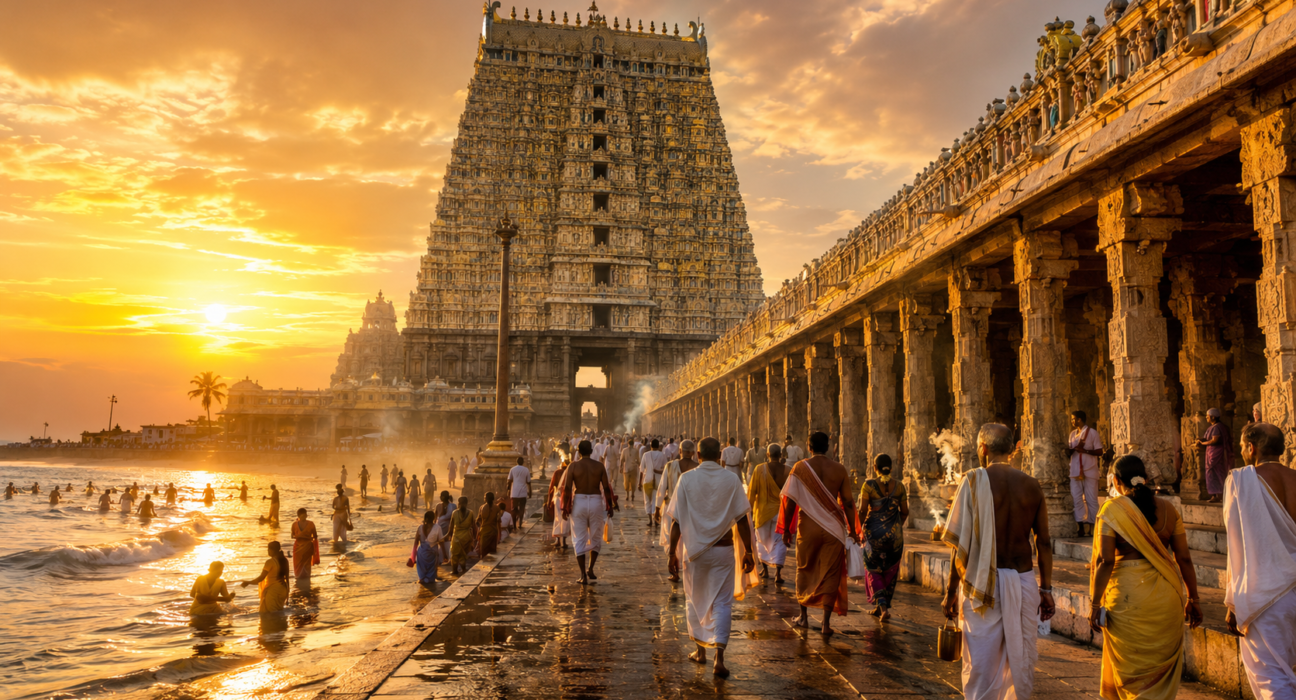
Rameswaram: Where Karma Finds Release
Introduction
There are sacred places that people visit to seek blessings.
There are temples where prayers are offered for health, prosperity, and success.
And then there is Rameswaram—a place where countless devotees believe they come not merely to ask for something, but to let go of burdens they have carried for lifetimes.
Rameswaram is far more than a pilgrimage destination.
It is one of India’s most profound spiritual landscapes, where devotion, repentance, ancestral reverence, and divine compassion converge in a way unlike anywhere else.
For millions of Hindus, this sacred island is believed to be a place where the invisible chains of karma begin to loosen, where ancestral obligations are honored, and where the soul finds the courage to seek forgiveness, healing, and renewal.
Can Karma Travel Across Generations?
Many families experience patterns that seem difficult to explain.
Despite honesty, hard work, and sincere effort, life appears to move from one obstacle to another.
Unexpected hardships repeat across generations.
Relationships become strained.
Important milestones are delayed.
Peace seems strangely difficult to attain.
Within the spiritual traditions of Sanatana Dharma, such experiences are sometimes understood as more than isolated events.
They may be connected to unresolved karmic consequences, forgotten duties, or unfulfilled obligations passed down through a family’s lineage.
Whether one interprets these ideas literally, symbolically, or as expressions of spiritual tradition, they have shaped the devotional practices of millions for centuries.
Among the places most closely associated with prayers for ancestral remembrance and spiritual reconciliation, Rameswaram occupies a unique place.
A Sacred Island at the Edge of India
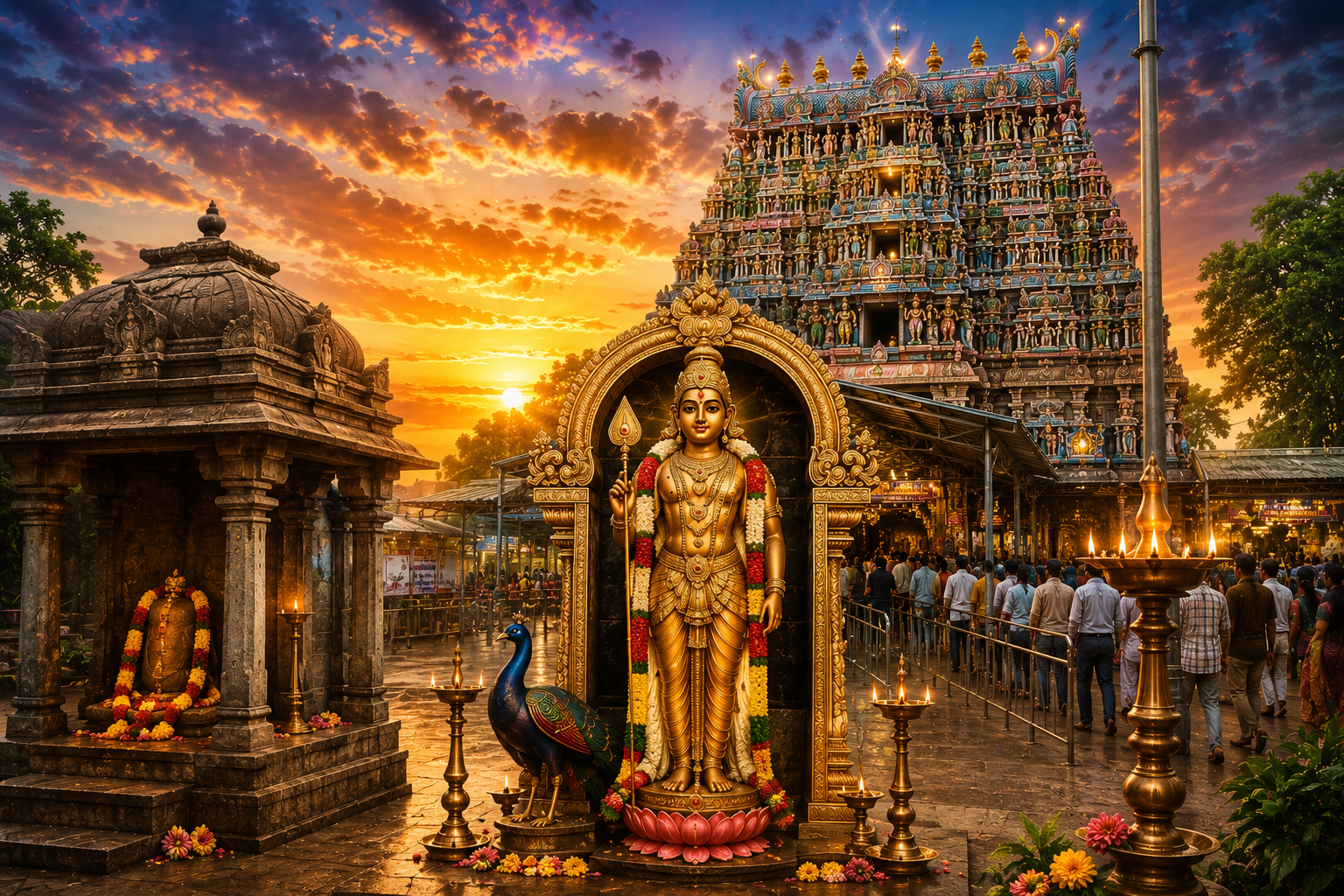
Located on the southeastern tip of India, where the waters of the Bay of Bengal and the Indian Ocean meet, Rameswaram has long been regarded as one of the holiest pilgrimage destinations in Hinduism.
It is home to the magnificent Ramanathaswamy Temple, one of the twelve sacred Jyotirlingas dedicated to Lord Shiva.
Yet devotees believe that its greatness extends far beyond this revered status.
According to the Ramayana, it was here that Lord Rama, after defeating Ravana, chose not to celebrate victory first.
Instead, he sought Lord Shiva’s blessings and performed worship with profound humility, praying for purification after the great war.
That single act transformed Rameswaram into an eternal symbol of repentance, compassion, and spiritual responsibility.
It reminds every pilgrim that true greatness is not measured by victory alone, but by the humility to seek forgiveness and inner purification.
A Journey That Begins Within
For many visitors, a pilgrimage to Rameswaram is not simply about traveling to a sacred temple.
It is an inward journey.
Every sacred bath.
Every prayer.
Every offering made for departed ancestors.
Every quiet step through the temple’s ancient corridors.
Each becomes part of a deeper process of reflection and release.
The destination is not merely the sanctum of Lord Ramanathaswamy.
It is a lighter heart.
A quieter mind.
A renewed relationship with one’s past, one’s ancestors, and ultimately, with oneself.
The Spiritual Meaning of Rameswaram
The name Rameswaram itself carries profound symbolism.
It is a place where devotion triumphs over pride.
Where compassion overcomes guilt.
Where remembrance heals separation.
Where faith transforms suffering into hope.
For generations, devotees have believed that prayers offered here bring peace not only to the living but also to departed ancestors, strengthening the spiritual bond between past, present, and future.
That enduring belief continues to draw pilgrims from every corner of the world.
In the next chapter, we will explore why some families seem to carry invisible burdens across generations, how Hindu spiritual tradition understands ancestral karma and Pitru Dosha, and why Rameswaram has become one of the most revered places for seeking spiritual release and family harmony.
Why Some Families Carry Unseen Burdens
Have you ever wondered why certain families seem to struggle through the same hardships generation after generation?
One generation battles financial instability.
Another faces repeated health challenges.
Some experience unexplained delays in marriage.
Others endure constant misunderstandings, broken relationships, or recurring tragedies despite living with honesty, compassion, and sincere effort.
To many, these may appear to be coincidences.
But within the spiritual wisdom of Sanatana Dharma, such recurring patterns are often viewed through a deeper lens.
They are sometimes understood as the lingering effects of unresolved karma and ancestral obligations that quietly influence the lives of future generations.
Can Karma Extend Beyond One Lifetime?
The Hindu understanding of karma is far more profound than the simple idea of reward and punishment.
Karma is not seen as divine retribution.
It is the natural law of cause and effect.
Every thought.
Every action.
Every intention.
Creates an impression that shapes future experiences.
While much of our karma belongs to our own individual journey, Hindu scriptures and traditional beliefs also speak of family karma—the subtle influence of actions, duties, and unresolved responsibilities carried through a lineage.
Just as families inherit physical traits, traditions, and values, many believe they may also inherit spiritual responsibilities that remain incomplete.
These are not always punishments.
More often, they are invitations to restore harmony where it has been lost.
The Meaning of Pitru Rin
Ancient Hindu philosophy teaches that every human being is born with three sacred debts, known as the Rinas.
One of the most significant is Pitru Rin—the debt owed to one’s ancestors.
This debt is not financial.
It is a debt of gratitude.
Our ancestors gave us life.
They preserved traditions, values, culture, and faith that allowed future generations to exist.
Honoring them through remembrance, prayers, and acts of gratitude is considered an essential part of dharmic living.
When these sacred responsibilities are neglected over generations, traditional belief holds that the flow of ancestral blessings may become weakened.
This condition is often described in devotional practice as Pitru Dosha.
What Is Pitru Dosha?
Pitru Dosha is widely understood in Hindu tradition as an imbalance arising from unfulfilled ancestral obligations.
Different spiritual traditions explain it in different ways.
Some associate it with neglected ancestral rites.
Others see it as unresolved karmic patterns within a family lineage.
Rather than viewing it as a curse, many spiritual teachers encourage understanding it as an opportunity for healing, remembrance, and reconciliation.
Traditional beliefs associate unresolved ancestral energies with recurring challenges such as:
- Persistent delays in marriage.
- Difficulty in having children.
- Repeated financial struggles.
- Unexplained obstacles despite sincere effort.
- Ongoing family conflicts.
- A lingering sense that life never moves forward despite doing everything “right.”
These experiences do not automatically mean someone has Pitru Dosha.
Life’s difficulties can arise for many reasons.
However, within Hindu devotional tradition, many families choose to perform ancestral prayers as an expression of gratitude and spiritual responsibility, regardless of whether such challenges exist.
Why Rameswaram Holds a Unique Place
Among all the sacred pilgrimage sites in India, Rameswaram has become one of the most revered destinations for performing ancestral rites.
This is not merely because of ancient customs.
It is deeply connected to the example set by Lord Rama himself.
After defeating Ravana, Rama did not consider victory alone to be enough.
Although he had fought in the cause of dharma, he still sought purification and offered worship to Lord Shiva before returning to Ayodhya.
His actions conveyed a timeless lesson.
Even the noblest victories should be accompanied by humility.
Even righteousness must be balanced with gratitude and self-reflection.
For countless devotees, this sacred example transformed Rameswaram into a place where one approaches not with pride, but with surrender.
Not seeking punishment.
Seeking peace.
Invisible Burdens, Visible Peace
Many pilgrims describe an experience that is difficult to explain after completing the sacred rituals at Rameswaram.
Nothing dramatic may happen externally.
Yet inwardly, something feels different.
A lingering heaviness begins to fade.
Old grief softens.
Relationships seem easier to mend.
The heart feels lighter.
Whether one understands this as spiritual grace, psychological healing, the power of ritual, or the peace that comes from honoring one’s ancestors, the experience has inspired generations of devotees to continue making this sacred pilgrimage.
Perhaps that is the greatest gift Rameswaram offers.
Not the promise that every problem will disappear overnight.
But the opportunity to reconnect with one’s roots, restore forgotten bonds of gratitude, and move forward with renewed hope.
In the next chapter, we will discover why Lord Rama, despite defeating Ravana in the cause of righteousness, came to Rameswaram to worship Lord Shiva—and how that act transformed this sacred island into one of the world’s most powerful places for karmic purification and spiritual renewal.
Rameswaram: The Sacred Land Where Lord Rama Sought Forgiveness
Among all the sacred places described in the Ramayana, few carry the spiritual depth of Rameswaram.
It is not remembered as the place where Lord Rama won his greatest victory.
It is remembered as the place where he laid aside that victory with humility.
This is what makes Rameswaram unlike any other pilgrimage destination.
It teaches that true righteousness is not proven by defeating evil alone.
It is fulfilled through compassion, humility, and the willingness to seek inner purification.
The Victory That Brought No Celebration
After a long and devastating war in Lanka, Lord Rama finally defeated Ravana.
For the world, it was the triumph of Dharma over Adharma.
Justice had prevailed.
Sita had been rescued.
The forces of righteousness had emerged victorious.
Yet the Ramayana tells us something remarkable.
Rama did not immediately return to Ayodhya in celebration.
He did not rejoice in conquest.
Instead, a deep silence settled within him.
Although Ravana had become the symbol of arrogance and tyranny, he was also a great scholar, a devoted worshipper of Lord Shiva, and a Brahmin by birth.
Taking his life—even in the cause of righteousness—left Rama with a profound sense of responsibility.
Victory alone could not erase the weight of taking a life.
The Lesson of True Humility
Most rulers celebrate after victory.
Rama chose repentance.
Most conquerors glorify power.
Rama demonstrated surrender.
He understood that no one, however righteous, stands above the eternal laws of Dharma.
His actions conveyed a timeless truth:
The higher one’s spiritual awareness, the greater one’s humility.
Rather than seeking honor for himself, Rama sought the blessings of Lord Shiva.
He wished to purify his mind, express gratitude, and acknowledge that even a righteous act deserves reflection before the Divine.
That single decision transformed Rameswaram into a sacred symbol of humility for generations to come.
The Worship of Ramanathaswamy
According to Hindu tradition, Lord Rama decided to install and worship a Shiva Lingam before beginning his journey home.
He instructed Hanuman to travel to Mount Kailash and bring a sacred Lingam for the ceremony.
Hanuman departed immediately.
But as the auspicious time for worship approached, he had not yet returned.
Not wishing to delay the sacred ritual, Goddess Sita is believed to have lovingly fashioned a Shiva Lingam from the sands of the seashore.
Lord Rama worshipped this Lingam with complete devotion.
This sacred deity is revered today as Sri Ramanathaswamy, the presiding Lord of Rameswaram.
When Hanuman finally returned carrying the Lingam from Kailash, Rama honored his devotion by installing that Lingam as well.
Today, devotees worship both forms, remembering not only the greatness of Shiva but also the devotion, humility, and harmony shared between Rama and Hanuman.
More Than a Jyotirlinga
Ramanathaswamy Temple is one of the twelve sacred Jyotirlingas, making it one of the holiest shrines dedicated to Lord Shiva.
Yet devotees believe its greatness cannot be measured by that title alone.
This is the only Jyotirlinga where Lord Shiva is worshipped by Lord Rama himself.
The symbolism is profound.
The Supreme Being, worshipping the Supreme Being.
Not because one is greater than the other.
But because Sanatana Dharma teaches that true divinity is free from ego.
Shiva blesses Vishnu.
Vishnu worships Shiva.
Together they demonstrate that the highest spiritual truth is unity, not division.
For this reason, Rameswaram stands as a sacred bridge between Shaivism and Vaishnavism, reminding pilgrims that all genuine paths ultimately lead to the same Divine reality.
A Temple of Compassion, Not Judgment
Many people associate karma with punishment.
Rameswaram teaches something entirely different.
Lord Ramanathaswamy is not worshipped here as a stern judge waiting to condemn human mistakes.
He is worshipped as the compassionate Lord who helps sincere seekers lay down the burdens they can no longer carry.
His form as the peaceful Shiva Lingam reflects this truth.
There are no fierce weapons.
No expression of anger.
Only profound stillness.
Only infinite compassion.
It is as though the Lord silently reminds every pilgrim:
“Come as you are.”
“Bring your fears…”
“Bring your regrets…”
“Bring the burdens your family has carried for generations…”
“Leave them here with faith, humility, and devotion.”
Perhaps that is why millions continue to undertake this pilgrimage.
Not because they fear divine punishment.
But because they trust divine compassion.
The Eternal Message of Lord Rama
The story of Rameswaram is not merely about an event from the Ramayana.
It is about every human life.
Every person makes mistakes.
Every family carries burdens.
Every soul longs for peace.
Lord Rama’s journey reminds us that true strength lies not in claiming perfection, but in embracing humility, seeking forgiveness, and walking the path of Dharma with sincerity.
That timeless message continues to echo through the sacred corridors of Rameswaram, inspiring pilgrims from every corner of the world.
In the next chapter, we will explore Ramanathaswamy Temple itself—why it is considered one of the most powerful Jyotirlingas, the spiritual significance of its magnificent architecture, and how every step within its sacred halls becomes part of a pilgrim’s journey toward inner purification.
Ramanathaswamy Temple: The Jyotirlinga of Compassion
The moment you enter Ramanathaswamy Temple, something changes.
The sounds of the outside world begin to fade.
The rhythm of your footsteps slows.
The vast stone corridors, ancient pillars, and the fragrance of incense create an atmosphere where silence speaks louder than words.
For centuries, kings, saints, ascetics, scholars, and ordinary pilgrims have walked these sacred halls.
Each arrived carrying different hopes.
Some came seeking forgiveness.
Some prayed for their ancestors.
Some searched for answers.
Others simply wished to experience the presence of the Divine.
Yet almost everyone left with the same feeling—
a heart that had become a little lighter.
One of the Twelve Sacred Jyotirlingas
Ramanathaswamy Temple occupies a unique place in Hindu spirituality.
It is one of the twelve sacred Jyotirlingas, where Lord Shiva is worshipped as an infinite pillar of divine light.
According to Shaiva tradition, a Jyotirlinga is not merely a stone Lingam.
It represents the limitless nature of Shiva—beyond form, beyond time, beyond human understanding.
Every Jyotirlinga possesses its own spiritual significance.
Yet Rameswaram is unlike any of the other eleven.
It is the only Jyotirlinga where Lord Rama, an incarnation of Lord Vishnu, offered worship to Lord Shiva before returning to Ayodhya.
That sacred act transformed this temple into a living symbol of humility, unity, and devotion.
Here, Shaivism and Vaishnavism do not stand apart.
They embrace one another.
The temple quietly reminds every pilgrim that all genuine paths ultimately lead toward the same Divine truth.
A Temple Built Over Centuries
The magnificent temple seen today is the result of centuries of devotion.
Successive Pandya, Jaffna, Vijayanagara, Nayak, and Sethupathi rulers expanded and enriched the shrine, creating one of the finest examples of Dravidian temple architecture.
Every stone seems to carry the devotion of countless generations.
Every pillar appears to preserve a silent prayer.
Walking through the temple is not simply moving from one sanctum to another.
It is walking through history itself.
The temple stands as a testimony to India’s enduring spiritual heritage, where architecture becomes worship and craftsmanship becomes devotion.
The World’s Longest Temple Corridor
Perhaps the most breathtaking feature of Ramanathaswamy Temple is its legendary corridor.
Stretching for nearly 1,200 meters (about 3,900 feet), it is recognized as the longest temple corridor in the world.
Its endless rows of exquisitely carved pillars create a mesmerizing sense of symmetry.
As sunlight filters through the ancient halls, the corridor seems to stretch toward infinity.
Many pilgrims describe the experience as deeply meditative.
Each step feels slower.
Each breath becomes more conscious.
The mind naturally turns inward.
In Hindu symbolism, this endless passageway represents life’s own journey.
Karma is not created in a single day.
Neither is it transformed overnight.
Just as the corridor unfolds one pillar at a time, spiritual growth unfolds one step at a time.
There are no shortcuts.
Only patience.
Reflection.
And steady progress toward the Divine.
A Temple That Invites Silence
Unlike many sacred places where rituals dominate every moment, Ramanathaswamy Temple offers something equally powerful—silence.
Within these ancient walls, silence becomes prayer.
Silence becomes meditation.
Silence becomes surrender.
Many devotees find themselves speaking less and observing more.
The cool granite beneath their feet.
The rhythmic chanting of priests.
The flickering lamps before the sanctum.
The gentle fragrance of sacred ash and sandalwood.
Every experience draws the pilgrim away from distraction and toward inner stillness.
It is often said that the greatest conversations with God happen without words.
Ramanathaswamy Temple seems to embody that truth.
The Lord Who Welcomes Every Soul
The presiding deity, Sri Ramanathaswamy, is not worshipped here as a fearsome destroyer.
He is revered as the compassionate Lord who receives every pilgrim with grace.
His presence offers reassurance rather than judgment.
Whether one arrives carrying grief, regret, unanswered questions, or heartfelt gratitude, the temple makes no distinction.
The Divine welcomes all.
Perhaps this is why countless pilgrims describe their visit not as an act of religious obligation but as an encounter with profound peace.
The temple does not promise instant miracles.
Instead, it offers something far more enduring—
the opportunity to surrender burdens that have become too heavy to carry alone.
Every Step Is Part of the Pilgrimage
In Rameswaram, the journey does not begin at the sanctum.
It begins long before.
It starts with purification in the sacred waters.
It continues through the temple’s ancient corridors.
It deepens with every prayer offered in humility.
By the time a devotee finally stands before Lord Ramanathaswamy, the pilgrimage has already begun transforming the heart.
The destination is not simply the Shiva Lingam.
It is inner peace.
It is surrender.
It is the quiet realization that true liberation begins not when the world changes—but when the soul learns to let go.
In the next chapter, we will explore Agni Theertham, the sacred seashore where every pilgrimage traditionally begins, and discover why devotees believe that a single holy dip in these waters marks the first step toward spiritual purification, ancestral remembrance, and karmic renewal.
Agni Theertham: The Sacred Gateway to Karmic Cleansing
Before a pilgrim enters the majestic corridors of Ramanathaswamy Temple, before prayers are offered, before sacred rituals begin, there is one place that tradition asks every devotee to visit first.
The shores of Agni Theertham.
At sunrise, thousands gather quietly along the sacred coastline.
Some stand with folded hands facing the endless sea.
Some offer prayers for departed parents and ancestors.
Others simply close their eyes, allowing the gentle waves to wash over their feet.
To an ordinary visitor, it may appear to be nothing more than a peaceful stretch of ocean.
But for millions of devotees, these waters represent the first step in a profound journey of spiritual purification.
A journey that begins not inside the temple—
but within the heart.
Why Every Pilgrimage Begins Here
Unlike many temples where pilgrims proceed directly to the sanctum, Rameswaram follows a sacred sequence.
The pilgrimage begins at Agni Theertham.
Only after bathing here do devotees traditionally enter Ramanathaswamy Temple.
This practice is not simply about physical cleanliness.
It symbolizes leaving behind the weight of the past before approaching the Divine.
The ocean becomes more than water.
It becomes a reminder that every spiritual journey begins with humility.
One does not carry pride into the presence of God.
One carries surrender.
The Legend Behind Agni Theertham
According to Hindu tradition, this sacred shore is associated with Agni, the deity of fire.
After the events of the Ramayana, Agni is believed to have sought purification here, giving the waters their sacred significance.
Over time, Agni Theertham became one of the most revered places for ritual bathing, especially for those seeking forgiveness, purification, and peace for departed ancestors.
Whether understood as sacred history or enduring spiritual symbolism, the message remains timeless.
Even fire—the great purifier—is shown seeking purification before the Divine.
The lesson is profound.
No one is beyond the need for humility.
No soul is beyond the possibility of renewal.
A Place of Ancestral Remembrance
One of the most important practices performed at Agni Theertham is Tarpanam, the sacred offering made in remembrance of one’s ancestors.
In Sanatana Dharma, remembering one’s forefathers is not viewed as a ritual of sorrow.
It is an act of gratitude.
A recognition that our lives are built upon the sacrifices, struggles, and blessings of those who came before us.
Standing at the edge of the sea, devotees offer water with prayers for the peace of departed souls.
It is a quiet and deeply personal moment.
One generation reaches back to another.
The visible world acknowledges the invisible.
Many pilgrims describe this experience as emotionally moving, not because they expect dramatic miracles, but because it allows them to express gratitude that may never have been spoken aloud.
More Than a Ritual Bath
To the casual observer, bathing in the sea may seem like an ordinary act.
But within the spiritual tradition of Rameswaram, every drop of water carries symbolic meaning.
The immersion represents letting go.
Letting go of guilt.
Letting go of resentment.
Letting go of fear.
Letting go of emotional burdens that quietly accumulate over a lifetime.
It is not the water alone that transforms the pilgrim.
It is the intention carried into those waters.
When faith and surrender meet sacred tradition, even the simplest act can become deeply meaningful.
Preparing the Soul for Darshan
The bath at Agni Theertham is not considered the destination.
It is the preparation.
Just as one washes dust from the body before entering a home, the sacred bath reminds devotees to cleanse the mind before entering the presence of Lord Ramanathaswamy.
After completing the ritual, pilgrims walk toward the temple with wet clothes, quiet minds, and renewed focus.
The journey has already begun to change them.
The sea has become the first teacher.
The temple will become the second.
Where the Ocean Meets Eternity
Standing on the shores of Agni Theertham at dawn is an experience that many pilgrims never forget.
The rising sun paints the waters in shades of gold.
Temple bells echo in the distance.
Priests chant ancient Vedic mantras.
Families gather to honor generations that came before them.
In that sacred atmosphere, the boundary between the physical and the spiritual seems to grow wonderfully thin.
It is easy to understand why countless devotees believe this is not merely a beach.
It is a sacred threshold.
A place where remembrance becomes prayer.
Where gratitude becomes worship.
Where the first waves of the ocean gently remind every pilgrim that before seeking blessings, one must first learn to let go.
The First Step Toward Inner Transformation
Every pilgrimage has a beginning.
In Rameswaram, that beginning is not marked by a temple gate.
It begins with water.
With silence.
With surrender.
Agni Theertham invites every pilgrim to pause before entering the sacred temple and ask a simple question:
What burden have I carried for too long?
Only after that question is faced does the journey truly continue.
And beyond the temple entrance lies another extraordinary spiritual mystery—
the twenty-two sacred Theerthams, where each well is believed to symbolize a different stage in the soul’s journey toward purification, healing, and divine grace.
The Mystery of the 22 Sacred Theerthams
After taking the holy dip in Agni Theertham, every pilgrim enters the sacred precincts of Ramanathaswamy Temple.
But before standing before Lord Ramanathaswamy for darshan, tradition prescribes another extraordinary spiritual practice.
Bathing in the 22 sacred Theerthams inside the temple.
At first glance, they appear to be ordinary wells.
Yet for centuries, saints, scholars, and devotees have regarded them as among the greatest spiritual treasures of Rameswaram.
Each well carries a unique name.
Each possesses water with a distinct taste and mineral composition, despite all of them being located within the same temple complex and only a short distance from the sea.
This remarkable phenomenon has fascinated pilgrims and researchers alike for generations.
But for devotees, the true mystery lies beyond science.
It lies in what these sacred waters represent.
Why Are There Twenty-Two Theerthams?
The number twenty-two is deeply significant in the traditions surrounding Ramanathaswamy Temple.
According to temple lore, these sacred wells are associated with different holy rivers, deities, and forms of divine grace.
Some traditions also connect the number twenty-two with the twenty-two arrows in Lord Rama’s quiver, symbolizing the destruction of ignorance and the gradual purification of the soul.
While different interpretations exist, they all point toward one profound truth:
Spiritual transformation does not happen in a single moment.
It unfolds step by step.
Just as a pilgrim moves from one sacred well to another, the journey toward inner peace is a gradual process of cleansing, surrender, and renewal.
Twenty-Two Steps Toward Inner Purification
Every Theertham is believed to carry its own spiritual significance.
Devotees believe that each sacred bath represents the release of a different burden.
Some pray for the well-being of their ancestors.
Others seek harmony in family life.
Some ask for freedom from fear, illness, or emotional suffering.
Others simply pray for wisdom and inner strength.
Although the exact spiritual associations vary across traditions, the deeper symbolism remains the same.
Each sacred well invites pilgrims to let go of something that no longer serves the soul.
Not merely external difficulties—
but inner burdens.
Pride.
Fear.
Anger.
Regret.
Attachment.
The pilgrimage becomes less about washing the body and more about transforming the heart.
A Living Miracle Within the Temple
One of the most fascinating aspects of the twenty-two Theerthams is that the water drawn from each well is noticeably different.
Some are cool and sweet.
Others have a slightly different texture or taste.
Yet all exist within the same temple complex, surrounded by the salty air of the sea.
For devotees, this is another reminder that the Divine often reveals extraordinary mysteries through ordinary means.
Just as every person carries a unique spiritual journey, every sacred well offers its own blessing.
The experience encourages pilgrims to see diversity not as division, but as another expression of the Divine.
More Than a Ritual
The bathing ritual follows a sacred order.
Temple attendants draw water from each well and pour it over the pilgrims.
With every Theertham, another prayer is silently offered.
Another intention is carried into the journey.
Another burden is symbolically released.
The experience is often joyful.
Families laugh together.
Children eagerly await the next bucket of cool water.
Elders close their eyes in silent prayer.
In that simple act of receiving water, generations stand together, united by faith and tradition.
For many pilgrims, the ritual becomes one of the most memorable moments of their visit to Rameswaram.
The Inner Meaning of the Twenty-Two Theerthams
Ancient Hindu wisdom repeatedly teaches that the greatest pilgrimage is the journey within.
The twenty-two Theerthams beautifully reflect this truth.
Every sacred well becomes a mirror.
Every drop of water becomes a reminder that true purification begins inside.
The body may become wet in a few minutes.
But the cleansing of the mind is a lifelong practice.
Patience.
Forgiveness.
Gratitude.
Humility.
Compassion.
These are the qualities that ultimately purify the soul.
The sacred waters simply remind us to cultivate them.
Preparing for the Final Darshan
Only after completing the baths in all twenty-two Theerthams do many pilgrims proceed toward the sanctum of Lord Ramanathaswamy.
By then, the journey feels different.
The rush of daily life has faded.
The mind has become quieter.
The heart feels lighter.
Standing before the Shiva Lingam is no longer merely an act of worship.
It becomes the culmination of a sacred inner journey.
The devotee arrives not simply with folded hands—
but with a spirit that has been gradually prepared through prayer, remembrance, surrender, and purification.
Perhaps this is why generations of pilgrims say that Rameswaram is not just a temple to be visited.
It is an experience to be lived.
In the next chapter, we will explore why Rameswaram is considered one of the most sacred places in India for performing Pitru Tarpanam and ancestral rites, and how these ancient traditions continue to strengthen the spiritual bond between generations.
Why Rameswaram Is India's Most Sacred Destination for Ancestral Rites
Among the countless sacred pilgrimage sites across India, Rameswaram holds a unique and deeply revered place for those wishing to honor their ancestors.
Every day, before sunrise, the shores of Agni Theertham become a gathering place for families from every corner of the country.
Some have travelled hundreds of miles.
Some arrive carrying the ashes of loved ones.
Others come to perform long-awaited ancestral rites that their families have observed for generations.
The atmosphere is unlike any other.
There is no celebration.
No grandeur.
Only quiet devotion.
Only gratitude.
Only the silent hope that prayers offered with sincerity may bring peace to those who came before us.
Remembering Those Who Gave Us Life
In Sanatana Dharma, ancestors are not viewed as people who simply belonged to the past.
They are regarded as an inseparable part of who we are.
Our family traditions.
Our values.
Our culture.
Even our very existence has been shaped by countless generations before us.
For this reason, remembering one’s ancestors is considered an act of gratitude rather than obligation.
The rituals performed at Rameswaram are not expressions of fear.
They are expressions of love, respect, and remembrance.
Every offering of water.
Every prayer.
Every sacred mantra.
Becomes a heartfelt acknowledgment that our lives are built upon the sacrifices of those who walked this earth before us.
The Meaning of Tarpanam and Shraddha
Two of the most important ancestral rites performed in Rameswaram are Tarpanam and Shraddha.
Tarpanam is the ritual offering of water, sesame seeds, and prayers to departed ancestors.
The word itself means “to satisfy” or “to offer with reverence.”
It symbolizes gratitude and the wish that departed souls may attain peace.
Shraddha, derived from the Sanskrit word Shraddha meaning “faith” or “sincere devotion,” is a more elaborate ceremony performed in remembrance of parents and forefathers.
These rituals have been preserved for thousands of years through the Vedic tradition.
For millions of devotees, they represent an opportunity to maintain a sacred connection between generations.
Rather than seeing death as an end, Hindu philosophy views it as a transition in the eternal journey of the soul.
The living remember the departed.
The departed continue to bless the living.
In this way, the bond of family extends beyond a single lifetime.
Why Rameswaram Is Considered So Powerful
Many sacred rivers and temples across India are associated with ancestral worship.
Yet Rameswaram occupies a special place because of the example set by Lord Rama himself.
After the great war in Lanka, Rama came here seeking purification before returning to Ayodhya.
His journey established Rameswaram as a place where humility, repentance, and gratitude come together.
For centuries, saints and spiritual teachers have encouraged devotees to perform ancestral rites here, believing that the sacred atmosphere of the temple, the sea, and the holy Theerthams creates an especially auspicious environment for such prayers.
Whether one understands this through faith, symbolism, or spiritual tradition, the message remains deeply meaningful:
A family grows stronger when it remembers those who made its existence possible.
An Unbroken Chain of Blessings
Imagine a mighty river flowing across generations.
Each generation receives its waters and passes them on.
When the flow remains uninterrupted, life flourishes.
But when gratitude is forgotten, relationships weaken, or traditions are abandoned, the river seems to lose its strength.
This image beautifully reflects the Hindu understanding of ancestral blessings.
The rituals performed at Rameswaram are often described as a way of restoring that sacred flow.
Not because the ancestors demand worship—
but because gratitude has the power to heal.
When we consciously remember those who came before us, we strengthen our sense of identity, belonging, and responsibility toward future generations.
In that sense, the blessings we seek are not only spiritual.
They are also emotional, cultural, and deeply human.
More Than a Ceremony
Many pilgrims arrive believing they are performing a ritual for someone who has passed away.
Yet by the time the ceremony concludes, they often discover that something within themselves has changed.
Old grief begins to soften.
Long-held guilt finds expression.
Unspoken gratitude finally has a voice.
The ritual becomes a moment of healing—not only for the departed but also for those who remain.
This is one reason why Rameswaram continues to touch millions of hearts.
Its ceremonies are not merely about death.
They are about life.
About remembering.
About forgiveness.
About carrying forward a legacy of love instead of a burden of regret.
A Sacred Bridge Between Generations
The Sanskrit word Setu means a bridge.
Rameswaram has long been associated with the legendary Rama Setu, the bridge that connected India to Lanka.
But spiritually, Rameswaram represents another kind of bridge.
It connects the past with the present.
The living with the departed.
Gratitude with grace.
One generation with the next.
Every prayer offered here reminds us that a family is more than those who are alive today.
It is a living continuum stretching across time.
When that connection is honored with sincerity, devotees believe that harmony naturally begins to return to the home, relationships become stronger, and the blessings of the lineage flow more freely once again.
In the next chapter, we will walk through the magnificent thousand-pillared corridors of Ramanathaswamy Temple, uncovering the profound spiritual symbolism hidden within their endless pathways and discovering why every step through these ancient halls is itself considered a silent prayer toward inner liberation.
The Endless Corridors of Ramanathaswamy Temple: A Walk Through Karma and Liberation
Among the countless architectural marvels of India, few inspire awe quite like the magnificent corridors of Ramanathaswamy Temple.
Stretching endlessly into the distance, lined with thousands of intricately carved stone pillars, these ancient passageways are far more than an architectural masterpiece.
For countless pilgrims, they are a spiritual journey in stone.
Every step taken here is believed to bring the devotee a little closer—not merely to the sanctum of Lord Shiva—but to inner peace.
A Corridor Unlike Any Other
The corridors of Ramanathaswamy Temple are renowned as the longest temple corridors in the world, extending nearly 1,200 meters (about 3,900 feet) in total length.
More than a thousand beautifully sculpted pillars stand in perfect symmetry, creating an illusion of infinite space.
As sunlight filters through the ancient halls, the pillars cast long shadows across the stone floor, transforming the corridor into a place of quiet contemplation.
Visitors often stop in silence.
Some admire the extraordinary craftsmanship.
Others simply stand still, overwhelmed by the feeling that they have stepped into another world.
The grandeur of the structure is undeniable.
Yet its greatest beauty lies not in its size—but in its symbolism.
Every Pillar Tells a Story
No two lives are exactly alike.
Every family carries its own history.
Every soul walks a unique path.
In much the same way, each pillar in these corridors contributes to the strength of the whole temple.
One pillar alone cannot support the structure.
Together, they create something timeless.
This reflects one of the deepest teachings of Sanatana Dharma.
Human life is not shaped by a single action.
It is shaped by countless thoughts, choices, relationships, and experiences accumulated over time.
Each action becomes another pillar in the temple of our own lives.
Some are built with compassion.
Some with sacrifice.
Some with wisdom.
Others with mistakes that become opportunities for growth.
Together, they shape the person we eventually become.
Walking as a Form of Prayer
Most prayers are spoken.
Some are sung.
Others are offered through ritual.
But inside Ramanathaswamy Temple, even walking becomes an act of worship.
Many pilgrims instinctively slow their pace.
The cool granite beneath their feet.
The rhythmic sound of temple bells.
The fragrance of incense drifting through the corridors.
The distant chanting of Vedic hymns.
Everything invites the mind to become still.
There is no urgency.
No race.
No destination to conquer.
Only the quiet awareness of each step.
In that silence, even ordinary movement becomes meditation.
The Journey of Karma
The endless corridors offer another powerful reminder.
Karma is rarely created in a single moment.
It unfolds over years.
Sometimes across generations.
Likewise, healing is seldom instantaneous.
Inner transformation happens gradually.
One prayer.
One act of kindness.
One moment of forgiveness.
One step toward self-awareness.
Just as a pilgrim cannot leap from the entrance directly into the sanctum, spiritual growth unfolds one step at a time.
The corridors teach patience.
They remind us that every sincere effort, however small, carries us closer to liberation.
Silence That Speaks
Many visitors notice something remarkable while walking through these ancient halls.
Conversations naturally become quieter.
Even large crowds seem unusually peaceful.
The temple itself seems to encourage silence.
Not because silence is required—
but because silence becomes effortless.
In that stillness, many pilgrims find themselves reflecting on their lives.
Old memories arise.
Long-forgotten emotions surface.
Unanswered questions gently come into focus.
The temple offers no spoken answers.
Instead, it creates the space where the heart begins to discover its own.
Perhaps this is why saints and sages have always valued silence.
Not as the absence of sound—
but as the presence of awareness.
Architecture as Spiritual Teaching
Every aspect of Ramanathaswamy Temple reflects the wisdom of ancient India, where architecture was never merely functional.
Temples were designed as spiritual maps.
The towering gopurams remind devotees to lift their vision beyond worldly concerns.
The sacred tanks symbolize purification.
The sanctum represents the innermost Self.
And the long corridors teach the greatest lesson of all—
the journey is as sacred as the destination.
Every step matters.
Every moment of awareness matters.
Every act of devotion matters.
The Pilgrim Leaves Changed
When pilgrims finally emerge from the endless corridors after offering their prayers, nothing outward may seem different.
The temple remains where it has stood for centuries.
The sea continues to embrace the island.
The ancient stones remain unchanged.
Yet many devotees feel that something within them has shifted.
The burdens they carried into the temple seem lighter.
The mind feels quieter.
The heart feels calmer.
Perhaps this is the true miracle of Rameswaram.
Not that it changes the world around us overnight—
but that it quietly transforms the way we carry the world within us.
And beyond the sacred temple lies another place that speaks its own profound spiritual truth—
Dhanushkodi, the mysterious land where the ocean swallowed an entire town, reminding every pilgrim that endings are not always destruction, but often the beginning of renewal.
Dhanushkodi: Where Every Ending Becomes a New Beginning
About 20 kilometers from the sacred island of Rameswaram lies a place unlike any other in India.
A land where the sea surrounds you on both sides.
A place where silence speaks louder than words.
A place where ruins still stand as witnesses to a forgotten chapter of history.
This is Dhanushkodi.
To most visitors, it is known as the “Ghost Town of India.”
But to countless pilgrims and spiritual seekers, Dhanushkodi is much more than an abandoned settlement.
It is a living reminder of one of life’s greatest truths—
every ending carries the possibility of a new beginning.
The Land of Legends
Long before history recorded its name, Dhanushkodi had already become immortal through the Ramayana.
According to Hindu tradition, this is the place where Lord Rama instructed the Vanara army to build the legendary Rama Setu, the bridge that connected India to Lanka.
With the blessings of the Divine and the unwavering devotion of his companions, the impossible became possible.
Stones floated.
A bridge rose across the sea.
Hope triumphed over despair.
Even today, standing on the shores of Dhanushkodi, it is difficult not to imagine that extraordinary moment.
The endless horizon seems to whisper ancient memories.
The waves continue to touch the same shores where, according to tradition, one of humanity’s greatest spiritual journeys began.
The Cyclone That Changed Everything
On the night of 22 December 1964, Dhanushkodi witnessed one of the most devastating natural disasters in Indian history.
A powerful cyclone struck the region with unimaginable force.
Massive waves engulfed the town.
Homes, schools, churches, the railway station, and countless lives were swept away within hours.
The famous passenger train travelling to Dhanushkodi was overwhelmed by the storm, leaving almost no survivors.
The destruction was so complete that the town was later declared unfit for habitation.
Today, only scattered ruins remain.
Broken walls.
Fragments of buildings.
A lonely church without a roof.
Silent reminders of a once-thriving community.
Nature reclaimed what humanity had built.
Yet strangely, the place does not feel frightening.
It feels deeply contemplative.
The Spiritual Symbolism of Dhanushkodi
For many devotees, Dhanushkodi carries a profound spiritual message.
Everything that appears permanent in life is, in truth, temporary.
We build homes.
We accumulate wealth.
We create identities.
We become attached to people, possessions, and achievements.
Yet time eventually transforms everything.
The ruins of Dhanushkodi quietly remind us of this eternal truth.
Nothing material lasts forever.
But the soul continues its journey.
Rather than inspiring fear, the town encourages detachment.
It gently asks every visitor:
What are you holding on to that life is asking you to release?
The End of Karma Is Not Destruction
Many people misunderstand the idea of karmic completion.
They imagine it as loss.
As suffering.
As something to fear.
But Hindu philosophy offers a very different perspective.
The end of karma is not destruction.
It is liberation.
Just as a seed must break open before becoming a tree, certain chapters of life must come to an end before new beginnings can emerge.
Dhanushkodi beautifully reflects this wisdom.
A town disappeared.
Yet the sacredness of the land remained.
Buildings vanished.
Yet faith endured.
Human history changed.
But the spiritual significance of the place became even stronger.
Sometimes what appears to be an ending is simply the beginning of a deeper transformation.
A Silent Place of Reflection
Visitors often describe an unusual feeling while standing at Dhanushkodi.
There is very little noise.
No crowded marketplaces.
No busy city streets.
Only the sound of waves meeting the shore.
The wind moving across the sand.
The distant cries of seabirds.
It becomes a place where the mind naturally slows down.
Many pilgrims choose to remain silent for a few minutes, watching the endless sea.
Some pray.
Some meditate.
Others simply absorb the stillness.
The experience often feels less like sightseeing and more like contemplation.
It is a reminder that the greatest answers are sometimes found not in conversation—but in silence.
From Ruins to Renewal
The story of Dhanushkodi mirrors the journey of every human life.
There are moments when everything seems to collapse.
Dreams fade.
Relationships end.
Plans change.
Loss feels overwhelming.
Yet life has an extraordinary ability to begin again.
New hope emerges.
New relationships form.
New purpose appears.
The ruins of Dhanushkodi do not celebrate destruction.
They celebrate resilience.
They remind us that after every storm, the soul has the capacity to rebuild itself.
This is why so many pilgrims visit Dhanushkodi after worshipping at Ramanathaswamy Temple.
The temple teaches surrender.
Dhanushkodi teaches acceptance.
Together, they complete the spiritual journey.
A Journey That Ends in Peace
As the sun sets over the waters surrounding Dhanushkodi, the ruins are bathed in golden light.
The sea continues its eternal rhythm.
The wind carries no sorrow.
Only silence.
Only peace.
Perhaps that is the greatest lesson this sacred land offers.
Not everything that disappears is truly lost.
Some things simply return to the Divine.
And in that return, they leave behind wisdom for those willing to listen.
From the sacred waters of Agni Theertham to the ancient corridors of Ramanathaswamy Temple, and finally to the quiet shores of Dhanushkodi, the pilgrimage of Rameswaram reveals one timeless truth:
Liberation is not found by escaping life—but by accepting it with humility, gratitude, and faith.
In the final chapter, we will bring together the spiritual essence of Rameswaram and discover why this sacred island continues to be one of India’s greatest destinations for inner transformation, ancestral remembrance, and the journey toward peace.
Conclusion: Rameswaram – A Journey That Transforms the Soul
There are temples where people go to ask for blessings.
There are sacred rivers where devotees seek purification.
There are pilgrimage sites that inspire faith and devotion.
But Rameswaram offers something even deeper.
It invites every pilgrim to pause…
To reflect…
To remember…
And ultimately, to let go.
It is not merely a place where rituals are performed.
It is a place where the heart begins to heal.
More Than a Sacred Destination
From the first holy dip in Agni Theertham…
To the twenty-two sacred Theerthams inside Ramanathaswamy Temple…
To the silent walk through the world’s longest temple corridors…
To the windswept shores of Dhanushkodi…
Every step of the pilgrimage carries a deeper meaning.
The journey is not simply from one sacred spot to another.
It is a journey from burden to peace.
From guilt to acceptance.
From fear to faith.
From attachment to surrender.
That is why pilgrims often say they return from Rameswaram feeling lighter than when they arrived.
Perhaps nothing outside has changed.
But something within has.
A Timeless Lesson from Lord Rama
The greatest teaching of Rameswaram is not hidden in stone inscriptions or ancient legends.
It is revealed through the life of Lord Rama.
After achieving the greatest victory of his life, he did not celebrate with pride.
He bowed his head before Lord Shiva.
He sought purification instead of recognition.
He chose humility over triumph.
That single act continues to inspire millions.
It reminds us that true greatness is not measured by power, wealth, or success.
It is measured by compassion.
By gratitude.
By the courage to acknowledge our responsibilities and seek inner transformation.
Honoring the Past, Blessing the Future
One of the most beautiful messages of Rameswaram is its reverence for ancestors.
The rituals performed here are not about fear.
They are not about superstition.
At their heart, they are acts of gratitude.
They remind us that every life is part of a much larger story.
We are shaped by those who came before us.
And the choices we make today will shape the generations yet to come.
Whether one performs Tarpanam, Shraddha, or simply offers a silent prayer in remembrance of loved ones, the deeper purpose remains the same—
to reconnect with the roots that sustain us.
In doing so, many pilgrims discover not only a stronger bond with their ancestors but also a deeper understanding of themselves.
The True Meaning of Liberation
People often associate liberation with leaving the world behind.
Rameswaram offers another perspective.
Liberation begins the moment we release what no longer serves us.
Old resentment.
Unspoken grief.
Lingering guilt.
Unnecessary fear.
The endless desire to control everything.
Like the waves that endlessly wash the shores of Agni Theertham, life constantly invites us to let go.
Not because our past has no value—
but because peace can only enter where there is space to receive it.
An Island That Continues to Call Millions
For centuries, saints, scholars, kings, and ordinary devotees have made the pilgrimage to Rameswaram.
Some come seeking answers.
Some come carrying sorrow.
Some come in gratitude.
Others simply come because their parents and grandparents did before them.
Every pilgrim walks the same sacred paths.
Every pilgrim hears the same ocean.
Every pilgrim stands before the same compassionate Lord Ramanathaswamy.
Yet each leaves with a unique experience.
That is the enduring mystery of Rameswaram.
It does not give every visitor the same blessing.
It gives each person the blessing they are ready to receive.
The Eternal Message of Rameswaram
As the waves continue to kiss the shores of this sacred island, and the temple bells echo through its ancient corridors, one timeless truth remains.
Life is not about carrying every burden forever.
It is about learning when to surrender.
It is about remembering those who came before us.
It is about living with humility.
It is about walking the path of Dharma with sincerity.
And above all, it is about discovering the peace that already exists within.
That is why Rameswaram is far more than one of India’s holiest pilgrimage destinations.
It is a sanctuary where devotion meets compassion…
Where remembrance becomes healing…
Where faith becomes transformation…
And where countless pilgrims continue to believe that the heaviest burdens of the soul can finally be laid to rest.
Whether you arrive seeking blessings, honoring your ancestors, or simply searching for inner peace, Rameswaram welcomes every pilgrim with the same silent promise:
Come with faith. Leave with peace.