
Vadapalani Murugan Temple: The Untold Story of the Three Siddhas Who Built Chennai’s Sacred Shrine
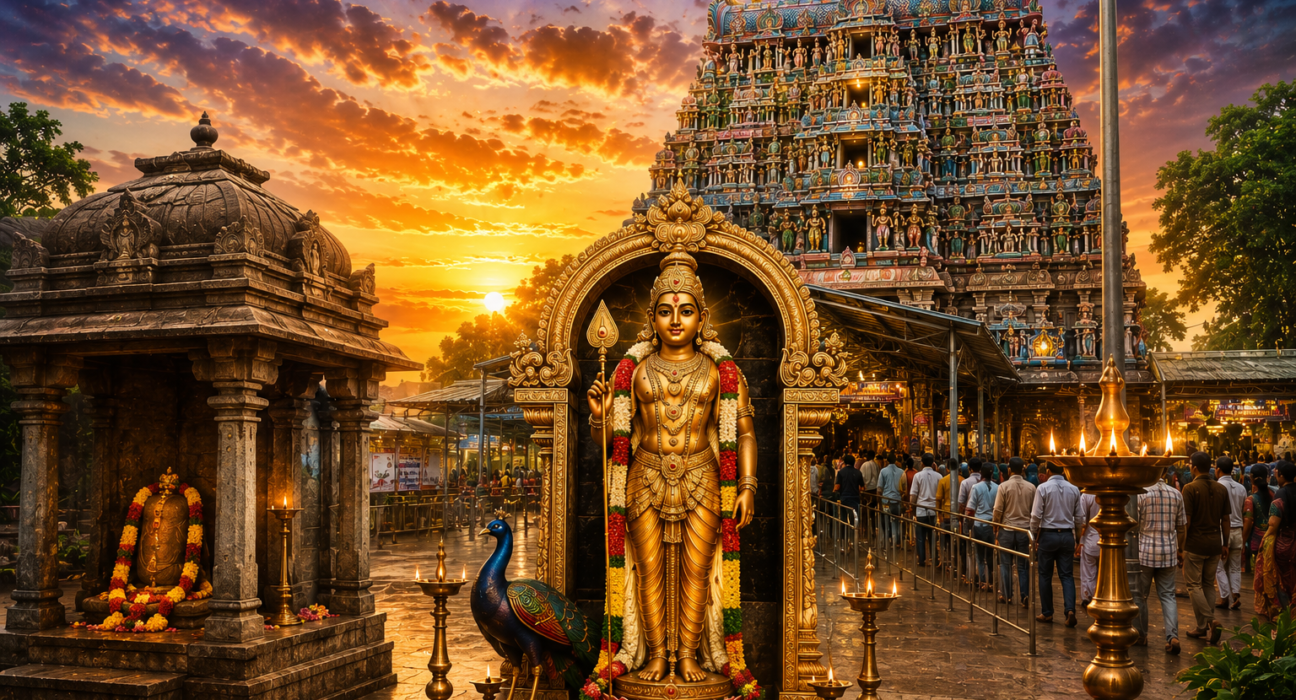
Vadapalani Murugan Temple: The Untold Story of Three Siddhas Who Built Chennai's Most Beloved Murugan Shrine
Introduction
Across the sacred landscape of India, the Siddhas and Yogis did far more than worship the Divine—they infused temples with extraordinary spiritual energy.
These enlightened masters did not merely consecrate idols according to ritual traditions. Through their tapas (intense spiritual austerities), yogic attainments, and divine realization, they transformed temples into powerful centers of grace, where seekers continue to experience profound spiritual vibrations centuries later.
Many of Tamil Nadu’s greatest temples stand as living testimony to this sacred tradition. Temples like Palani, Marudamalai, and Rameswaram are revered not only because of their presiding deities but also because of the great Siddhas whose spiritual presence continues to permeate these holy places.
Among these sacred shrines stands one of Chennai’s most beloved temples—Vadapalani Murugan Temple.
Every day, thousands of devotees visit this temple seeking Lord Murugan’s blessings for marriage, education, career, health, and family prosperity.
Yet very few know the remarkable story behind its origin.
The Vadapalani Temple was not founded by kings or wealthy patrons.
It was born through the unwavering devotion, unimaginable sacrifice, and spiritual power of three extraordinary Siddha saints:
- Annaswami Thambiran
- Rathinaswami Thambiran
- Bhakiyalinga Thambiran
Their lives reveal how divine grace works through pure devotion, ultimately transforming a small thatched shrine into one of South India’s most visited Murugan temples.
The Divine Selection of Annaswami
Every temple is believed to come into existence only through the will of the presiding deity.
Even renovating an existing temple is considered impossible without divine grace.
How much greater, then, must be the blessing required to establish an entirely new temple?
According to the temple’s traditional history, Lord Murugan Himself chose Annaswami, a humble devotee from present-day Saligramam in Chennai, to establish what would later become the Vadapalani Temple.
Just as Murugan is traditionally believed to have drawn saints like Vallimalai Swamigal to Palani through divine circumstances, He similarly called Annaswami into His service.
But before that calling came, Annaswami had to endure immense suffering.
A Mysterious Illness
At a stage in life when everything seemed stable, Annaswami was suddenly struck by an unbearable stomach ailment.
The pain became so severe that no medicine offered relief.
Doctors failed.
Traditional remedies failed.
His suffering only intensified.
Gradually, he realized that only divine grace could heal him.
Every day, despite his intense pain, he walked to the nearby Sri Vyagrapureeswarar Temple, praying earnestly for relief.
One day, unable to bear the agony any longer, he collapsed inside the temple itself.
The Mysterious Ascetic
As Annaswami lay unconscious, a wandering ascetic entered the temple.
Without speaking much, the saint took sacred ash (Vibhuti) from his pouch and gently applied it to Annaswami’s abdomen.
Within moments, the unbearable pain began to subside.
When Annaswami opened his eyes, he found before him a radiant ascetic whose face reflected extraordinary compassion and spiritual brilliance.
Falling at the saint’s feet, he poured out his suffering.
The ascetic simply said:
“Surrender yourself to Lord Dhandayuthapani of Palani. Offer your pain to Him. Lord Murugan alone will remove your suffering.”
Annaswami wept.
“I cannot even walk properly because of this illness. How can I undertake a pilgrimage all the way to Palani?”
The ascetic smiled.
“If you cannot go to Palani, then for three consecutive Krittika days, worship Lord Murugan at Tirupporur. On the fourth Krittika, go to Tiruttani and offer Him your highest gift.”
Having said this, the mysterious saint disappeared.
Annaswami accepted these words as Murugan’s own command.
A Divine Dream
Despite his severe illness, Annaswami completed the first pilgrimage to Tirupporur on foot.
But before the second Krittika, torrential rains flooded the rivers, making travel impossible.
Heartbroken, he returned home.
That night, Lord Murugan intervened.
In his dream, a saint appeared and spoke:
“Murugan already resides where you live. You need not wander everywhere. Worship Him from your own place.”
When Annaswami awoke, he accepted the dream as divine instruction.
From that day onward, he worshipped Lord Murugan daily from his own residence with complete faith.
The Greatest Offering
Soon the fourth Krittika arrived.
Remembering the ascetic’s words, Annaswami travelled to Tiruttani.
Standing before Lord Murugan, he prayed with all his heart.
But another problem arose.
He possessed no money.
He had no valuable gift to offer.
Yet he had promised to present his Lord with the highest offering.
Then he made an unimaginable decision.
If nothing he possessed was worthy…
Then his own body would become the offering.
According to temple tradition, Annaswami cut off his own tongue and offered it to Lord Murugan.
The devotees who witnessed the act stood in stunned silence.
It was an act of absolute surrender.
After returning home, an even greater miracle unfolded.
The severed tongue gradually regenerated.
His speech returned.
His illness disappeared.
Murugan had accepted His devotee’s offering.
From that day, Annaswami became known as the saint blessed with Divine Speech, and countless devotees began seeking his spiritual guidance.
The Beginning of Vadapalani
As news of Annaswami’s miracles spread across Chennai, devotees gathered daily to receive his blessings and seek guidance.
The place where he delivered divine messages eventually became the birthplace of today’s Vadapalani Temple.
Later, Annaswami finally undertook a pilgrimage to Palani.
After worshipping Lord Dhandayuthapani, he noticed a beautiful portrait of Lord Murugan in a nearby shop.
He longed to take it home for worship.
Unfortunately, he had no money.
That night, he slept beneath a gooseberry tree with a heavy heart.
The following morning, another miracle occurred.
A stranger approached carrying the very same portrait.
He explained:
“Lord Murugan appeared in my dream last night and instructed me to give this picture to you.”
With tears of gratitude, Annaswami accepted the sacred image.
He returned to Kodambakkam, built a simple thatched shrine, and installed the portrait.
He lovingly named the deity:
Vadapalani Andavar—the Lord of Northern Palani.
Thus began one of Chennai’s greatest Murugan temples.
Rathinaswami Thambiran and the First Temple
Among the many devotees who visited Annaswami was a sincere seeker named Rathinaswami.
Initially, he came seeking guidance for his personal problems.
Gradually, he became Annaswami’s closest disciple.
One day, Annaswami told him:
“Vadapalani Andavar has remained in this humble hut for too long. It is time to build Him a proper temple.”
Rathinaswami felt deeply blessed.
He travelled among devotees collecting donations.
With the help of Murugan’s devotees, the first permanent shrine was constructed.
In 1865, the sanctum that would later become today’s famous Vadapalani Temple was established.
A proper stone idol of Lord Murugan was consecrated.
The humble vision of one devotee had now become a sacred temple.
The Three Siddhas
Soon after the temple’s consecration, Annaswami attained Mahasamadhi.
His body was interred near the temple, where a shrine now marks his Jeeva Samadhi.
Determined to continue his guru’s work, Rathinaswami embraced the life of renunciation.
Following his guru’s example, temple tradition states that he too offered his tongue to Lord Murugan at Tiruttani.
For nearly twenty years, he dedicated his entire life to expanding the temple and serving devotees.
Later, another disciple, Bhakiyalinga Thambiran, joined him.
After Rathinaswami attained Mahasamadhi in 1886, Bhakiyalinga continued the sacred mission.
It was during his leadership that Vadapalani Temple gained widespread fame throughout Chennai.
The present sanctum and the first inner prakaram are traditionally credited to his tireless service.
For nearly fifty years, Bhakiyalinga devoted his life entirely to Vadapalani Murugan.
He attained Mahasamadhi in 1931, and his Jeeva Samadhi was established beside those of his gurus.
Thus, three Siddhas dedicated their entire lives—and, according to temple tradition, even offered their tongues—to Lord Murugan’s service.
Vadapalani Today
Today, Vadapalani Murugan Temple stands among the most visited temples in Chennai.
Thousands visit daily seeking blessings for marriage, education, childbirth, career success, and relief from difficulties.
While many come only for the darshan of Lord Murugan, relatively few are aware that the temple also preserves the sacred Jeeva Samadhis of the three Siddha saints whose devotion gave birth to this holy shrine.
For devotees, visiting both the temple and these sacred samadhis is believed to bring immense spiritual blessings.
Conclusion
The story of Vadapalani Temple is not merely the history of a temple.
It is the story of unwavering faith.
It is the story of complete surrender.
It is the story of three enlightened souls who dedicated every breath of their lives to Lord Murugan.
Their devotion transformed a simple hut into one of South India’s greatest Murugan temples.
Even today, countless devotees believe that Lord Vadapalani Andavar continues to shower His grace upon all who approach Him with sincere faith.
And perhaps, just as importantly, the silent presence of Annaswami Thambiran, Rathinaswami Thambiran, and Bhakiyalinga Thambiran continues to bless every pilgrim who walks through the sacred precincts of Vadapalani—reminding us that true temples are first built in the hearts of great devotees before they are ever built in stone.