
Mahakaleshwar Jyotirlinga: History, Bhasma Aarti & the Eternal Lord of Time
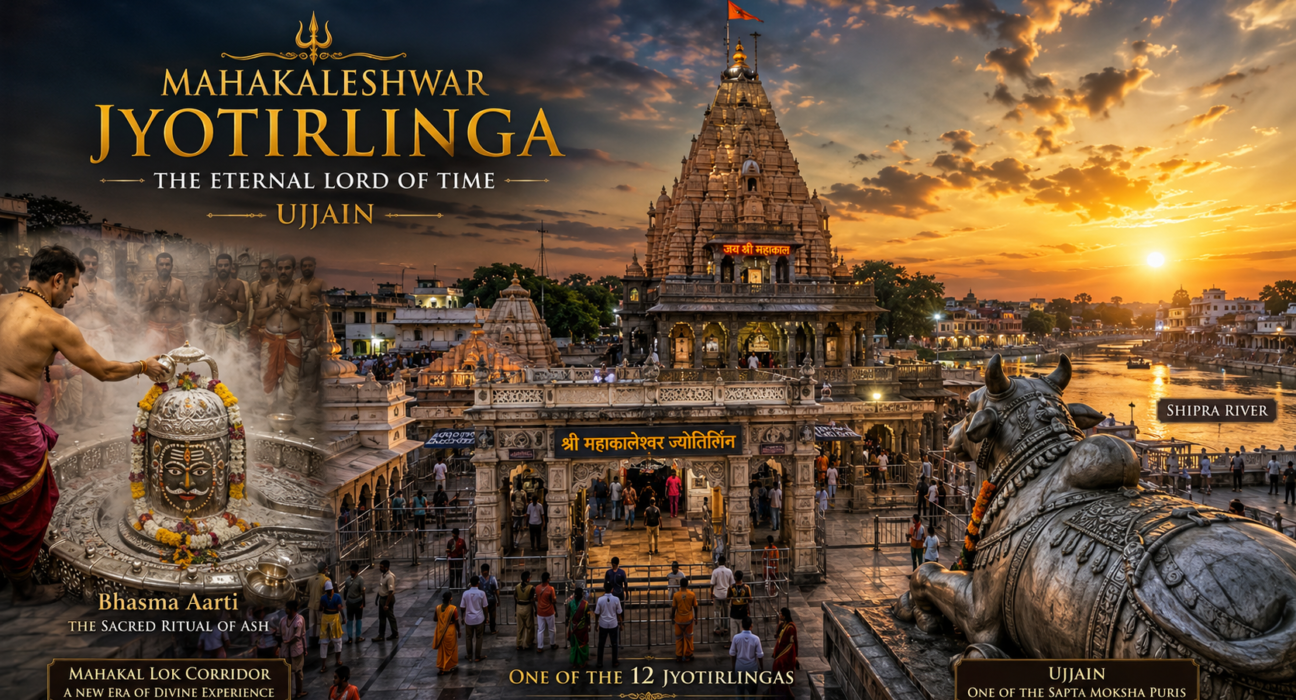
Mahakaleshwar Jyotirlinga: The Eternal Lord of Time and Death
The Ancient Glory of Ujjain and the First Jyotirlinga
Among the countless temples dedicated to Lord Shiva across India, twelve stand apart as the most sacred.
These are not ordinary Shiva temples.
According to Hindu tradition, they commemorate the divine moment when Lord Shiva manifested as an infinite pillar of cosmic light—a Jyotirlinga, symbolizing His limitless and formless nature.
This celestial manifestation occurred when Lord Vishnu and Lord Brahma sought to discover the beginning and the end of Shiva’s boundless form. Neither could find its source nor its summit, revealing that the Supreme Reality transcends time, space, and human comprehension.
To preserve the memory of this divine revelation, twelve sacred Jyotirlinga shrines came to be revered across India.
Among them, one temple occupies an especially unique place.
It is Mahakaleshwar Jyotirlinga, situated in the ancient city of Ujjain, where Shiva is worshipped not merely as the destroyer of evil, but as Mahakala—the Lord who transcends Time itself.
The Twelve Jyotirlingas of India
The twelve Jyotirlingas are spread across the Indian subcontinent, each representing a distinct aspect of Lord Shiva’s divine presence.
They are located in:
- Maharashtra – Four Jyotirlingas
- Gujarat – Two Jyotirlingas
- Madhya Pradesh – Two Jyotirlingas
- Uttarakhand – One Jyotirlinga
- Uttar Pradesh – One Jyotirlinga
- Tamil Nadu – One Jyotirlinga
- Andhra Pradesh – One Jyotirlinga
Each shrine possesses its own legends, rituals, and spiritual significance.
Among them, Mahakaleshwar of Ujjain is traditionally regarded by many devotees as one of the oldest and most powerful Jyotirlingas, revered for its unique association with time, मृत्यु (death), liberation, and cosmic dissolution.
Unlike other forms of Shiva, Mahakala is believed to govern Kala—Time itself.
If Kal Bhairava is the fierce guardian who destroys evil, Mahakala is the Supreme Lord who commands even Time and Death.
Ujjain – One of India’s Seven Sacred Cities
The Mahakaleshwar Temple stands in Ujjain, one of Hinduism’s Sapta Moksha Puris—the seven sacred cities believed to bestow liberation upon sincere devotees.
These ancient cities have been celebrated in scriptures for thousands of years as gateways to spiritual awakening.
Long before it became known as Ujjain, the city was called Avantika, a name that appears frequently in the Puranas.
Over time, the city came to be known as Ujjayini or Ujjain, a name associated with victory, prosperity, and royal glory.
Situated on the banks of the sacred Shipra River, Ujjain has remained a vibrant centre of religion, philosophy, astronomy, literature, and learning for more than two millennia.
For many pilgrims, visiting Ujjain is considered second only to visiting Kashi.
Indeed, it is often affectionately called “The Second Kashi.”
A City That Shaped Indian Civilization
Ujjain is not merely a religious destination.
It is one of India’s oldest continuously inhabited cities and has played a pivotal role in shaping the country’s cultural and intellectual history.
Over different periods, it served as the capital of powerful dynasties, including the Mauryas and later the Guptas, whose reign is often regarded as the Golden Age of ancient India.
One of the city’s most celebrated rulers was Chandragupta II, better known as Vikramaditya.
His legendary court became synonymous with scholarship, attracting some of the greatest minds of classical India.
The renowned Sanskrit poet Kalidasa, whose literary masterpieces continue to inspire readers across the world, is traditionally associated with Ujjain.
The great grammarian Patanjali is also linked with this ancient city, while Tamil Vaishnavite saint Thirumangai Alvar praised its spiritual significance in his devotional hymns.
Even the epics Ramayana and Mahabharata contain references that connect Ujjain and the surrounding region with important historical and mythological events, reflecting the city’s extraordinary antiquity.
The Sacred City of Lord Krishna
Ujjain also occupies an important place in the life of Lord Krishna.
According to tradition, Krishna and His elder brother Balarama studied under the great sage Sandipani at his ashram in Ujjain.
It was here that Krishna mastered not only the Vedas and martial arts but also disciplines such as astronomy, philosophy, politics, and sacred sciences.
The Sandipani Ashram continues to attract pilgrims who wish to visit the place where the Divine Teacher Himself once lived as a humble student.
This remarkable association adds yet another spiritual dimension to the city, making Ujjain sacred to both Shaivites and Vaishnavites alike.
The Sacred Shipra River
Flowing gracefully beside Ujjain is the holy Shipra River, revered in Hindu scriptures as one of India’s most sacred rivers.
The Agni Purana extols the Shipra as a river capable of purifying devotees who bathe in its waters with sincere faith.
For thousands of years, sages, ascetics, yogis, and pilgrims have meditated, performed penance, and conducted sacred rituals along its banks.
The river is inseparable from the spiritual identity of Ujjain.
Without the Shipra, the story of Mahakaleshwar would remain incomplete.
The City of Yogis and Siddhas
Unlike many pilgrimage centres known primarily for magnificent temples, Ujjain has long been celebrated as a city of realized masters.
For centuries, saints, Siddhas, Aghoris, Nath Yogis, ascetics, and wandering monks have considered Mahakaleshwar their living deity.
Many believe that Lord Mahakala responds swiftly to sincere devotion, regardless of one’s social status or background.
Perhaps this is why the atmosphere of Ujjain feels different from most other sacred cities.
The air carries the fragrance of incense, sacred ash, Vedic chants, temple bells, and centuries of uninterrupted spiritual practice.
Every narrow street seems to echo with a single greeting that has united generations of devotees:
“Jai Mahakal!”
It is not merely a slogan.
It is an expression of faith.
A declaration that Time itself bows before the Eternal Lord.
The Mysterious Bhasma Aarti and the Unique Rituals of Mahakaleshwar
Among the thousands of Shiva temples spread across India, every shrine has its own unique tradition.
Some are renowned for their grand festivals.
Others are famous for miraculous legends or ancient architecture.
But Mahakaleshwar Temple in Ujjain is unlike any other.
Here, before sunrise, when the world is still asleep and silence blankets the ancient city, one of Hinduism’s most extraordinary rituals unfolds.
A ritual that has fascinated saints, scholars, yogis, and pilgrims for centuries.
It is known as the Bhasma Aarti.
For many devotees, witnessing this sacred ceremony even once is considered one of life’s greatest spiritual blessings.
Why Is Lord Shiva Adorned with Sacred Ash?
To understand the significance of the Bhasma Aarti, one must first understand the symbolism of Bhasma—sacred ash.
In Shaivism, ash is not merely a ritual substance.
It represents the ultimate truth of existence.
Everything that is born will one day perish.
Every kingdom, every possession, every achievement, and every human body ultimately returns to ash.
Lord Shiva, who dwells in cremation grounds and is often depicted with sacred ash covering His body, constantly reminds humanity of this eternal reality.
The ash signifies the destruction of ego, attachment, and illusion.
It is a profound reminder that only the Supreme Consciousness is eternal.
This is why Mahakala—the Lord beyond Time—is worshipped with Bhasma.
The Ancient Tradition of the Bhasma Aarti
For centuries, the Bhasma Aarti at Mahakaleshwar followed a remarkable tradition.
According to long-standing temple customs, the sacred ash used for the ritual was traditionally obtained from a fresh cremation performed earlier that morning.
This practice symbolized Shiva’s association with the cremation ground and His transcendence over birth and death.
Over time, however, the ritual evolved.
Today, the temple uses ritually prepared sacred ash, commonly made from purified cow-dung ash, in accordance with present-day temple practice and legal guidelines.
While the material has changed, devotees believe the spiritual symbolism remains unchanged.
The ceremony continues to remind worshippers that every human life ultimately merges into the eternal reality represented by Lord Shiva.
The Spiritual Meaning Behind the Ritual
Many first-time visitors are surprised by the idea of offering ash to the deity.
Yet for followers of Shaivism, this ritual carries extraordinary philosophical depth.
The Bhasma Aarti teaches that:
- The physical body is temporary.
- Wealth and power are impermanent.
- Time eventually consumes everything.
- Only the Divine Self remains eternal.
Standing before Mahakala during the ceremony, devotees are invited to reflect not on death itself, but on the freedom that comes from realizing the impermanence of worldly existence.
This is why saints describe Mahakaleshwar not as the Lord of death, but as the One who liberates us from the fear of death.
Witnessing the Bhasma Aarti
The Bhasma Aarti begins in the early hours of the morning.
The temple opens around 4:00–4:30 a.m., and devotees who wish to witness the ceremony are generally required to obtain advance permission or reservation due to the enormous number of pilgrims who visit each day.
As the sanctum doors open, Vedic chants begin to resonate through the temple.
Priests carry the sacred ash with great reverence.
The Bhasma is gently offered over the Jyotirlinga in accordance with ancient ritual traditions.
Oil lamps illuminate the sanctum with a soft golden glow.
There are no dazzling lights.
Only flickering flames, sacred chants, the fragrance of incense, and the overwhelming spiritual presence of Mahakala.
For countless devotees, this is not merely a ritual—it is an experience that leaves a lasting impression on the heart.
The Magnificent Alankaram of Mahakala
After the Bhasma Aarti, another extraordinary tradition takes place.
The Jyotirlinga is adorned in a manner found nowhere else in India.
Instead of elaborate floral decorations alone, the priests carefully create a divine facial form upon the sacred Linga.
Traditional ingredients such as:
- Sandalwood paste
- Saffron
- Dry fruits
- Almonds
- Raisins
- Cherries
- Fragrant herbal preparations
are artistically arranged to depict the Lord’s eyes, eyebrows, nose, moustache, sacred forehead markings, and divine expression.
The result is breathtaking.
The formless Jyotirlinga momentarily appears with a living, compassionate face, allowing devotees to experience both the Nirguna (formless) and Saguna (manifest) aspects of Shiva simultaneously.
The Eternal Witness—Nandi
Facing the sanctum sits the majestic silver Nandi, Lord Shiva’s sacred bull.
Throughout the ceremony, Nandi appears to gaze unblinkingly toward his beloved Lord.
For devotees, this image carries profound meaning.
Nandi represents unwavering devotion.
He does not ask for wealth.
He does not seek liberation.
He simply waits patiently, forever absorbed in the presence of Shiva.
Many pilgrims quietly spend a few moments beside Nandi before entering the sanctum, believing that true devotion begins with humility and silent surrender.
Why Millions Visit Before Dawn
Most temple rituals are beautiful.
But the Bhasma Aarti is transformative.
It is one of the very few ceremonies in the world where the deepest truths of life, death, time, and liberation are expressed not through philosophy alone, but through a living ritual performed every single day.
Perhaps this is why devotees from across India—and increasingly from around the world—travel to Ujjain simply to witness these sacred moments before sunrise.
For them, the Bhasma Aarti is not merely something to watch.
It is something to experience.
The Divine Origin of Mahakala: How Shiva Manifested to Protect His Devotees
Every Jyotirlinga has a story.
Some speak of penance.
Others recount miraculous visions.
But the origin of Mahakaleshwar Jyotirlinga is a story of unwavering devotion, divine compassion, and the eternal promise that Lord Shiva never abandons those who surrender to Him completely.
It is a legend preserved in the Skanda Purana, one that has inspired devotees for centuries.
The story begins in the ancient forests surrounding present-day Ujjain.
The Peaceful City Under Threat
Long ago, the sacred region of Avantika, now known as Ujjain, was a flourishing centre of Vedic learning and spiritual practice.
Its forests echoed with the chanting of mantras.
The banks of the holy Shipra River were filled with sages performing austerities.
Yajnas, homas, meditation, and the study of the Vedas formed the rhythm of daily life.
Among these holy men lived a great Shiva Yogi, renowned for his unwavering devotion and strict observance of spiritual discipline.
His life was entirely dedicated to Lord Shiva.
But this peace would not last forever.
The Rise of the Demon Dushana
In the nearby Ratnamala Hills, there lived a powerful demon named Dushana.
Blinded by arrogance and intoxicated by his strength, Dushana despised righteousness.
He attacked innocent villagers.
He disrupted sacred rituals.
He destroyed yajnas and homas before they could be completed.
Temples were desecrated.
Ascetics were harassed.
The people lived in constant fear.
No king could stop him.
No warrior dared confront him.
The sacred land of Avantika slowly became a place of suffering.
The Cry of the Devotees
Unable to bear the oppression any longer, the distressed people approached the revered Shiva Yogi.
With folded hands, they pleaded,
“Protect us, O Master. Only Lord Shiva can save us from this tyranny.”
The yogi listened with compassion.
He did not raise an army.
He did not seek weapons.
Instead, he chose the greatest power known in Sanatana Dharma—devotion.
He consecrated a Shiva Linga upon the sacred ground and began an intense Maha Yajna, invoking Lord Shiva with complete surrender.
The flames of the sacrificial fire rose toward the heavens.
The chanting of Vedic hymns filled the air.
The entire region prayed with one heart.
Evil Tries to Destroy Dharma
As the sacred yajna progressed, Dushana arrived in fury.
The sight of thousands of devotees praying together enraged him.
He mocked the sages.
He ridiculed the rituals.
He commanded everyone to abandon the worship of Shiva.
When no one obeyed, he attacked.
His soldiers stormed the sacrificial grounds.
The sacred fire was threatened.
Panic spread among the devotees.
Yet the Shiva Yogi remained unmoved.
His eyes stayed closed.
His meditation never wavered.
His faith in Lord Shiva remained absolute.
The Earth Trembled
Then…
Something extraordinary happened.
The ground beneath the Shiva Linga began to shake.
The sacrificial altar radiated an unimaginable brilliance.
The earth split open.
From the very Jyotirlinga that the yogi had consecrated, an infinite column of divine energy burst forth.
The brilliance surpassed the radiance of thousands of suns.
The heavens trembled.
The gods watched in awe.
Time itself seemed to stand still.
From that blazing pillar emerged Lord Shiva in one of His fiercest and most majestic manifestations.
Not as the serene ascetic of Mount Kailasa.
Not as Nataraja, the Cosmic Dancer.
But as Mahakala—the Supreme Lord before whom even Time bows.
The Wrath of Mahakala
The appearance of Mahakala transformed the battlefield.
His eyes blazed like cosmic fire.
His matted locks flowed like storm clouds.
The sound of His roar echoed through the three worlds.
Dushana, who moments earlier had mocked the devotees, now stood trembling before the Infinite.
The battle lasted only moments.
With effortless divine power, Mahakala destroyed the demon and his forces.
Darkness vanished.
The sacred fire continued to burn.
Peace returned to Avantika.
The devotees bowed before the Lord with tears of gratitude.
A Prayer That Changed History
After witnessing Shiva’s divine intervention, the sages and the people made a humble request.
“O Lord, do not leave us.
Remain here forever.
Protect this sacred land and all those who seek Your refuge.”
Moved by their devotion, Lord Shiva granted their wish.
He chose to remain eternally in the very Jyotirlinga from which He had manifested.
From that day onward, He became known as Sri Mahakaleshwar—the Great Lord of Time.
Unlike other temples where devotees seek worldly blessings alone, Mahakaleshwar became a place where seekers prayed for something even greater:
Freedom from fear.
Freedom from time.
Freedom from death.
And ultimately, Moksha.
Why He Is Called Mahakala
The Sanskrit word “Kala” carries many meanings.
It signifies:
- Time
- Death
- Destiny
- Cosmic change
Mahakala means “The One who is beyond all of these.”
He is not controlled by time.
He controls time.
He is not subject to death.
He governs death.
He is the eternal witness before whom entire universes arise and dissolve.
For this reason, Mahakaleshwar is worshipped not merely as a deity of protection but as the Supreme Reality that transcends birth, life, death, and rebirth.
The Eternal Message of Mahakaleshwar
The legend of Mahakala is more than a miraculous story.
It carries a timeless spiritual lesson.
When arrogance threatens righteousness…
When darkness appears to overpower truth…
When sincere devotees feel abandoned…
The Divine does not remain silent forever.
At the right moment, in the right form, the Supreme manifests to restore Dharma.
The story of Mahakaleshwar reminds us that true devotion never goes unanswered.
Faith may be tested.
Patience may be required.
But the grace of Lord Shiva always arrives when it is needed most.
The Destruction, Rediscovery, and Grand Revival of Mahakaleshwar
The story of Mahakaleshwar is not only a tale of mythology and divine miracles.
It is also a story of survival.
Across the centuries, the temple witnessed the rise and fall of kingdoms, foreign invasions, destruction, abandonment, and finally, a remarkable rebirth.
Despite every attempt to erase its existence, the faith of millions ensured that Lord Mahakala would once again return to His rightful abode.
The Temple That Kings Revered
For many centuries, Mahakaleshwar was one of the wealthiest and most revered temples in central India.
Ancient rulers, merchants, saints, and devotees contributed generously toward its expansion.
Magnificent halls, towering gateways, elaborate sculptures, and sacred tanks surrounded the shrine.
The temple stood not only as a religious centre but also as a symbol of the prosperity and spiritual greatness of ancient Ujjain.
Pilgrims travelled from every corner of Bharat to seek the blessings of the Lord who governs Time itself.
The city flourished under the protection of Mahakala, becoming one of India’s foremost centres of religion, philosophy, and learning.
The Invasion That Changed History
The peaceful existence of the temple came to a tragic end during the medieval period.
Historical records describe that in 1235 CE, the forces of Shams ud-Din Iltutmish, the Sultan of Delhi, invaded Ujjain.
During this campaign, the ancient Mahakaleshwar Temple suffered extensive destruction.
Many medieval chronicles and later historical accounts state that the temple was demolished, its treasures looted, and the original shrine severely damaged.
According to long-standing local tradition, the sacred Jyotirlinga was removed from the sanctum and thrown into the nearby Koti Tirtha (also known as Kotitirtha Kund), while structures associated with the temple complex were destroyed during the invasion.
As with many events of the medieval period, historians differ on certain details, but there is broad agreement that the temple experienced significant destruction during this era. The memory of this event remains deeply embedded in the devotional history of Mahakaleshwar.
Five Centuries of Silence
Following the destruction, the original temple gradually disappeared from the landscape.
Generations passed.
Empires rose and fell.
The once-glorious shrine remained lost to time.
For nearly five centuries, devotees believed that the original Jyotirlinga lay hidden beneath the waters of Koti Tirtha, awaiting the day when it would once again emerge.
Yet even in the absence of the grand temple, the devotion of the people never disappeared.
Pilgrims continued to remember Mahakala.
Saints preserved the sacred traditions through oral history.
Faith endured where monuments had fallen.
The Maratha Revival
A new chapter began in the eighteenth century.
As the Maratha Empire expanded into central India, Ujjain came under Maratha administration.
One of the great Maratha commanders, Ranoji Shinde (Scindia), learned of the ancient temple’s destruction and the traditions surrounding the lost Jyotirlinga.
Determined to restore one of Hinduism’s holiest shrines, he initiated efforts to rebuild the temple.
According to local tradition, the sacred Jyotirlinga was recovered from Koti Tirtha and ceremonially reinstalled.
A new temple was constructed over the ancient sacred site.
Although different from the original medieval structure, this reconstruction restored Mahakaleshwar as the spiritual heart of Ujjain.
The revival represented more than the rebuilding of a monument.
It symbolized the resilience of faith.
Koti Tirtha – The Sacred Tank of Memory
Within the temple complex lies Koti Tirtha, a sacred water tank intimately connected with the history of Mahakaleshwar.
Tradition holds that the Jyotirlinga remained hidden in its waters for centuries after the medieval invasion.
For devotees, this sacred tank represents hope.
It reminds them that although temples may be damaged and civilizations may change, the Divine can never truly be destroyed.
Pilgrims continue to offer prayers at Koti Tirtha, remembering both the trials endured by the temple and its miraculous restoration.
Mahakal Lok – A New Era
In the twenty-first century, Mahakaleshwar entered another remarkable phase of its history.
Recognizing the temple’s immense religious and cultural importance, the Government of India and the Government of Madhya Pradesh launched an ambitious redevelopment initiative known as the Mahakal Lok Corridor.
The project sought not only to improve facilities for pilgrims but also to recreate the spiritual grandeur befitting one of India’s twelve Jyotirlingas.
Spread across an expansive area, the new complex features:
- Grand ceremonial entrances.
- Beautiful sandstone pathways.
- Magnificent sculptures depicting episodes from the Shiva Puranas.
- Landscaped gardens.
- Sacred water features.
- Large devotional plazas capable of accommodating millions of pilgrims annually.
Rather than replacing the ancient temple, the development enhances the pilgrimage experience while preserving the sanctity of the historic shrine.
A Monument Reborn
In October 2022, the first phase of the Mahakal Lok Corridor was inaugurated by Prime Minister Narendra Modi, marking one of the largest temple redevelopment projects undertaken in modern India.
Today, visitors entering the Mahakal Lok experience a seamless blend of ancient spirituality and modern infrastructure.
Towering statues of Lord Shiva’s divine manifestations line the pathway.
Sacred murals narrate stories from the Puranas.
Every architectural element has been designed to deepen the pilgrim’s spiritual journey before reaching the sanctum of Mahakaleshwar.
The redevelopment has transformed Ujjain into one of the world’s most impressive spiritual destinations while preserving the timeless sanctity of the Jyotirlinga.
“Jai Mahakal” – More Than a Greeting
For the people of Ujjain, Mahakala is not merely the presiding deity of the city.
He is a member of the family.
Walk through the streets of Ujjain, and you will hear devotees greeting one another not with ordinary salutations, but with two powerful words:
“Jai Mahakal!”
These words express much more than devotion.
They embody a way of life.
A reminder that every moment belongs to Mahakala.
That time itself is sacred.
And that no matter how difficult life becomes, the Eternal Lord continues to watch over His devotees.
Simhastha Kumbh Mela, Sacred Temples of Ujjain, and the Eternal Grace of Mahakala
A pilgrimage to Mahakaleshwar Jyotirlinga is never complete with the darshan of Mahakala alone.
For thousands of years, Ujjain has been a vast spiritual landscape where temples, ashrams, sacred rivers, saints, Siddhas, and ancient legends have come together to create one of India’s greatest centres of Sanatana Dharma.
Every street tells a story.
Every shrine preserves a tradition.
Every devotee who walks through this ancient city becomes part of a spiritual journey that has continued uninterrupted for millennia.
Simhastha Kumbh Mela – Where Millions Gather for Liberation
Among all the religious gatherings held across the world, few can rival the grandeur of the Kumbh Mela.
According to Hindu tradition, during the Samudra Manthan (Churning of the Ocean of Milk), the Devas and Asuras struggled for possession of the pot containing Amrita, the nectar of immortality.
As the celestial beings carried the pot across the heavens, drops of the divine nectar are believed to have fallen at four sacred places:
- Haridwar
- Prayagraj
- Nashik
- Ujjain
These four locations became the sacred sites where the Kumbh Mela is celebrated.
The festival held at Ujjain is known as Simhastha Kumbh Mela, taking place approximately once every twelve years when specific planetary alignments occur.
Millions of pilgrims, saints, ascetics, Naga Sadhus, yogis, and spiritual seekers gather on the banks of the Shipra River, believing that a holy dip during this auspicious period cleanses accumulated karma and becomes a powerful step toward spiritual liberation.
Local traditions even associate Lord Rama with this sacred region, and the area where pilgrims gather includes a place known as Ram Ghat, preserving the memory of these ancient beliefs.
The Remarkable Temple Traditions of Mahakaleshwar
Mahakaleshwar Temple preserves several unique ritual practices that distinguish it from many other Shiva temples.
One such tradition concerns Nirmalya—the flowers, Bilva leaves, and offerings that have already been presented to the deity.
In many temples, these offerings are respectfully removed and replaced after each major worship.
At Mahakaleshwar, however, certain ritual traditions follow a different pattern, reflecting the temple’s ancient customs and Agamic practices.
These distinctive observances have been preserved for generations and continue to be an integral part of the temple’s identity.
For devotees, every ritual performed here is believed to carry profound symbolic significance rather than being merely ceremonial.
Harsiddhi Mahakali Temple
A short distance from Mahakaleshwar stands one of Ujjain’s most revered Shakti shrines—the Harsiddhi Mahakali Temple.
The Goddess enshrined here has been worshipped for centuries as the Divine Mother who grants wisdom, courage, and victory.
According to popular tradition, the legendary emperor Vikramaditya was an ardent devotee of this Goddess and received Her blessings before undertaking many of his great achievements.
Another cherished legend associates the temple with the great Sanskrit poet Kalidasa.
It is believed that the compassionate grace of the Divine Mother transformed him into one of India’s greatest literary geniuses.
Whether viewed as history or sacred tradition, these stories reflect the immense reverence that devotees have always held for the Goddess of Ujjain.
The temple itself, adorned with its distinctive deepa stambhas (lamp towers), becomes especially magnificent during Navaratri, when thousands of lamps illuminate the entire complex.
Sandipani Ashram – Where Krishna Studied
Few places in India can claim to have served as the classroom of Lord Krishna.
Yet in Ujjain stands the ancient Sandipani Ashram, where Krishna and His elder brother Balarama are traditionally believed to have studied under Sage Sandipani.
Here they mastered:
- The Vedas.
- Warfare.
- Statecraft.
- Philosophy.
- Sacred sciences.
- Astronomy.
For devotees, the ashram symbolizes an eternal truth:
Even the Supreme Lord accepted the discipline of learning from a Guru.
Visitors continue to experience the peaceful atmosphere of this sacred place, where education was regarded as a path toward self-realization rather than worldly success alone.
Siddhavat – The Eternal Banyan Tree
Another important pilgrimage site in Ujjain is Siddhavat.
At its heart stands an ancient banyan tree that has been revered for centuries.
Local belief holds that prayers offered beneath this sacred tree with sincere devotion are fulfilled through divine grace.
Like the Akshayavat of Prayagraj, Siddhavat has become a place associated with meditation, ancestral rites, and spiritual contemplation.
Even today, countless devotees tie sacred threads around its branches as symbols of their prayers and aspirations.
Pattinathar’s Extraordinary Connection with Ujjain
Ujjain also shares a fascinating connection with Saint Pattinathar, one of Tamil Nadu’s greatest saints.
According to traditional accounts, Pattinathar visited Mahakaleshwar during his pilgrimage across India.
After worshipping Lord Mahakala, he entered deep meditation near a shrine outside the city.
At that very time, thieves fleeing the royal guards are said to have thrown away a valuable pearl necklace.
By chance, it landed around the saint’s neck.
Mistaking him for the thief, the king’s soldiers arrested Pattinathar and brought him before King Bhadragiri.
Without a proper investigation, the king ordered the saint’s execution.
Standing before the execution stake, Pattinathar sang a hymn glorifying Lord Shiva.
Miraculously, the wooden stake burst into flames on its own.
Witnessing this divine intervention, the king realized his grave mistake.
Filled with remorse, he renounced his throne and became Pattinathar’s disciple.
This remarkable episode continues to be remembered as a testimony to the power of true devotion and the transforming grace of Lord Shiva.
Kal Bhairav Temple
No pilgrimage to Ujjain is considered complete without visiting the famous Kal Bhairav Temple.
Kal Bhairava is worshipped as the fierce guardian of Ujjain and the protector of Mahakala’s sacred city.
The temple is especially renowned for its unique ritual in which offerings are made to the deity according to long-standing local traditions.
For devotees, Kal Bhairava represents unwavering protection, justice, and the destruction of fear.
Mangalnath Temple – The Birthplace of Mars
Another significant shrine is the Mangalnath Temple, dedicated to Lord Shiva.
Traditional belief identifies this sacred place as the birthplace of Mangala (the planet Mars).
Because of this association, devotees visit the temple seeking relief from Mangala Dosha (Mars afflictions) in Vedic astrology.
The temple’s serene surroundings and its close connection with ancient astronomical traditions make it one of Ujjain’s most important pilgrimage destinations.
Bade Ganesh Temple
Close to Mahakaleshwar stands the impressive Bade Ganesh Temple, housing a majestic image of Lord Ganesha.
The enormous idol symbolizes wisdom, auspicious beginnings, and the removal of obstacles.
Many pilgrims begin or conclude their visit to Mahakaleshwar by offering prayers here, seeking Lord Ganesha’s blessings before continuing their spiritual journey.
A City Where Every Path Leads to the Divine
Few places in India combine so many sacred traditions within a single city.
In Ujjain, devotees can:
- Witness the mystical Bhasma Aarti.
- Worship one of the Twelve Jyotirlingas.
- Seek the blessings of Mahakali.
- Visit the Guru of Lord Krishna.
- Meditate beneath the sacred Siddhavat.
- Receive the protection of Kal Bhairava.
- Offer prayers at Mangalnath.
- Explore one of the world’s oldest living centres of spirituality.
Every temple complements the others, creating a pilgrimage unlike any other in India.
Conclusion
Mahakaleshwar is more than an ancient temple.
It is a profound reminder that while kingdoms rise and fall, civilizations change, and generations pass away, the Eternal remains unchanged.
As Mahakala, Lord Shiva teaches that time governs every living being—but time itself is governed by Him.
The sacred ash of the Bhasma Aarti, the timeless waters of the Shipra River, the chants echoing through the ancient streets of Ujjain, and the unwavering faith of millions of devotees all point toward one eternal truth:
Life is temporary.
The Divine is eternal.
For those who visit Ujjain with humility and devotion, Mahakaleshwar offers more than blessings.
He offers a glimpse into the timeless reality beyond birth, death, and time itself.
And as devotees have proclaimed for centuries with unwavering faith:
“Jai Mahakal!”