
Cheyyur Kandaswamy Temple: The Mystery of the 27 Nakshatra Vedhalas
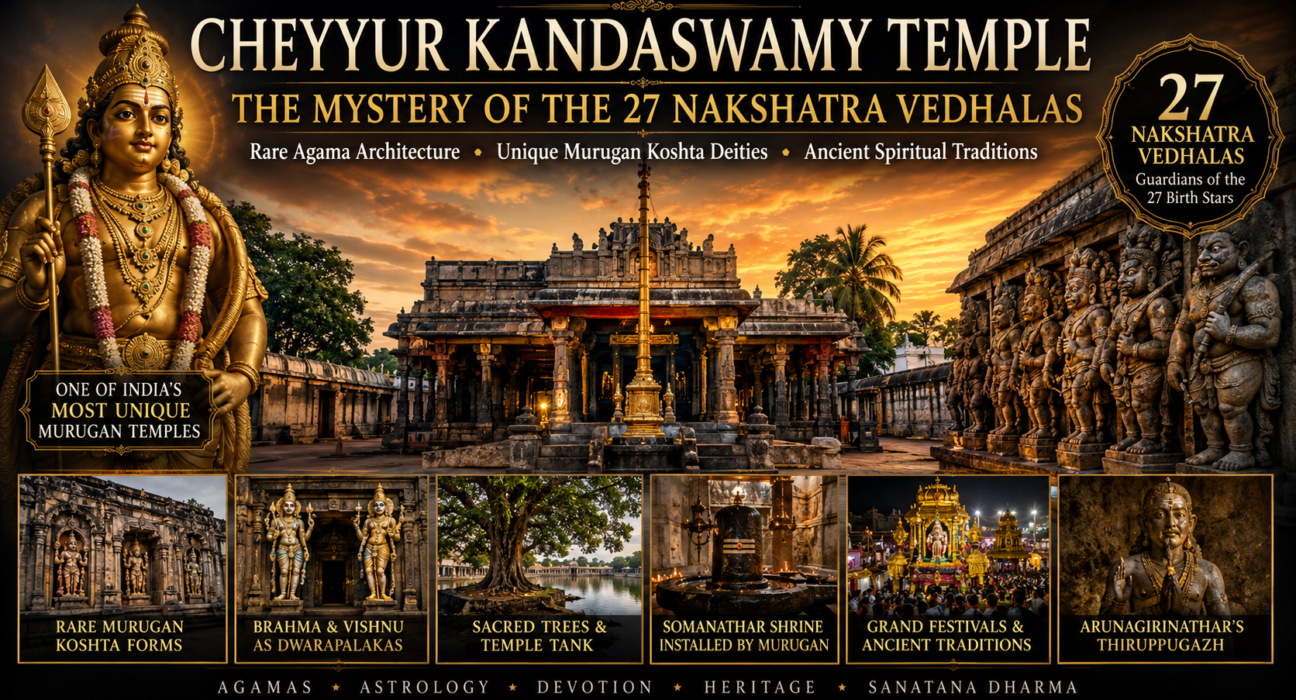
The Forgotten Murugan Temple That Houses the 27 Nakshatra Vedhalas
Discovering the Mystical Secrets of Cheyyur Kandaswamy Temple
Introduction
Tamil Nadu is home to thousands of ancient temples dedicated to Lord Murugan. While sacred shrines such as Palani, Tiruchendur, Swamimalai, and Thirupparankundram attract millions of devotees every year, there are also hidden temples whose greatness remains known only to a handful of seekers.
One such extraordinary shrine is the Cheyyur Kandaswamy Temple.
At first glance, it appears to be a modest Murugan temple tucked away in a peaceful village. But once you step inside, you begin to realize that this is no ordinary temple. Every stone, every sculpture, and every shrine reveals mysteries rarely found anywhere else in India.
Imagine a temple where:
- All 27 Nakshatras are represented not by ordinary deities, but by 27 mystical Vedhalas (Bhuta Ganas).
- The traditional Koshta deities found around the sanctum are replaced entirely by different forms of Lord Murugan Himself.
- Brahma and Vishnu stand as guardians before a Shiva shrine.
- The temple follows the ancient Kumara Tantra Agama with remarkable precision.
- Devotees believe that their prayers are carried directly to Lord Murugan through the celestial Bhuta Ganas during Krishna Paksha Ashtami.
These extraordinary features make Cheyyur Kandaswamy Temple one of the rarest Murugan temples in Tamil Nadu.
Located in Cheyyur, about 100 km from Chennai, 26 km from Madurantakam, and 23 km from Melmaruvathur, this ancient temple remains surprisingly unknown despite its immense spiritual and historical significance.
The village itself was once known by several historic names, including Jayamkonda Chola Nallur, Veera Rajendra Nallur, and Valavapuri, as revealed through ancient inscriptions preserved within the temple. These inscriptions indicate that the region flourished under the Cholas, while local traditions suggest that the sacred site may be even older than the surviving Chola structures.
The temple is also deeply connected with the great saint-poet Arunagirinathar, who praised the presiding deity in his immortal Thiruppugazh. His hymns refer to Murugan here as “Valavapuri Vazh Mayil Vagana Perumale,” confirming that this sacred shrine was already a celebrated pilgrimage centre during his lifetime.
Unlike many temples that are famous because of massive towers or royal patronage, Cheyyur Kandaswamy Temple is revered for something far more profound—its perfect harmony between Agamic architecture, spiritual symbolism, and living tradition.
Every aspect of this temple, from its orientation to its sanctums, reflects the timeless wisdom preserved in the ancient Kumara Tantra, one of the most authoritative Agamic texts governing the construction and worship of Murugan temples.
But perhaps the greatest mystery lies hidden within its outer prakaram, where twenty-seven enigmatic celestial guardians silently watch over devotees, each connected to one of the twenty-seven Nakshatras.
Who are these mysterious Vedhalas?
Why are they worshipped only here?
And what ancient spiritual science links them to every human being born under a particular star?
The Ancient History of Cheyyur Kandaswamy Temple
Every ancient temple has a story.
Some stories are preserved in inscriptions carved on stone.
Some survive through sacred literature.
Others continue to live in the faith of devotees who have worshipped there for generations.
Cheyyur Kandaswamy Temple is one such sacred monument where history, legend, and spirituality merge into a single timeless tradition.
Today, Cheyyur is a quiet town in Tamil Nadu’s Chengalpattu district. Yet centuries ago, it was an important settlement known by several prestigious names, each reflecting a different period of its glorious past.
Ancient inscriptions found within the temple refer to the village as Jayamkonda Chola Nallur, Veera Rajendra Nallur, and Valavapuri. These names reveal that the region flourished under the Chola Empire and enjoyed royal patronage for many centuries.
Scholars generally attribute the present granite structure of the temple to the 10th century Chola period. However, many researchers and traditional scholars believe that the sacred site itself is considerably older than the surviving stone structure.
One of the strongest reasons for this belief lies in the temple’s architecture.
Unlike most medieval South Indian temples, Cheyyur Kandaswamy Temple does not possess the towering Rajagopuram that became characteristic of later Chola and Vijayanagara temples. Instead, its simple and highly disciplined layout reflects an earlier phase of Dravidian temple architecture, where spiritual geometry was considered more important than monumental height.
This has led many historians to believe that an earlier shrine may have existed here long before the Cholas expanded and renovated it. Over time, successive dynasties—including the Cholas and later the Vijayanagara rulers—added new structures while preserving the sanctity of the original temple. Inscriptions also record grants made during the Vijayanagara period, illustrating the temple’s continued importance through the centuries.
The Sacred Legend Behind Cheyyur
The temple’s spiritual history is inseparable from Lord Murugan’s victory over the demon Surapadman.
According to temple tradition, after receiving the divine Vel from Goddess Parvati, Lord Murugan set out to destroy the forces of adharma. During this great cosmic battle, Shiva’s celestial attendants—the Bhuta Ganas—fought alongside Him.
Although Murugan ultimately destroyed Surapadman, He chose to perform an act of divine humility.
To symbolically atone for the violence of war, He installed a Shiva Linga at this sacred place and worshipped Lord Shiva.
That Shiva shrine is worshipped today as Sri Somanathar, making Cheyyur one of the rare temples where Murugan Himself is believed to have consecrated and worshipped Shiva.
It is said that because “Sei” (Murugan, the divine son) worshipped here, the place gradually came to be known as Cheyyur. This beautiful legend expresses the harmony between Shaivism and Murugan worship, a hallmark of Tamil spiritual tradition.
Blessed by Arunagirinathar
No Murugan temple is considered complete without the grace of Saint Arunagirinathar.
The great 15th-century saint visited Cheyyur and composed a magnificent Thiruppugazh hymn in praise of the Lord here.
In his immortal verses, he lovingly addresses the deity as:
“Valavapuri Vazh Mayil Vagana Perumale”
This single phrase preserves one of the temple’s ancient names—Valavapuri—and confirms that Cheyyur was already a renowned pilgrimage centre during Arunagirinathar’s lifetime.
Even today, devotees recite this Thiruppugazh within the temple, continuing a tradition that has endured for centuries. The temple also houses inscriptions of the hymn and a statue of Arunagirinathar, honoring his enduring connection to this sacred shrine.
A Living Monument of Ancient Wisdom
Unlike many historical monuments that survive only as archaeological relics, Cheyyur Kandaswamy Temple remains a vibrant place of worship.
Daily rituals continue according to ancient Agamic traditions.
Festivals attract thousands of devotees.
The sacred traditions of Murugan worship have been preserved without interruption for generations.
This continuity is perhaps the temple’s greatest miracle.
It is not merely an ancient building.
It is a living embodiment of Tamil spirituality, where history still breathes through ritual, architecture, music, and devotion.
In the next chapter, we will explore one of the temple’s greatest architectural marvels—its astonishing design based on the Kumara Tantra Agama, a system of sacred temple architecture found in only a handful of Murugan temples.
The Kumara Tantra – The Sacred Blueprint Behind Cheyyur Kandaswamy Temple
Most devotees admire a temple for its towering gopurams, majestic sculptures, or divine atmosphere.
But very few realize that behind every authentic Hindu temple lies an intricate spiritual science.
A traditional temple is not merely an architectural structure.
It is a living energy field designed according to sacred Agamas—ancient scriptures that describe every aspect of temple construction, deity installation, rituals, festivals, and worship.
Among these Agamic texts, one of the most important for Murugan temples is the Kumara Tantra.
Cheyyur Kandaswamy Temple stands today as one of the finest surviving examples of a temple built according to this remarkable tradition.
What is Kumara Tantra?
The Kumara Tantra is one of the ancient Upagamas dedicated exclusively to Lord Subrahmanya (Murugan).
It is much more than a manual for constructing temples.
It is a complete spiritual guide that explains:
- How a Murugan temple should be planned.
- The proportions of the sanctum and the deity.
- The placement of every shrine.
- The preparation of Panchagavya and Panchamirtham.
- The procedures for daily worship.
- Temple festivals.
- Consecration ceremonies (Kumbhabhishekam).
- Yagas and Homas.
- The responsibilities of priests.
- The spiritual symbolism behind every architectural element.
Traditional scholars state that the Kumara Tantra contains 51 chapters, each describing a different aspect of Murugan worship and temple tradition.
For centuries, this knowledge was preserved within temple lineages and passed down from one generation of priests to another.
Cheyyur Kandaswamy Temple preserves many of these ancient principles almost exactly as described in the Agamas.
A Temple Built with Sacred Geometry
Unlike modern buildings that are planned only for convenience, Agamic temples are designed to channel divine energy.
Every direction has a purpose.
Every entrance has meaning.
Every shrine occupies a carefully chosen location.
According to the Kumara Tantra, the land selected for constructing a temple should possess specific geographical characteristics.
One important guideline states that the terrain should gradually rise towards the south and west, allowing the temple to harmonize with the natural flow of spiritual energy.
Cheyyur Kandaswamy Temple follows this ancient prescription.
Even the orientation of the temple reflects Agamic wisdom.
The sanctum is positioned so that its sacred layout aligns with the spiritual principles described in the Kumara Tantra, symbolizing prosperity, protection, and divine grace. Temple traditions hold that such alignment enhances the blessings received by devotees.
A Silent Witness to Great Antiquity
One feature immediately surprises every visitor.
There is no massive Rajagopuram.
To many, this may appear unusual.
Yet this simplicity may actually reveal the temple’s extraordinary age.
The earliest rock-cut temples of the Pallavas, the Pancha Rathas at Mamallapuram, and several early South Indian shrines were constructed without the monumental gateway towers that later became the hallmark of Dravidian architecture.
Large Rajagopurams became common only in later periods as temple architecture evolved under the Pallavas, Cholas, Pandyas, and Vijayanagara rulers.
Cheyyur Kandaswamy Temple retains a remarkably simple layout that echoes these earlier architectural traditions.
Many researchers therefore believe that the temple’s original core may predate the later medieval additions, even though renovations and expansions were carried out during the Chola period.
Every Structure Has a Purpose
Walking through the temple, one quickly realizes that nothing has been placed randomly.
The sanctum, mandapams, flagstaff, subsidiary shrines, circumambulatory paths, and sacred trees all follow a deliberate spiritual order.
Even the Deepa Sthambam (lamp pillar) and the Dhwaja Sthambam (flagstaff) are positioned facing the sanctum according to Agamic principles, reminding devotees that every ritual movement within the temple is part of a carefully designed spiritual journey.
This is why traditional temples continue to radiate a unique sense of peace.
Their architecture is not simply artistic.
It is spiritual science expressed through stone.
Every measurement, every direction, and every shrine serves a higher purpose—to guide the devotee from the outer world toward inner awakening.
Yet the greatest architectural mystery of Cheyyur Kandaswamy Temple still lies ahead.
As visitors walk around the sanctum, they expect to see the familiar Koshta deities found in every Shaivite temple.
Instead, they encounter something that exists in almost no other Murugan temple in India.
In the next chapter, we will uncover this astonishing mystery—the rare Murugan Koshta forms that make Cheyyur Kandaswamy Temple one of the most unique temples in the entire country.
The Temple Where Lord Murugan Replaces Every Koshta Deity
If there is one feature that immediately sets Cheyyur Kandaswamy Temple apart from every other Murugan temple in Tamil Nadu, it is the extraordinary arrangement of its Koshta deities.
For devotees familiar with South Indian temples, this comes as a complete surprise.
In almost every Shiva temple, the outer walls of the sanctum (Garbhagriha) contain a fixed arrangement of deities known as the Koshta Devatas.
These sacred niches are not decorative sculptures.
They are an essential part of Agamic temple architecture and represent different aspects of cosmic knowledge.
Traditionally, devotees circumambulating the sanctum worship:
- Lord Ganesha
- Dakshinamurti
- Lingodbhava (or Vishnu in some traditions)
- Lord Brahma
- Goddess Durga
This arrangement has remained virtually unchanged for over a thousand years across countless Shiva temples in South India.
But when you walk around the sanctum of Cheyyur Kandaswamy Temple, something astonishing happens.
None of these familiar deities are present.
Instead…
Every single Koshta niche is occupied by a different manifestation of Lord Murugan Himself.
This is one of the rarest architectural features found anywhere in India.
Murugan in Five Extraordinary Forms
Rather than assigning different gods to the sacred niches, the temple presents Lord Murugan as the embodiment of every divine principle.
Each form carries its own profound symbolism.
Nritya Skanda
In the place where Lord Ganesha usually appears stands Nritya Skanda—Murugan in His graceful dancing form.
The image symbolizes divine joy, cosmic rhythm, and the eternal dance of creation.
It reminds devotees that spiritual realization is not merely achieved through meditation but also through the harmonious movement of life itself.
Brahma Sastha
Instead of Dakshinamurti—the universal Guru—this temple enshrines Brahma Sastha, another profound manifestation of Lord Murugan.
According to ancient traditions, Murugan once imprisoned Lord Brahma after discovering that Brahma could not explain the true meaning of the sacred syllable Om.
Murugan Himself then assumed the role of the cosmic teacher.
This form beautifully reflects that supreme wisdom.
Bala Skanda
Where Lingodbhava or Vishnu is normally worshipped, Cheyyur presents Bala Skanda—the youthful form of Murugan.
This representation symbolizes purity, innocence, divine potential, and limitless spiritual energy.
It reminds devotees that true enlightenment is untouched by age.
The Divine remains eternally youthful.
Shiva Gurunatha
Perhaps the most philosophically profound image is Shiva Gurunatha, occupying the place traditionally reserved for Brahma.
Here Murugan appears as the Guru who instructed none other than Lord Shiva Himself.
This refers to the famous episode at Swamimalai, where Murugan explained the supreme meaning of the Pranava Mantra to His own father.
In this form, knowledge transcends age, hierarchy, and worldly relationships.
The Guru alone is supreme.
Pulindar – Murugan as the Hunter
The final niche, usually occupied by Goddess Durga, contains Pulindar, a tribal or hunter manifestation of Lord Murugan.
This form recalls Murugan’s association with the hill tribes and His marriage to Valli, the daughter of a hunter chief.
It also reminds devotees that the Divine is not confined to royal palaces or grand temples.
God walks equally among forests, mountains, and humble villages.
The Supreme belongs to everyone.
A Temple That Reveals Murugan’s Complete Identity
Seen together, these five forms reveal something extraordinary.
Murugan is not worshipped here merely as the God of War.
He is presented as:
- The Cosmic Dancer.
- The Supreme Guru.
- The Eternal Child.
- The Teacher of Shiva.
- The Lord of Nature and Tribal Wisdom.
Few temples express such a complete theological vision through architecture alone.
Every sculpture becomes a lesson in philosophy.
Every niche becomes a chapter of Sanatana Dharma.
The Presence of Shiva’s Guardians
Another fascinating feature of Cheyyur Kandaswamy Temple is that although it is primarily a Murugan temple, several elements traditionally associated with Shiva temples remain beautifully preserved.
Both Chandikeswara and Bhairava occupy their customary positions within the temple complex, emphasizing the inseparable bond between Lord Shiva and Lord Murugan.
This harmony reflects an important truth of Hindu philosophy.
Murugan is never separate from Shiva.
He is the very manifestation of Shiva’s divine knowledge.
Where one is worshipped, the other is always present.
Yet remarkable as these Koshta forms are, they are still not the temple’s greatest mystery.
The true wonder lies in the outer prakaram, where twenty-seven mysterious celestial beings stand in silent vigil.
Each one is connected to a Nakshatra.
Each one serves Lord Murugan.
And each one is believed to carry the prayers of devotees to the Divine.
In the next chapter, we will explore the incredible mystery of the 27 Nakshatra Vedhalas—a tradition found almost nowhere else in the world.
The Incredible Mystery of the 27 Nakshatra Vedhalas
Among the countless Murugan temples scattered across India, Cheyyur Kandaswamy Temple preserves a tradition so rare that many devotees have never even heard of it.
Not the Six Abodes of Murugan.
Not the Navagrahas.
Not the Sapta Rishis.
But something even more mysterious…
Twenty-seven Vedhalas—one for each Nakshatra.
At first, the word Vedhala may sound frightening.
Most people associate Vedhalas with the famous stories of King Vikramaditya and the Vetala, where supernatural beings dwell in cremation grounds and challenge kings with riddles.
But the Vedhalas worshipped at Cheyyur Kandaswamy Temple are entirely different.
They are not evil spirits.
They are not ghosts.
They are divine Bhuta Ganas—celestial attendants of Lord Shiva who later became the loyal warriors of Lord Murugan.
Who Are These Vedhalas?
According to temple tradition, when Lord Murugan prepared for His great battle against the demon king Surapadman, He did not fight alone.
Alongside Him marched the countless Bhuta Ganas, the divine hosts of Lord Shiva.
These celestial warriors fought fearlessly against the armies of adharma, helping Murugan restore cosmic balance.
The Vedhalas enshrined at Cheyyur are believed to be among these sacred attendants.
Unlike the frightening image of spirits portrayed in folklore, these Vedhalas are revered as protectors, guardians, and devoted servants of Lord Murugan.
They symbolize courage, loyalty, discipline, and unwavering devotion to Dharma.
Why Twenty-Seven?
This is where the mystery becomes even more profound.
In Vedic astrology, every human being is born under one of the 27 Nakshatras, or lunar constellations.
Each Nakshatra carries its own unique qualities, karmic influences, strengths, and challenges.
Cheyyur Kandaswamy Temple beautifully connects this cosmic system with Murugan worship.
Instead of assigning a deity to each Nakshatra, the temple assigns a Vedhala—a celestial guardian who is believed to protect devotees born under that particular star.
Thus, the temple houses twenty-seven Bhuta Ganas, each representing one Nakshatra.
This remarkable arrangement is found in almost no other Murugan temple in India and remains one of Cheyyur’s greatest spiritual treasures.
The Role of Bhairava
Another fascinating aspect of this tradition is its connection to Lord Bhairava.
According to temple belief, the twenty-seven Vedhalas function under the command of Bhairava, the fierce guardian of Shiva’s divine hosts.
For this reason, Bhairava also occupies an important place within the temple.
The symbolism is profound.
The Vedhalas are not independent beings.
They are disciplined spiritual guardians carrying out the divine will.
Just as an army follows its commander, these celestial attendants serve Bhairava, who in turn serves the Supreme Divine.
This explains why Bhairava is worshipped alongside the Vedhalas in this sacred temple.
A Temple Unlike Any Other
As devotees walk around the outer prakaram, they encounter these twenty-seven sacred guardians arranged one after another.
Each one corresponds to a specific Nakshatra.
Each one represents a distinct spiritual force.
Together, they create a cosmic circle that reflects the rhythm of time itself.
The message is deeply symbolic.
Every soul is born under a star.
Every star has its guardian.
And every guardian ultimately leads the devotee toward Lord Murugan.
This beautiful integration of astrology, Agama, and Murugan worship demonstrates the extraordinary spiritual vision of the temple’s ancient architects.
Carrying the Prayers of Devotees
Perhaps the most cherished belief associated with these Vedhalas concerns prayer.
Temple tradition holds that when devotees sincerely worship the Vedhala associated with their birth star, their prayers are received by these celestial guardians.
The Vedhalas then present those prayers to Bhairava, who in turn carries them to Lord Murugan.
This beautiful belief transforms worship into a divine chain of grace.
The devotee offers heartfelt prayer.
The Vedhala receives it.
Bhairava blesses it.
Murugan grants His compassion.
Whether understood symbolically or spiritually, the tradition inspires countless devotees to approach the Divine with faith and humility.
A Forgotten Spiritual Heritage
Modern Hinduism often emphasizes only the major deities while many ancient temple traditions quietly fade into history.
Cheyyur Kandaswamy Temple stands as a rare exception.
Here, an ancient system connecting Nakshatras, Bhuta Ganas, Bhairava, and Murugan continues to survive exactly as it has for centuries.
It reminds us that Sanatana Dharma is far deeper than rituals alone.
It is an intricate spiritual science where the cosmos, the stars, divine beings, sacred architecture, and human destiny are woven together into one harmonious whole.
In the next chapter, we will explore the special worship performed for the 27 Nakshatra Vedhalas, why devotees flock to the temple on Krishna Paksha Ashtami, and how this unique ritual is believed to bring divine protection, remove obstacles, and fulfill heartfelt prayers.
Worshipping the 27 Nakshatra Vedhalas
A Rare Ritual of Faith, Protection, and Divine Grace
Many devotees visit temples seeking blessings for health, marriage, career, children, or peace of mind.
At Cheyyur Kandaswamy Temple, however, worship follows a uniquely ancient tradition that beautifully combines Nakshatra worship, Bhairava worship, and devotion to Lord Murugan.
This sacred ritual has been preserved for centuries and remains one of the temple’s greatest spiritual treasures.
The Power of Krishna Paksha Ashtami
Every month, during Krishna Paksha Ashtami (Theipirai Ashtami), the temple becomes a center of special worship.
While devotees across India generally associate Ashtami with Lord Bhairava, Cheyyur observes the day in a remarkable way by also honoring the 27 Nakshatra Vedhalas.
According to temple tradition, this is the most auspicious time for devotees to pray through the celestial guardians connected to their birth star.
It is believed that sincere prayers offered on this sacred day receive special divine attention.
How the Sacred Ritual Unfolds
The monthly worship follows an ancient sequence that has remained largely unchanged for generations.
The ceremonies begin with a Sankalpa before Lord Ganesha, invoking His blessings to remove all obstacles.
Once the Sankalpa is completed, the focus shifts to the twenty-seven Vedhalas.
Around 5:00 PM, each Vedhala receives a special offering of red Arali (Oleander) flowers, one of the traditional flowers associated with strength, protection, and divine energy.
As evening approaches, attention turns to the main sanctum.
At approximately 7:00 PM, an elaborate Abhishekam is performed for Lord Kandaswamy.
The atmosphere fills with the chanting of Vedic mantras, the fragrance of sandalwood and sacred herbs, and the sound of temple bells.
Later, around 8:00 PM, Lord Bhairava receives a special Ashta Pushpa Archana, symbolizing His role as the guardian of the divine hosts and the protector of devotees.
Together, these rituals create a powerful spiritual sequence that links Ganesha, the Vedhalas, Bhairava, and finally Lord Murugan into one continuous act of worship.
The Twenty-Seven Nakshatra Vedhalas
One of the most fascinating features of Cheyyur Kandaswamy Temple is that every Nakshatra is represented by a specific celestial guardian.
According to temple tradition, the twenty-seven Vedhalas are:
| Nakshatra | Vedhala |
|---|---|
| Ashwini | Nagayudhapani Bhuta |
| Bharani | Vajradhari Bhuta |
| Krittika | Vairagya Bhuta |
| Rohini | Kadgadhari Bhuta |
| Mrigashirsha | Gnana Bhuta |
| Ardra | Thomara Bhuta |
| Punarvasu | Vakradantha Bhuta |
| Pushya | Vishala Nethra Bhuta |
| Ashlesha | Ananda Bhairava Bhakta Bhuta |
| Magha | Gnana Skanda Bhakta Bhuta |
| Purva Phalguni | Dharpakara Bhuta |
| Uttara Phalguni | Veerabahu Sevaka Bhuta |
| Hasta | Surapadma Samhara Bhuta |
| Chitra | Tarakasura Himsa Bhuta |
| Swati | Ananda Guha Bhakta Bhuta |
| Vishakha | Sura Nipuna Bhuta |
| Anuradha | Chandagopa Bhuta |
| Jyeshtha | Singhamukhasura Himsa Bhuta |
| Moola | Parakrama Bhuta |
| Purva Ashadha | Mahodara Bhuta |
| Uttara Ashadha | Uthuva Sikabandha Bhuta |
| Shravana | Gathabharani Bhuta |
| Dhanishta | Sankarapani Bhuta |
| Shatabhisha | Perunda Bhuta |
| Purva Bhadrapada | Gorarupa Bhuta |
| Uttara Bhadrapada | Ruru Bhairava Sevaka Bhuta |
| Revati | Krodhana Bhairava Bhakta Bhuta |
These names are unique to the temple’s tradition and are rarely encountered elsewhere in Murugan worship.
What If You Cannot Visit the Temple?
One of the most compassionate traditions associated with Cheyyur Kandaswamy Temple is that physical presence is not considered absolutely necessary.
Temple tradition teaches that devotees who are unable to travel to Cheyyur may simply remember the name of the Vedhala corresponding to their birth Nakshatra during Krishna Paksha Ashtami and offer heartfelt prayers from their own homes.
It is believed that sincere devotion reaches the Divine regardless of distance.
This beautiful belief reflects one of the central teachings of Sanatana Dharma:
True worship begins in the heart—not merely within the walls of a temple.
Faith Beyond Ritual
Whether one views these traditions through the lens of faith, symbolism, or ancient spiritual psychology, their deeper message remains timeless.
Every human being is born under a star.
Every soul faces unique karmic challenges.
Yet divine grace is always available to those who seek it with sincerity.
The twenty-seven Vedhalas remind devotees that no one walks the spiritual path alone.
Seen and unseen forces of Dharma continue to guide, protect, and uplift those who surrender themselves to the Divine.
In the next chapter, we will explore the temple’s other remarkable features—including the Somanathar Shrine, Brahma and Vishnu as Dwarapalakas, the sacred trees, temple tank, festivals, and the immortal Thiruppugazh of Saint Arunagirinathar—bringing together every remaining mystery of this extraordinary Murugan temple.
Where Every Shrine Preserves an Ancient Spiritual Tradition
By now, it is clear that Cheyyur Kandaswamy Temple is far more than a place of worship.
It is a living repository of Agamic wisdom, sacred architecture, astrology, philosophy, and Murugan devotion.
Yet, even beyond the mysteries of the 27 Nakshatra Vedhalas, the temple preserves several extraordinary features that make it one of Tamil Nadu’s most unique spiritual destinations.
The Somanathar Shrine – A Shiva Linga Installed by Murugan
Inside the temple complex stands a sacred shrine dedicated to Lord Somanathar and Goddess Meenakshi.
According to temple tradition, this Shiva Linga was consecrated and worshipped by Lord Murugan Himself after His victory over Surapadman.
This symbolizes an important truth of Sanatana Dharma.
Although Murugan is worshipped as the Supreme Commander of the Devas, He remains the devoted son of Lord Shiva.
His worship of Shiva teaches that humility is the highest ornament of true greatness.
The Somanathar shrine also follows traditional Shaivite temple customs, including the presence of Nandi facing the sanctum.
Brahma and Vishnu as Dwarapalakas
Perhaps one of the temple’s most astonishing architectural features can be seen at the entrance to the Somanathar shrine.
Instead of the conventional Dwarapalakas, devotees are greeted by Lord Brahma and Lord Vishnu, standing on either side of the sanctum entrance.
Such an arrangement is exceptionally rare.
The symbolism is profound.
The Trimurti—Brahma, Vishnu, and Shiva—are united within a single sacred space, reminding devotees that creation, preservation, and dissolution are not separate forces but different expressions of the same Supreme Reality.
Temple tradition holds that worshipping here is equivalent to receiving the blessings of all three deities together.
The Sacred Trees of the Temple
Every ancient Hindu temple preserves one or more Sthala Vrikshas, or sacred trees, believed to radiate subtle spiritual energy.
Cheyyur Kandaswamy Temple is blessed with two such trees:
- Vanni Tree
- Karungali Tree
For centuries, devotees have worshipped beneath these trees, believing they symbolize endurance, wisdom, and divine protection.
Even today, many visitors quietly circumambulate the sacred trees while offering silent prayers.
The Temple Tank – Chettikulam
To the west of the temple lies the sacred tank known as Chettikulam.
Interestingly, the word “Chetti” is one of the traditional names associated with Lord Murugan.
Like many temple tanks across South India, Chettikulam is regarded as a sacred body of water where devotees cleanse themselves before approaching the Divine.
Temple tanks symbolize the purification of both body and mind before entering the spiritual path.
Festivals That Keep Ancient Traditions Alive
Throughout the year, Cheyyur Kandaswamy Temple celebrates Murugan’s festivals with great devotion.
Among the most important are:
- Aadi Krittikai
- Kanda Sashti
- Soorasamharam
- Karthigai Deepam
- Thai Poosam
- Panguni Uthiram
- Vaikasi Visakam
During these celebrations, thousands of devotees gather to witness elaborate rituals, processions, and special pujas.
One of the temple’s most distinctive traditions is the Vel Vaangum Vizha, celebrated during Kanda Sashti. According to temple custom, this ceremony takes place near the shrine of the Mahodara Vedhala, the guardian associated with the Purva Ashadha Nakshatra—a ritual unique to this sacred temple.
Blessed by Arunagirinathar
The spiritual greatness of Cheyyur Kandaswamy Temple received immortal recognition through the saint-poet Arunagirinathar.
His celebrated Thiruppugazh hymn in praise of the Lord of Cheyyur continues to echo through the temple even today.
Within the temple, devotees can see:
- A statue of Arunagirinathar.
- Stone inscriptions preserving his sacred hymn.
- The hall where his devotion is commemorated.
For devotees of Murugan, these are not merely historical monuments.
They are reminders that divine poetry has the power to transform ordinary worship into profound spiritual experience.
Why Every Murugan Devotee Should Visit Cheyyur
In an age where many famous temples are crowded with pilgrims, Cheyyur Kandaswamy Temple offers something increasingly rare.
Silence.
Authenticity.
Ancient wisdom.
Every corner of this temple reveals a forgotten chapter of Sanatana Dharma.
Here, architecture becomes philosophy.
Astrology becomes devotion.
Ritual becomes meditation.
And history becomes a living spiritual experience.
Whether you come seeking blessings, historical knowledge, architectural beauty, or inner transformation, Cheyyur Kandaswamy Temple offers far more than an ordinary pilgrimage.
It invites you to rediscover the timeless wisdom of India’s sacred tradition.
Final Thoughts
Some temples become famous because of their grandeur.
Others because of miracles.
But a few become immortal because they preserve knowledge that the world has almost forgotten.
Cheyyur Kandaswamy Temple belongs to that rare category.
From its precise Kumara Tantra architecture to its extraordinary Murugan Koshta forms…
From its unique 27 Nakshatra Vedhalas to its centuries-old worship traditions…
From the blessings of Arunagirinathar to the enduring faith of countless devotees…
Every aspect of this temple reminds us that Sanatana Dharma is not merely a religion.
It is a vast and timeless civilization of spiritual knowledge.
If your journey ever takes you through Tamil Nadu, make time to visit this hidden gem.
You may arrive expecting to see an ancient Murugan temple.
But you will leave having discovered one of the most extraordinary spiritual treasures preserved in South India.