
Kartik Swami Temple: The Hidden Murugan Shrine in the Himalayas That Connects Tamil Nadu with Kailash
Kartik Swami Temple: The Hidden Murugan Shrine in the Himalayas That Connects Tamil Nadu with Kailash
There are still places on Earth that continue to challenge human understanding.
Among them, none has fascinated spiritual seekers more than the Himalayas.
For thousands of years, these majestic mountains have guarded the silent meditations of sages, the austerities of yogis, and countless legends of gods and enlightened beings. They are not merely the world’s highest mountain range—they are regarded as the very soul of India’s spiritual heritage.
Even today, the Himalayas remain home to mysteries that continue to intrigue pilgrims, explorers, and scientists alike.
Legends speak of Gyanganj, the hidden kingdom of immortal yogis. Stories of the mysterious Yeti, often called the Abominable Snowman, continue to spark debate. The eerie Roopkund Lake, filled with hundreds of ancient human skeletons, raises questions that remain unanswered. And there are countless accounts of mountaineers who disappeared without explanation while attempting to conquer Mount Everest.
The Himalayas are not just mountains.
They are a kingdom of unanswered questions.
Yet, hidden among these countless mysteries is one extraordinary secret that surprises every devotee of Lord Murugan.
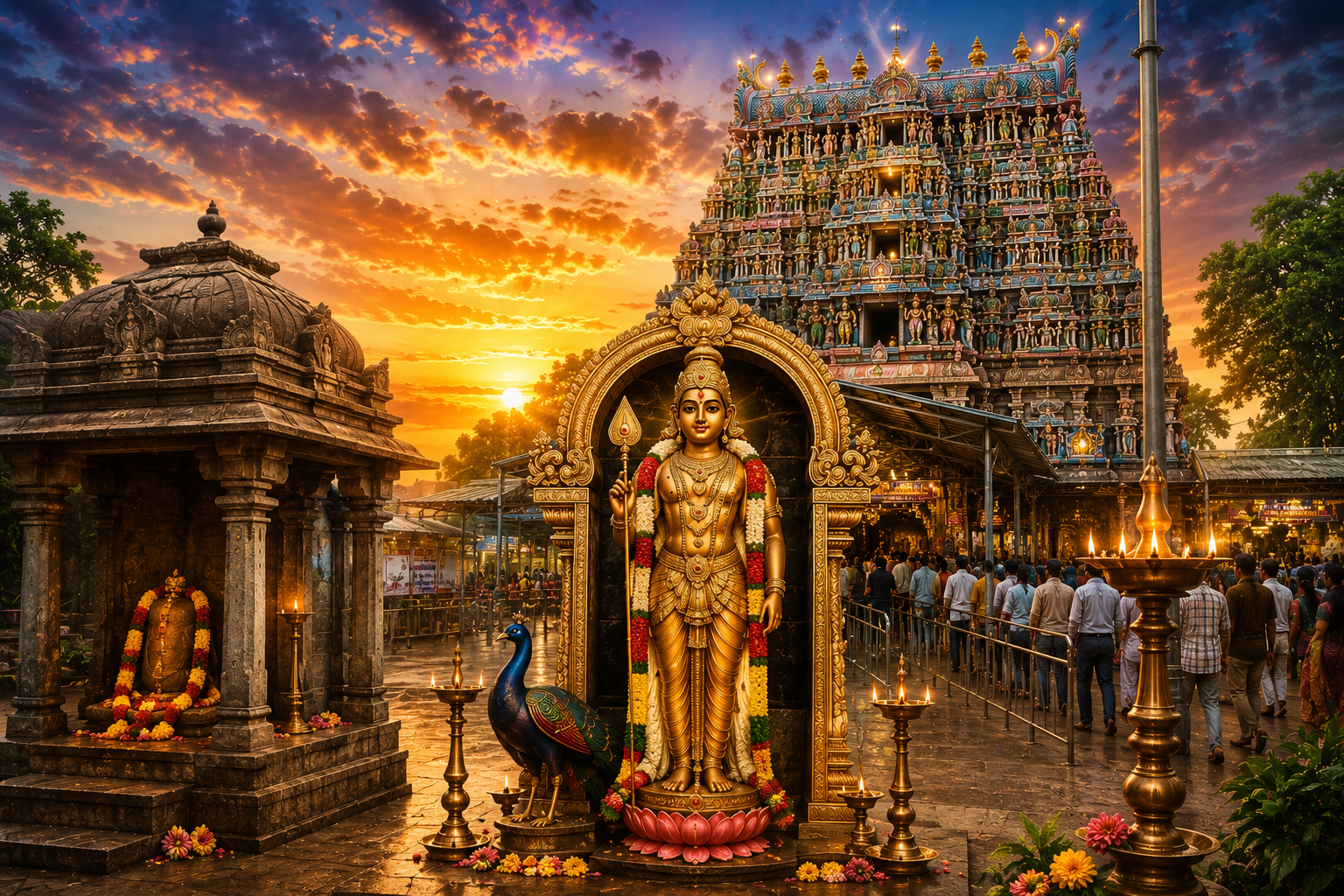
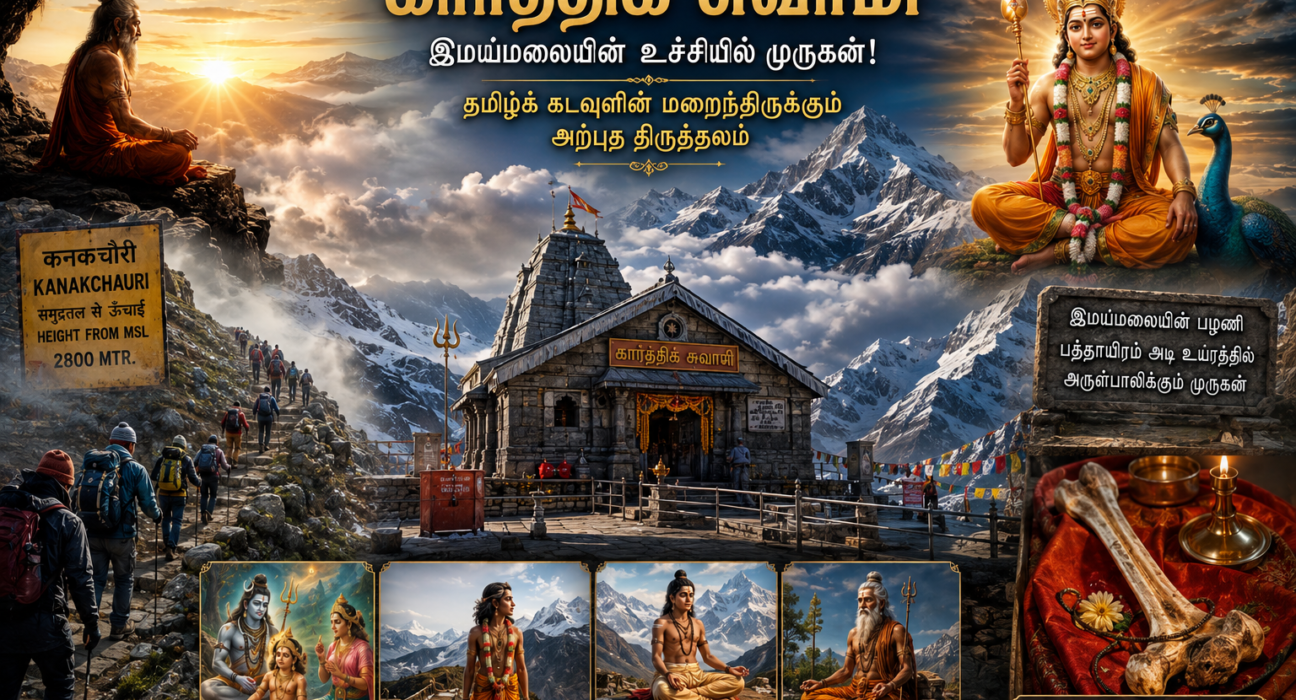
High above the clouds, at an altitude of nearly 10,000 feet, stands an ancient shrine dedicated to Lord Murugan—not in Tamil Nadu, but in the heart of the Himalayas.
Here, He is worshipped as Kartik Swami.
This astonishing fact raises several fascinating questions.
Why would the beloved Tamil deity be worshipped thousands of kilometers away from Tamil Nadu?
Is this simply another Himalayan temple?
Or does it preserve a forgotten chapter of India’s spiritual history?
The answers take us on an unforgettable journey through sacred mountains, ancient legends, profound philosophy, and a spiritual connection that unites Tamil Nadu and the Himalayas in ways few people realize.
Along the way, we will discover:
- The breathtaking Himalayan temple known as Kartik Swami.
- The remarkable legend that earned it the title “The Palani of the Himalayas.”
- Why local tradition believes Lord Murugan’s sacred bones are worshipped here.
- The mythological story of Krauncha Mountain and the destruction of Tarakasura.
- The hidden links connecting Agastya Maharishi, Bogar Siddhar, Kailash, and Tamil spirituality.
- The extraordinary annual ritual that continues to unite the Six Abodes of Murugan in Tamil Nadu with this remote Himalayan shrine.
By the end of this journey, you may never look at Murugan—or the Himalayas—in the same way again.
Why Is Lord Murugan Worshipped in the Himalayas?
Standing before the breathtaking Kartik Swami Temple, one question naturally arises in every devotee’s mind.
Why is Lord Murugan—revered as the beloved Tamil God—enshrined on a remote Himalayan peak nearly 2,700 kilometers away from Tamil Nadu?
Why would one of the most cherished deities of the South choose to reside among the snow-covered mountains of North India?
The answer lies in one of the most profound stories in Hindu tradition.
It is a story that begins not with a great battle, but with a single fruit.
A fruit that would forever change the life of Lord Murugan.
The Fruit of Wisdom and a Prince’s Broken Heart
Most devotees are familiar with the famous legend of the Gnana Pazham, or the Fruit of Wisdom.
According to Hindu tradition, Lord Shiva received a divine fruit possessing extraordinary spiritual significance. When both Lord Ganesha and Lord Murugan desired it, Shiva declared that whoever circled the entire universe first would earn the prize.
Confident in his strength and speed, Murugan immediately mounted his majestic peacock and began his journey around the cosmos.
Meanwhile, Lord Ganesha quietly walked around his parents—Lord Shiva and Goddess Parvati—declaring that they themselves were the entire universe.
Pleased with his wisdom, Shiva awarded the sacred fruit to Ganesha.
When Murugan returned and discovered what had happened, he was deeply hurt.
For him, it was not simply about losing a contest.
It was the pain of feeling misunderstood.
The sorrow of believing that his sincere effort had gone unrecognized.
The disappointment that even his own parents had failed to understand his heart.
This emotional wound became the turning point in Murugan’s divine journey.
A Divine Anger That Led to Enlightenment
Murugan’s anger was intense.
But it was not the kind of anger that destroys.
It was the kind that transforms.
History is filled with great souls whose lives changed because of a single moment of profound pain.
For Lord Murugan, this was that defining moment.
Instead of allowing disappointment to consume him, he chose an entirely different path—a path of renunciation and self-realization.
The Prince Who Renounced Everything
Standing at the height of his emotional turmoil, Murugan made an extraordinary decision.
He would abandon every symbol of worldly power.
No royal garments.
No magnificent ornaments.
No throne.
No kingdom.
No glory.
No victories.
Nothing.
The divine prince who possessed everything willingly chose to become a wandering ascetic.
This was far more than a physical departure from Kailash.
It marked the beginning of an inward spiritual journey.
Murugan realized that attachment itself was the greatest obstacle to true wisdom.
Wealth, relationships, pride, even one’s own identity could become invisible chains preventing spiritual liberation.
Therefore, he chose to walk the path not of a victorious prince, but of a humble yogi seeking the highest truth.
A Tradition Found Only at Kartik Swami
While the story of Murugan’s renunciation is well known through the traditions of Palani, the Kartik Swami Temple preserves a far more mysterious and lesser-known belief.
According to the sacred traditions of Krauncha Mountain, Murugan’s renunciation did not stop with giving up his kingdom or royal life.
It reached a level almost impossible to imagine.
The Extraordinary Legend of Murugan’s Sacred Bones
Local tradition teaches that Lord Murugan reflected deeply on the nature of attachment.
His flesh had come from his mother, Goddess Parvati.
His bones had come from his father, Lord Shiva.
Even the physical body, he realized, represented another form of worldly attachment.
To attain absolute spiritual freedom, Murugan is believed to have offered even his own body back to his divine parents.
His flesh was returned to Mother Parvati.
His bones were offered to Lord Shiva.
For this reason, devotees believe that the Kartik Swami Temple enshrines and worships the sacred bones of Lord Murugan, making it one of the most unique traditions associated with the deity anywhere in India.
History, Mythology, or Spiritual Philosophy?
Was this an actual historical event?
Is it purely a mythological legend?
Or is it a symbolic spiritual teaching expressed through sacred storytelling?
Different devotees may hold different beliefs.
Yet the deeper message remains remarkably powerful.
The story teaches that true wisdom can only be attained when one completely surrenders ego, anger, attachment, and identification with the physical body.
Murugan’s offering of his own flesh and bones is therefore understood not merely as a miraculous event, but as the ultimate symbol of total surrender.
It represents the highest form of renunciation—a state where nothing remains except pure divine consciousness.
A Greater Mystery Still Awaits
Most people assume the story ends with Murugan’s renunciation.
In reality, it is only the beginning.
For the mountain itself carries another astonishing legend.
Who was Krauncha?
Why is this Himalayan peak associated with a powerful curse from Agastya Maharishi?
How did the demon Tarakasura hide within the mountain?
And why did Lord Murugan split an entire mountain with a single throw of His divine Vel?
These ancient legends reveal why Kartik Swami Temple is not merely a Himalayan shrine—it is one of the most spiritually significant Murugan temples in all of India.
The Legend of Krauncha Mountain and the Destruction of Tarakasura
The story of Kartik Swami Temple does not end with Lord Murugan’s renunciation.
In many ways, it begins there.
For the mountain on which the temple stands is itself wrapped in one of the oldest legends found in Hindu mythology—a tale of curses, demons, divine battles, and the ultimate triumph of wisdom over ignorance.
Who Was Krauncha?
According to ancient Puranic traditions, thousands of years ago there lived a powerful asura named Krauncha.
He was no ordinary demon.
Krauncha possessed extraordinary mystical powers and frequently disturbed sages engaged in meditation and sacred rituals. His arrogance and misuse of power caused immense suffering to those who sought spiritual enlightenment.
The Curse of Agastya Maharishi
One day, the great sage Agastya Maharishi was travelling toward South India on his sacred mission.
During his journey, Krauncha obstructed and harassed the revered sage.
Agastya, known for his immense spiritual power and unwavering discipline, became deeply angered by the demon’s actions.
He pronounced a powerful curse:
“Remain forever as a mountain.”
The curse took effect immediately.
Krauncha was transformed into an enormous mountain.
That mountain came to be known as Krauncha Parvat, the very peak where Kartik Swami Temple stands today.
The Demon Hidden Inside the Mountain
Yet the curse did not end the mountain’s dark history.
According to the legend, another fearsome demon named Tarakasura sought refuge within the hollow interior of Krauncha Mountain.
From this hidden fortress, Tarakasura terrorized the world.
He attacked sages.
He destroyed sacred yajnas.
He disrupted meditation.
He spread fear among devotees and ascetics alike.
Unable to withstand his growing tyranny, the devas once again turned to the one warrior capable of restoring cosmic order.
Lord Murugan.
The Great Battle Begins
Murugan accepted the divine mission.
Leading the celestial armies, He advanced toward Krauncha Mountain.
A fierce battle erupted between the devas and the armies of Tarakasura.
The clash shook the heavens.
But despite the intense fighting, Tarakasura remained hidden deep within the mountain itself, protected by its enormous rocky walls.
The Divine Vel That Split a Mountain
Finally, Lord Murugan stood before the mighty mountain.
He understood that the mountain itself had become the demon’s fortress.
For a brief moment, everything became silent.
Then Murugan raised His Vel, the sacred spear given to Him by Goddess Parvati.
This was no ordinary weapon.
In Hindu philosophy, the Vel symbolizes divine wisdom, spiritual knowledge, and the power that destroys ignorance.
With a single, decisive throw, Murugan released the Vel.
The heavens thundered.
The earth trembled.
Krauncha Mountain split into two.
Hidden within its depths, Tarakasura was struck down, bringing an end to his reign of terror and restoring peace to the worlds.
The Spiritual Meaning Behind the Legend
Beyond its dramatic imagery, this ancient story carries a profound philosophical message.
Krauncha Mountain represents the obstacles that rise within the human mind.
Tarakasura symbolizes ignorance, ego, fear, and the negative tendencies that hide deep within us.
Murugan’s Vel is not merely a weapon of war.
It is the light of wisdom that pierces illusion.
Just as the Vel split the mountain and destroyed the demon concealed within it, spiritual knowledge has the power to break through the walls of ego and reveal the truth hidden inside every human being.
For devotees, this legend is far more than mythology.
It is a timeless lesson on inner transformation.
An Even Greater Mystery Connects the Himalayas and Tamil Nadu
The legends of Agastya Maharishi, Krauncha Mountain, and Lord Murugan reveal something even more fascinating.
Why do these Himalayan stories feature one of the greatest sages so closely associated with Tamil Nadu?
Why do so many traditions of the Tamil Siddhas lead back to the Himalayas?
Could there be a forgotten spiritual bridge connecting Kailash, Krauncha Mountain, Palani, and the sacred traditions of South India?
The answers uncover one of the most extraordinary connections in India’s spiritual history—a bond that has united the Himalayas and Tamil Nadu for thousands of years.
The Hidden Spiritual Connection Between the Himalayas and Tamil Nadu
At first glance, the Himalayas and Tamil Nadu appear to belong to two entirely different worlds.
One lies in the snow-covered north, crowned by towering peaks and icy glaciers.
The other flourishes in the tropical south, home to magnificent temple towers, ancient Tamil culture, and centuries-old spiritual traditions.
More than 2,700 kilometers separate these two sacred lands.
Yet in the spiritual landscape of India, this distance simply does not exist.
Ancient scriptures, temple traditions, and the teachings of saints reveal that the Himalayas and Tamil Nadu have always been connected through a single, uninterrupted spiritual current.
Agastya Maharishi: The Sage Who United North and South India
The first great bridge between these two regions was built by one of India’s most revered sages—Agastya Maharishi.
According to Hindu tradition, when Lord Shiva and Goddess Parvati were married at Mount Kailash, gods, sages, and celestial beings gathered in the Himalayas to witness the divine wedding.
The immense gathering caused the Earth to become imbalanced.
To restore harmony, Lord Shiva requested Agastya Maharishi to journey south and establish spiritual balance across the Indian subcontinent.
Agastya obeyed without hesitation.
His journey from Kailash to the southern mountains of Tamil Nadu was far more than the physical travel of a sage.
It symbolized the transmission of sacred wisdom from North India to the South.
In many ways, Agastya became the spiritual architect who united two great traditions into one continuous stream of Sanatana Dharma.
Agastya’s Presence Around Krauncha Mountain
Even today, local traditions surrounding Kartik Swami Temple preserve the memory of Agastya Maharishi.
Many believe that his ashram once existed in the region surrounding Krauncha Mountain.
Pilgrims visiting the temple often hear stories describing the sage’s meditation and spiritual practices in these Himalayan forests.
Whether viewed as history, sacred tradition, or local folklore, these beliefs continue to strengthen the spiritual connection between the Himalayas and Tamil Nadu.
The Siddhas Who Walked Between Two Worlds
The connection does not end with Agastya.
It continues through the mysterious tradition of the Tamil Siddhas.
Among the eighteen celebrated Siddhas of Tamil spiritual heritage, names such as Bogar, Korakkar, and Pulippani Siddhar appear repeatedly in traditions linking South India with the Himalayas.
According to Siddha literature and oral traditions, these enlightened masters traveled extensively through the Himalayan caves, seeking rare herbs, higher yogic knowledge, and profound spiritual realizations.
Bogar Siddhar and the Hidden Himalayan Connection
Perhaps the most fascinating figure among them is Bogar Siddhar.
Traditional accounts state that Bogar journeyed deep into the Himalayas, where he mastered advanced knowledge of alchemy, medicinal herbs, and yogic sciences under great spiritual masters.
After returning to Tamil Nadu, he is believed to have created the world-famous Navapashanam idol of Lord Murugan at Palani, one of the Six Sacred Abodes of Murugan.
This remarkable tradition suggests that even Palani, the most celebrated Murugan temple in Tamil Nadu, shares a hidden spiritual connection with the Himalayan world through the Siddhas.
Kailash and Chidambaram: Two Ends of the Same Spiritual Axis
Indian spiritual philosophy also presents another profound relationship.
In the north stands Mount Kailash, revered as the eternal abode of Lord Shiva.
In the south stands Chidambaram, where Shiva performs His cosmic dance as Nataraja.
One represents perfect stillness.
The other represents divine movement.
One embodies silence.
The other celebrates creation through rhythm and dance.
Yet both express the same infinite cosmic consciousness.
This is why many spiritual teachers explain that the relationship between Kailash and Tamil Nadu is not merely geographical or mythological.
It is deeply philosophical.
Together, they represent two complementary expressions of the same Divine Reality.
Murugan: A Deity for All of India
Many devotees lovingly refer to Murugan as the God of the Tamils.
That description is certainly true.
But it tells only part of the story.
Lord Murugan is not confined by language, region, or culture.
Across North India, He is worshipped as Kartikeya, Skanda, and Kumara.
His glory is celebrated in the Skanda Purana, one of the largest and most important Puranas in Hindu literature.
The great Sanskrit poet Kalidasa immortalized Him in the epic Kumarasambhavam, while Adi Shankaracharya recognized Kaumaram, the worship centered on Lord Murugan, as one of the principal traditions within Sanatana Dharma.
These traditions demonstrate that Murugan is not only the beloved deity of Tamil Nadu but a revered divine presence throughout India.
A Living Connection That Continues Today
The spiritual bond between Tamil Nadu and the Himalayas is not merely a memory preserved in ancient scriptures.
It remains alive even today.
Every year, a remarkable tradition takes place.
Sacred garments that have adorned Lord Murugan in the Six Abodes (Arupadai Veedu) of Tamil Nadu are ceremonially carried thousands of kilometers to the Kartik Swami Temple in the Himalayas.
Likewise, the garments offered to Kartik Swami are respectfully sent back to the Murugan temples of Tamil Nadu.
This extraordinary exchange is far more than a ritual.
It is a living symbol of an ancient spiritual relationship that continues to unite the Himalayas and Tamil Nadu across geography, language, and time.
One Lord, Two Sacred Mountains
As this remarkable journey draws to a close, one profound realization begins to emerge.
The Murugan who blesses devotees from the hill of Palani and the Kartik Swami who silently watches over the Himalayas are not two different deities.
They are two manifestations of the same eternal truth.
One resides amidst the vibrant devotion of South India.
The other sits in the serene silence of the snow-clad Himalayas.
Together, they remind us that true spirituality transcends geography, language, and regional identity.
It unites all seekers on a single path toward wisdom, surrender, and divine realization
Conclusion: Kartik Swami – The Palani of the Himalayas
Hidden high above the clouds, Kartik Swami Temple stands as one of India’s most extraordinary yet least-known pilgrimage destinations.
It is a place where mythology meets philosophy, where ancient legends inspire timeless wisdom, and where the sacred traditions of the Himalayas and Tamil Nadu converge.
Whether you are drawn by the breathtaking mountain trek, the legend of Krauncha Mountain, the mystery of Murugan’s sacred bones, or the enduring connection between Kailash and the Six Abodes of Murugan, this temple offers a spiritual experience unlike any other.
The next time you hear the word Himalayas, don’t think only of Mount Everest, hidden yogis, or snow-covered peaks.
Remember that among those majestic mountains, a beloved Tamil deity continues to bless devotees in silence.
He is Kartik Swami—the Palani of the Himalayas, an eternal reminder that the spiritual heart of India beats as one from Kailash to Tamil Nadu.