


Pratishtha: The Ancient Science Behind India’s Living Temples and Sacred Energy
Pratishtha: The Forgotten Science of Living Energy Behind India's Sacred Temples
Absolutely. I’ll convert this into the same style as your previous articles—a long-form, cinematic, SEO-optimized documentary blog while preserving the original theme and expanding it into an engaging article.
Proposed Blog Structure
- Introduction – Pratishtha: The Forgotten Science of Living Energy
- What Is Pratishtha? Beyond Rituals and Religious Ceremonies
- The Limits of Modern Science and the Mystery of Consciousness
- The Sadhguru Meditation Experiment That Challenged Scientific Instruments
- Understanding Prana: The Invisible Force That Makes Life Possible
- How Ancient Yogis Installed Life Energy into Temples
- Why Ancient Indian Temples Feel Different
- How Pratishtha Benefits Children, Adults, and Human Well-being
- How to Experience the Power of a Consecrated Space
- Conclusion – Rediscovering India’s Greatest Spiritual Technology
Pratishtha: The Forgotten Science of Living Energy Behind India’s Sacred Temples
Walk into an ancient Indian temple, and you may experience something difficult to explain.
Some people feel an overwhelming sense of peace.
Others suddenly become emotional without knowing why.
Many experience goosebumps, while others describe a deep silence that words cannot capture.
What causes these powerful experiences?
Is it merely faith?
Is it the architecture?
Or is there something far more profound hidden within these sacred spaces?
For thousands of years, India’s rishis, siddhas, and enlightened yogis believed that temples were far more than places of worship.
They were carefully designed centers of living energy.
At the heart of this ancient spiritual science lies a concept known as Pratishtha—one of the most sophisticated yet least understood technologies developed by Indian civilization.
Today, many people think of Pratishtha as simply a religious ritual performed before installing a deity in a temple.
In reality, the ancient masters viewed it very differently.
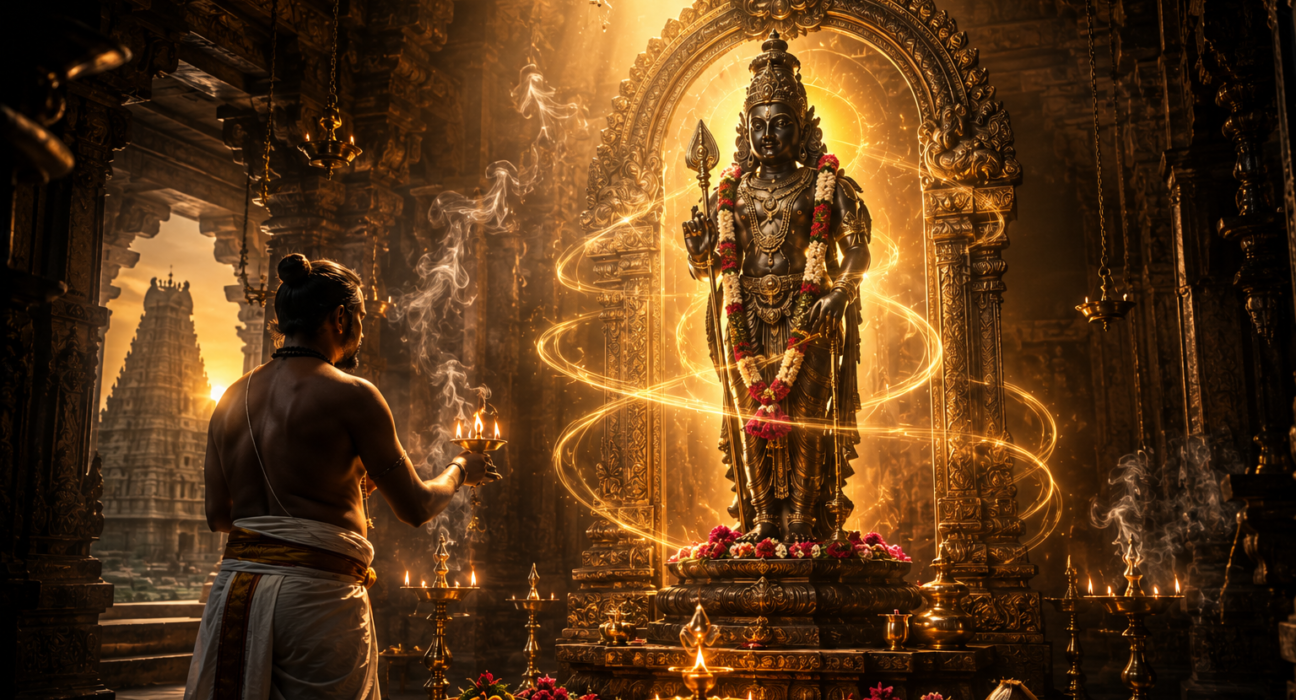
According to yogic science, Pratishtha is the process of establishing life energy within a particular form or sacred space so that it continuously radiates spiritual power for generations.
It is not merely the placement of a stone idol.
It is the transformation of matter into a living spiritual presence.
How did ancient yogis accomplish something so extraordinary?
Can consciousness really be established within stone?
And why do some temples continue to feel vibrantly alive even after a thousand years?
To understand these questions, we must first explore the limits of modern science itself—and discover why some aspects of existence cannot be measured by even the most advanced instruments.
What Is Pratishtha? Beyond Rituals and Religious Ceremonies
When people hear the word Pratishtha, they often imagine a temple consecration ceremony—a priest chanting Vedic mantras while a newly sculpted idol is installed inside a sanctum.
While these rituals are certainly part of the process, they represent only the outermost layer of a much deeper spiritual science.
According to the ancient yogic tradition, Pratishtha is not merely the installation of a deity—it is the installation of life itself.
It is a highly refined process through which a realized yogi channels and stabilizes Prana, or life energy, into a particular form or sacred space, allowing it to continuously radiate spiritual energy for generations.
A Living Presence, Not Just a Stone Idol
To an ordinary observer, a temple idol appears to be nothing more than stone, metal, or clay.
Modern science can analyze its weight, chemical composition, density, and physical structure.
But according to India’s spiritual masters, these measurements reveal only the outer shell.
What truly makes a temple sacred is not the material from which the idol is carved—it is the living energy established within it.
That is precisely what Pratishtha seeks to accomplish.
When properly consecrated, the idol ceases to be merely an artistic sculpture.
It becomes a powerful center of subtle energy capable of influencing the minds, emotions, and inner well-being of those who come into its presence.
The Difference Between Matter and Life
Modern civilization has achieved remarkable scientific breakthroughs.
Humanity has split the atom, decoded the human genome, developed artificial intelligence, and explored distant planets.
These accomplishments demonstrate the incredible power of scientific inquiry.
Yet, according to yogic philosophy, modern science still operates primarily within the realm of measurable matter.
It investigates only what can be observed, quantified, and reproduced through instruments.
Anything beyond that boundary remains difficult to study.
This raises a profound question:
Can everything that exists be measured?
Ancient sages believed the answer is no.
There are dimensions of existence that can be experienced directly but cannot easily be captured by physical instruments.
It is within this unseen dimension that Pratishtha operates.
Ramana Maharshi’s Timeless Question: “Who Am I?”
One of the greatest spiritual masters of modern India, Ramana Maharshi, left humanity with a deceptively simple question:
“Who am I?”
At first glance, the answer appears obvious.
Most people naturally identify themselves with their physical body.
But is the body truly who we are?
According to both biology and spiritual inquiry, the human body is constantly changing.
Every day we consume food, drink water, and breathe air.
Our bodies are continuously built from elements borrowed from the Earth.
Science itself tells us that over time, most of the cells in our body are replaced.
The body we possess today is not exactly the same body we had years ago.
If every cell changes over time, can this constantly changing body alone define our identity?
If the body is not the complete answer, then what exactly is the “I” that experiences life?
This is where spiritual inquiry begins—and where conventional scientific measurement reaches its limits.
Where Modern Science Becomes Silent
Science excels at studying the physical universe.
It can measure heartbeat, brain waves, blood chemistry, electrical activity, and countless biological processes with extraordinary precision.
But when asked a deeper question—
What is consciousness?
What is the fundamental nature of awareness?
There is still no universally accepted scientific answer.
The inability to measure something does not necessarily mean it does not exist.
Love cannot be weighed.
Peace cannot be measured with a ruler.
Joy has no physical dimensions.
Yet every human being knows these experiences are real.
Similarly, yogic traditions suggest that life energy belongs to a subtler dimension that lies beyond ordinary physical measurement.
To illustrate this idea, an extraordinary incident involving a modern spiritual master provides a fascinating perspective—one that challenged even sophisticated scientific instruments.
In the next section, we’ll explore the remarkable meditation experiment involving Sadhguru, where medical equipment reportedly indicated something impossible, raising profound questions about the nature of consciousness and the limits of modern science.
The Sadhguru Meditation Experiment That Challenged Modern Science
For centuries, yogis have claimed that through intense spiritual practice, it is possible to consciously regulate the body’s internal processes in ways that seem impossible to ordinary human beings.
To many people, these claims sound unbelievable.
After all, modern medicine tells us that essential bodily functions such as heartbeat, breathing, and brain activity are necessary signs of life.
But what happens when a yogi enters such a profound meditative state that these measurable functions become almost undetectable?
An incident involving Sadhguru offers a fascinating perspective on this question.
A Scientific Investigation into Deep Meditation
During a visit to a research facility, scientists invited Sadhguru to participate in an experiment.
Their objective was straightforward.
They wanted to observe what happens inside the human brain during advanced meditation.
Using sophisticated medical equipment, they attached various monitoring devices to his body, including instruments designed to record:
- Brain activity (EEG)
- Heart activity (ECG)
- Other measurable physiological functions
The researchers were especially interested in studying Gamma brain waves, which neuroscience associates with heightened states of awareness, intense focus, and advanced meditation.
When the Instruments Reported the Impossible
As Sadhguru entered an exceptionally deep meditative state, the monitoring equipment continued recording his physiological data.
Approximately twenty minutes later, the researchers attempted to bring him out of meditation by striking his ankle and knee with a metal object.
When he finally opened his eyes, the scientists reportedly made an astonishing statement:
“According to our instruments, you were dead.”
Naturally, Sadhguru was very much alive.
What the instruments had detected was not death but an extraordinary reduction in measurable bodily activity.
His breathing, heartbeat, and brain activity had slowed to levels that the instruments struggled to interpret using conventional biological parameters.
The Limits of Scientific Instruments
This incident raises an important philosophical question.
Scientific instruments are designed to measure physical processes.
They detect electrical signals, blood circulation, respiration, temperature, and other measurable biological functions.
But can they measure consciousness itself?
Can they detect awareness independent of ordinary bodily activity?
Ancient yogic traditions argue that they cannot.
According to yogic science, consciousness and life energy belong to dimensions that extend beyond the physical body.
While physical instruments can observe the body’s activity, they cannot directly measure the deeper reality that animates it.
This does not diminish the value of modern science.
Instead, it highlights that different methods may be required to investigate different dimensions of existence.
Science excels at exploring the external world.
Yoga focuses on the direct exploration of inner experience.
What Is the Difference Between the Body and Life?
To understand Pratishtha, we must first understand a simple but profound observation.
Imagine a living tree.
It grows, breathes, and responds to its environment.
Now imagine that tree has been cut down.
Its trunk still contains the same atoms.
The same molecules remain.
Its physical structure appears almost unchanged.
Yet something essential has disappeared.
The tree is no longer alive.
Similarly, when a person dies, the body does not instantly lose its weight, shape, or chemical composition.
Every organ remains in place.
Every cell is still present.
Yet the person is no longer there.
What changed?
Ancient Indian wisdom answers this question with a single concept:
Prana—the life force.
Prana: The Invisible Force Behind Life
According to yogic science, Prana is the subtle energy that sustains every living being.
It is not produced by food alone.
It is not created by oxygen.
Nor is it simply another name for electricity or biochemical activity.
Rather, Prana is understood as the fundamental life force that animates the body and enables consciousness to express itself through it.
When Prana is present, the body lives.
When Prana departs, only the physical structure remains.
This distinction lies at the heart of India’s ancient spiritual sciences and provides the foundation for understanding how Pratishtha is believed to work.
If life energy can be consciously directed, stabilized, and transmitted by realized yogis, then an extraordinary possibility emerges.
Could that same life energy be established permanently within a sacred form?
That question leads us directly into one of the most remarkable spiritual technologies ever developed by ancient India—the science of Pratishtha.
How Ancient Yogis Installed Life Energy into Temples
Once we understand the concept of Prana, the science of Pratishtha begins to make sense.
According to India’s yogic tradition, Pratishtha is the process of consciously establishing this subtle life energy within a specific form or sacred space.
It is not simply about placing an idol inside a temple.
It is about transforming that idol into a living center of spiritual energy.
This is why ancient temples were never considered mere buildings.
They were regarded as living spiritual instruments designed to elevate human consciousness.
Why Stone Was Chosen Instead of Human Beings
One might naturally ask:
If life energy can be established within a person, why did ancient yogis choose stone idols instead?
The answer lies in the nature of human beings.
Among all forms of life on Earth, the human body is undoubtedly the most sophisticated.
Its nervous system is incredibly refined and capable of experiencing the highest levels of consciousness.
In that sense, a human being is the ideal vessel for spiritual transformation.
However, there is one challenge.
Human beings are constantly changing.
Our thoughts fluctuate from moment to moment.
Our emotions shift throughout the day.
Our beliefs, desires, fears, and mental states continuously evolve.
Because of this instability, maintaining a consistent energetic state within a person is far more difficult.
A stone, on the other hand, does not change.
It remains exactly as it is.
Its stability makes it an ideal medium for preserving subtle energy over long periods.
For this reason, enlightened yogis chose materials such as stone, metal, and clay to create sacred forms capable of holding consecrated energy for centuries.
Pratishtha Is a Precise Spiritual Technology
Contrary to popular belief, Pratishtha is not performed randomly.
Ancient texts describe it as a highly systematic process involving numerous carefully calculated steps.
Before consecration begins, several factors are considered:
- The selection of the appropriate material.
- The proportions and geometry of the sacred form.
- The spiritual attainment of the person performing the consecration.
- The alignment of celestial positions.
- The appropriate time and astrological conditions.
- The methods used to stabilize the life energy within the form.
According to yogic tradition, none of these elements are arbitrary.
They are part of a refined body of knowledge that evolved through centuries of observation, experimentation, and spiritual realization.
Rather than being based on blind belief, Pratishtha is presented as a carefully developed spiritual technology passed down through generations of realized masters.
Ancient India Was Designed as a Network of Living Energy
One of the most fascinating aspects of ancient Indian civilization is that temples were never intended to exist in isolation.
Villages, towns, and cities were often planned around consecrated spaces.
Small shrines stood along village roads.
Sacred idols welcomed travelers at town entrances.
Homes contained dedicated places for daily worship.
This was not simply a cultural habit.
According to yogic understanding, these consecrated spaces formed an interconnected network of subtle energy.
People living within such environments continuously absorbed these positive influences, often without consciously realizing it.
The surrounding atmosphere itself became an active participant in human well-being.
Why Some Ancient Temple Towns Feel Different
Even today, many pilgrims describe a remarkable feeling when entering certain ancient temple towns.
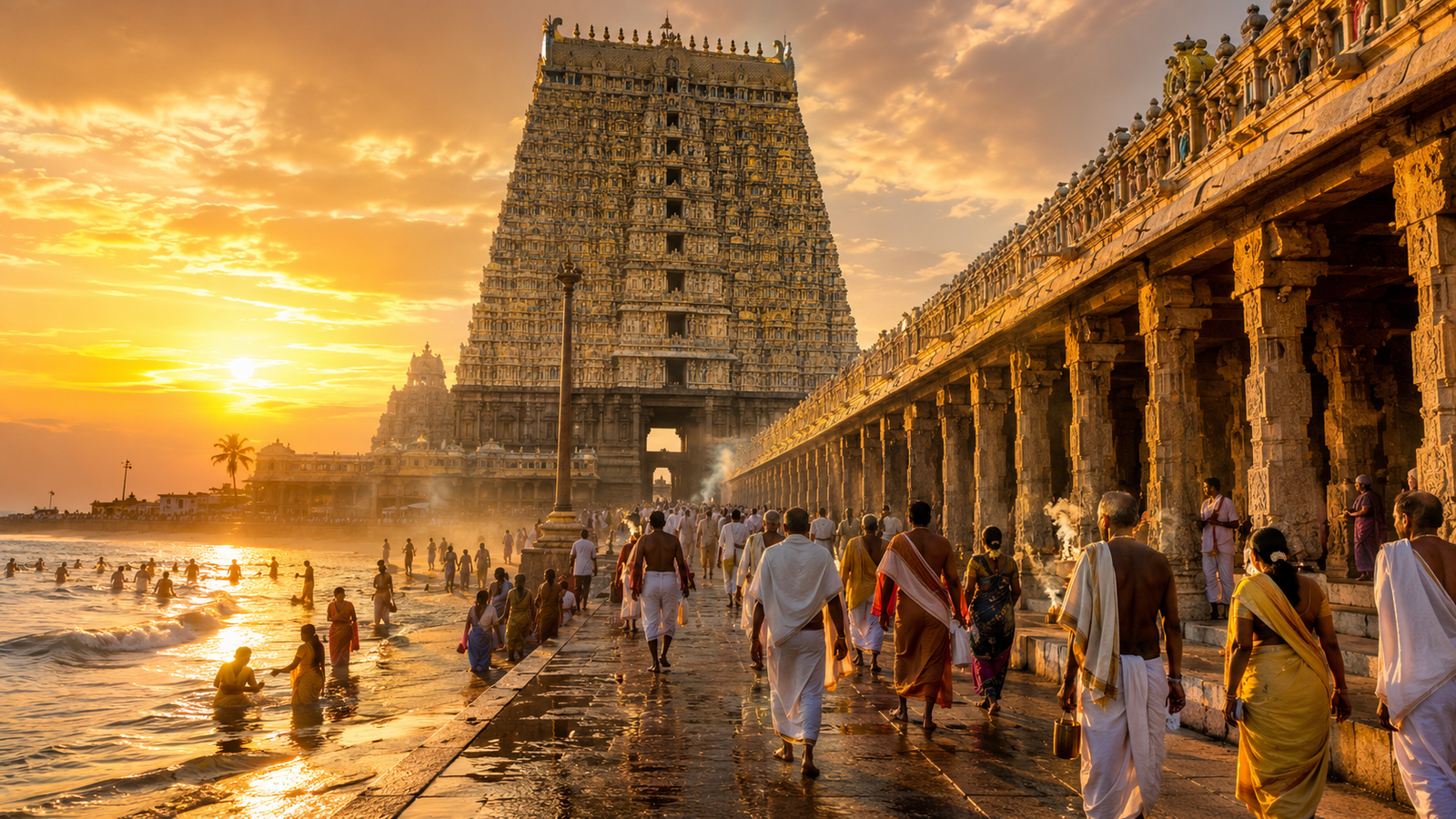
Places like Chidambaram, Thiruvannamalai, and Vaitheeswaran Koil often evoke an immediate sense of calm, reverence, or inner stillness.
For some visitors, tears arise unexpectedly.
Others experience goosebumps or a deep sense of peace without any obvious reason.
From the yogic perspective, these responses are not merely emotional reactions.
They occur because consecrated spaces are believed to remain energetically alive long after their creation.
Just as one living being naturally responds to another, the human energy system is said to recognize these vibrant spiritual environments instinctively.
No intellectual explanation is necessary.
The experience speaks directly to the individual.
Pratishtha: More Than Religion
Viewed in this light, Pratishtha is not limited to any particular religion or ritual.
It represents an attempt by ancient yogis to create spaces that support inner balance, clarity, and spiritual growth.
Whether one approaches a temple with devotion, curiosity, or even skepticism, the purpose of a consecrated space remains the same—to offer an environment where the mind naturally becomes quieter and the individual becomes more receptive to deeper dimensions of life.
But does this ancient science have practical relevance in today’s fast-paced world?
Can spending time in a consecrated temple actually influence our mental well-being, children, and everyday life?
In the next section, we will explore why the ancient masters believed Pratishtha was not merely for monks and yogis—but for every human being seeking a healthier, more balanced, and more joyful life.
How Pratishtha Can Transform Our Daily Lives
At this point, an important question naturally arises.
Even if Pratishtha is a profound spiritual science, what relevance does it have in our everyday lives?
Can simply spending time in a consecrated temple make any real difference?
According to India’s ancient yogic tradition, the answer is yes.
Pratishtha was never intended only for monks, saints, or advanced spiritual seekers.
It was designed as a gift for ordinary people—helping them live healthier, calmer, and more balanced lives while navigating the challenges of the world.
Why Consecrated Spaces Are Especially Important for Children
Children experience the world very differently from adults.
Their minds are still developing.
Their nervous systems are highly receptive.
Ancient yogis understood this long before modern neuroscience began exploring the remarkable adaptability of the developing brain.
According to yogic wisdom, children below the age of fourteen possess a naturally open and impressionable energy system.
When they regularly spend time in consecrated spaces, those subtle influences are believed to create a strong psychological and emotional foundation.
As they grow older, this inner stability helps them navigate fear, confusion, anxiety, and the emotional turbulence often associated with adolescence more gracefully.
Rather than reacting impulsively, they develop a greater sense of balance and inner resilience.
This is one reason why temple visits were traditionally woven into everyday family life in India—not merely as acts of worship, but as part of a child’s holistic development.
A Place Where the Mind Finally Finds Rest
Modern life has become increasingly complex.
Deadlines, responsibilities, financial pressures, constant notifications, and endless streams of information keep the mind continuously active.
Many people feel mentally exhausted without even realizing it.
According to yogic philosophy, much of this suffering arises because we attempt to understand the vastness of life using only logic and analysis.
While reasoning is invaluable, it cannot answer every question the human heart asks.
A consecrated space offers something different.
When a person quietly sits inside such an environment, the restless, calculating mind gradually begins to soften.
Without effort, thoughts slow down.
The need to control every situation diminishes.
In that moment of inner relaxation, genuine rest becomes possible.
It is not simply physical relaxation.
It is a deeper kind of stillness that many people spend their entire lives searching for.
The Connection Between Spiritual Spaces and Well-Being
Researchers have long been interested in understanding how peaceful environments influence human health.
The original script notes that observations made in temple environments have documented changes such as reduced stress, lower blood pressure, increased mental calmness, and improvements in overall well-being.
Within the yogic framework, these benefits are understood not only as psychological responses but also as the influence of the subtle energetic atmosphere created through Pratishtha.
For countless devotees, entering an ancient temple is not simply an act of religious devotion.
It is an experience that touches every aspect of their being.
Some feel an inexplicable sense of joy.
Others experience tears flowing naturally.
Many leave feeling lighter, calmer, and more centered than when they arrived.
Whether one interprets these experiences spiritually, psychologically, or both, they remain a common thread in the lives of millions who regularly visit India’s ancient temples.
When Devotion Becomes a Living Experience
According to yogic tradition, entering a truly consecrated temple should awaken something profound within us.
The energy of the space is believed to resonate with the life force inside every human being.
When this happens, devotion ceases to be merely an intellectual idea.
It becomes a direct experience.
For some, that experience appears as tears of gratitude.
For others, it manifests as overwhelming love, joy, or an indescribable sense of belonging.
These are not regarded as signs of weakness.
Rather, they are seen as moments when the heart becomes more open than the mind, allowing a person to experience life beyond ordinary thought.
The ancient masters considered such experiences not extraordinary miracles, but natural possibilities available to every sincere seeker.
A Simple Practice Anyone Can Begin Today
The beauty of Pratishtha is that one does not need years of meditation or advanced spiritual knowledge to begin benefiting from it.
The journey can start with a few simple practices:
- Visit an ancient consecrated temple whenever possible, especially historic temples known for their powerful spiritual heritage.
- Upon entering, spend a few minutes in complete silence. Put away your phone, avoid unnecessary conversation, and simply become present.
- If visiting with children, allow them to quietly experience the temple atmosphere rather than rushing through the visit.
- Create a clean and peaceful prayer space at home. Even a small sacred corner can become a daily reminder to pause, reflect, and reconnect with yourself.
These simple habits may appear small, but over time they can help cultivate greater mindfulness, emotional balance, and inner peace.
Conclusion: Rediscovering India's Greatest Spiritual Technology
India inherited one of the world’s most sophisticated spiritual traditions.
For thousands of years, enlightened yogis did more than build magnificent temples.
They created living spaces designed to nourish human consciousness.
Pratishtha represents the heart of that wisdom.
It reminds us that a temple is not merely a monument of stone but, according to yogic tradition, a carefully consecrated space intended to support inner transformation.
Whether one approaches this subject through faith, philosophy, or curiosity, Pratishtha invites us to look beyond the visible world and explore the deeper dimensions of life.
Perhaps that is why ancient temple towns such as Chidambaram, Thiruvannamalai, and Kanchipuram continue to draw millions of pilgrims year after year.
People do not visit these places only to admire architecture.
They come seeking something they cannot easily describe—a sense of peace, clarity, connection, and aliveness.
In an age dominated by speed, distraction, and constant stimulation, the ancient science of Pratishtha offers a timeless reminder:
Sometimes the greatest transformation begins not by doing more, but by entering a sacred space, becoming completely still, and allowing life itself to reveal its deeper mysteries.