
Chinnamasta Devi: The Fierce Goddess Who Destroys Ego, Fear, and Ignorance
Chinnamasta Devi: The Fearless Goddess Who Cuts Through Ego, Fear, and Illusion
Why Does the Fiercest Goddess Represent the Deepest Compassion?
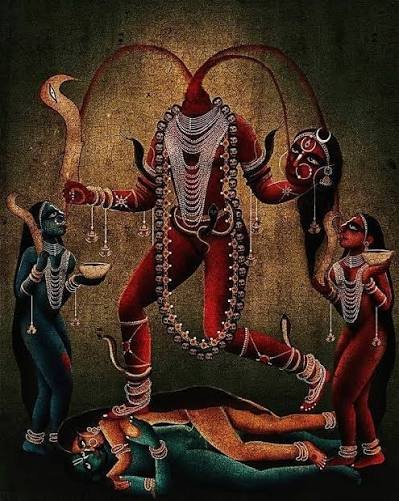
Imagine witnessing a divine form unlike any other.
A goddess without a head.
Three streams of blood flowing from her severed neck.
A terrifying smile.
A cremation ground beneath her feet.
To many, this image appears frightening.
But what if this terrifying form is actually one of the greatest symbols of unconditional love ever conceived?
What if every drop of blood represents sacrifice rather than violence?
What if the severed head symbolizes freedom instead of death?
This is the profound mystery of Goddess Chinnamasta—one of the most enigmatic and spiritually significant deities among the Dasa Mahavidyas.
Far from being a goddess of destruction alone, Chinnamasta is revered in the Tantric tradition as the Divine Mother who destroys ego, dissolves fear, awakens courage, and leads seekers toward ultimate liberation.
Her appearance may shock the mind.
But her message transforms the soul.
A Goddess Unlike Any Other
Descriptions of Chinnamasta often evoke awe.
Her radiance is compared to countless flashes of lightning.
Her brilliance rivals thousands of suns.
Yet within that overwhelming power exists the cooling compassion of countless moons.
She embodies two seemingly opposite realities.
She is fierce enough to dissolve illusion.
Yet gentle enough to embrace every sincere devotee like a loving mother.
This paradox is precisely what makes Chinnamasta unique.
She reminds us that true compassion is not always gentle.
Sometimes love appears as the force that removes everything preventing our spiritual growth.
The Mystery Behind the Severed Head
Among all Hindu goddesses, Chinnamasta’s iconography is perhaps the most startling.
She is depicted holding her own severed head while streams of blood nourish both herself and her attendants.
At first glance, this image can seem disturbing.
Yet Tantric philosophy interprets it very differently.
The severed head represents the cutting away of Ahamkara—the ego.
It is an invitation to transcend the constant voice that says:
“I.”
“Mine.”
“My success.”
“My suffering.”
According to the Tantric tradition, genuine spiritual awakening begins only when the ego loosens its grip.
Chinnamasta therefore symbolizes the ultimate victory over self-centered identity.
She teaches that true freedom begins when we stop living only for ourselves.
Why Tantric Yogis Worship Chinnamasta
For centuries, advanced Tantric practitioners have regarded Chinnamasta as one of the highest embodiments of transformative spiritual power.
The Tantric path is not concerned merely with external rituals.
Its goal is inner transformation.
Practitioners seek to confront the deepest realities of existence:
- Birth
- Death
- Fear
- Desire
- Impermanence
- Consciousness
Rather than avoiding these truths, they meditate upon them directly.
For this reason, Chinnamasta occupies a central place within certain Tantric traditions.
Her fierce form becomes a reminder that fear itself must eventually be transcended.
The journey is demanding.
But it ultimately leads toward inner freedom.
The Goddess Who Destroys Fear at Its Root
Most people spend their lives trying to manage fear.
Chinnamasta teaches something different.
She removes fear at its source.
Fear of failure.
Fear of rejection.
Fear of uncertainty.
Even fear of death.
Her message is simple:
Anything born must eventually change.
Anything changing cannot define who you truly are.
When this truth is deeply understood, fear gradually loses its power.
This is why many spiritual traditions describe courage not as the absence of fear, but as freedom from its control.
The Cremation Ground Is a Symbol of Awakening
Chinnamasta is frequently associated with cremation grounds.
This symbolism is often misunderstood.
In Tantra, the cremation ground does not merely represent physical death.
It symbolizes the end of illusion.
Everything humans cling to—
wealth,
status,
beauty,
possessions,
identity—
eventually disappears.
The cremation ground reminds seekers that only consciousness remains eternal.
By meditating on impermanence, practitioners learn to value what truly matters.
The Sacred Meaning Behind Every Symbol
Every aspect of Chinnamasta’s iconography carries profound spiritual meaning.
The Severed Head
The destruction of ego and false identity.
The Three Streams of Blood
Life energy flowing continuously through creation, preservation, and transformation.
It also symbolizes the generous sharing of spiritual energy rather than selfish possession.
Drinking Her Own Blood
Inner self-sufficiency.
The realization that true fulfillment arises from within rather than external approval.
Her Two Attendants
The balance of complementary energies within every human being.
Just as day and night coexist, strength and compassion must remain in harmony.
The Lotus Beneath Her Feet
Purity emerging from impurity.
Just as a lotus blossoms from muddy water, spiritual awakening can arise from life’s greatest struggles.
Chinnamasta and the Transformation of Modern Life
Although her symbolism originated centuries ago, Chinnamasta’s teachings remain remarkably relevant today.
Modern humanity faces different forms of suffering.
Stress.
Anxiety.
Comparison.
Addiction.
Consumerism.
Emotional exhaustion.
The ego constantly demands more.
More recognition.
More success.
More validation.
Chinnamasta challenges this endless cycle.
She teaches that genuine strength comes not from possessing more but from becoming inwardly free.
The Mantra of Chinnamasta
One of the simplest devotional mantras associated with the Goddess is:
Om Chinnamastayai Namah
For devotees, this mantra is not merely a sequence of words.
It is a prayer of surrender.
“Om” invokes the universal Divine.
“Chinnamastayai” honors the Goddess who severs ignorance and ego.
“Namah” expresses complete humility and surrender.
Many practitioners believe that sincere repetition of this mantra cultivates courage, mental clarity, and spiritual resilience.
As with all sacred practices, its purpose is inner transformation rather than the pursuit of extraordinary powers.
Five Ways Chinnamasta Transforms the Devotee
1. Fear Begins to Dissolve
The devotee gradually becomes less controlled by anxiety about the future, failure, or death.
Instead, courage begins replacing uncertainty.
2. Desire Becomes Purified
Rather than being dominated by endless cravings, desires become aligned with higher values and spiritual growth.
3. Inner Strength Awakens
Hidden confidence emerges.
Challenges that once seemed overwhelming become opportunities for growth.
4. Greater Peace in Daily Life
As attachment decreases, emotional stability increases.
External circumstances lose the power to dictate inner happiness.
5. A Deeper Spiritual Connection
Life is no longer experienced merely as a series of random events.
Instead, every experience becomes part of a greater spiritual journey toward self-realization.
Chinnamasta Is Not a Goddess of Horror
Modern audiences often mistake fierce divine imagery for violence.
Tantric philosophy offers a completely different perspective.
Chinnamasta does not celebrate destruction.
She celebrates liberation.
She cuts away ignorance.
She severs attachment.
She dissolves fear.
She destroys ego.
So that compassion,
wisdom,
freedom,
and divine consciousness can emerge.
Final Reflection
Goddess Chinnamasta is perhaps one of the most misunderstood manifestations of the Divine Mother.
Those who see only her external appearance encounter fear.
Those who understand her symbolism discover freedom.
She reminds us that the greatest battle is not against the world.
It is against ignorance within ourselves.
The moment ego falls,
fear loses its grip.
Desire becomes wisdom.
Death becomes transformation.
And life itself becomes an expression of divine consciousness.
For those who approach her with humility, devotion, and sincere spiritual aspiration, Chinnamasta is not merely a fierce goddess.
She is the fearless Mother who teaches us how to transcend fear itself—and awaken to the limitless power already hidden within.