
Why Is Lord Murugan Called the Tamil God? Ancient Truths
Why Is Lord Murugan Revered as the Tamil God?
The Profound Connection Between Murugan, the Tamil Language, and Ancient Tamil Civilization
Among the countless deities worshipped in Hinduism, one question has fascinated scholars, devotees, and lovers of Tamil culture for centuries:
Why is Lord Murugan uniquely celebrated as the “Tamil God” (தமிழ் கடவுள்)?
This title is not merely a devotional expression. It is rooted in Tamil literature, grammar, philosophy, symbolism, Sangam history, and spiritual tradition. The relationship between Murugan and Tamil civilization is so intimate that one cannot fully understand Tamil culture without understanding Murugan.
Let us explore this extraordinary connection.
Murugan and the Structure of the Tamil Language
One of the most beautiful symbolic explanations comes from the Tamil language itself.
The word “தமிழ்” (Tamil) contains all three categories of Tamil consonants:
- வல்லினம் (Hard consonants)
- மெல்லினம் (Soft consonants)
- இடையினம் (Medium consonants)
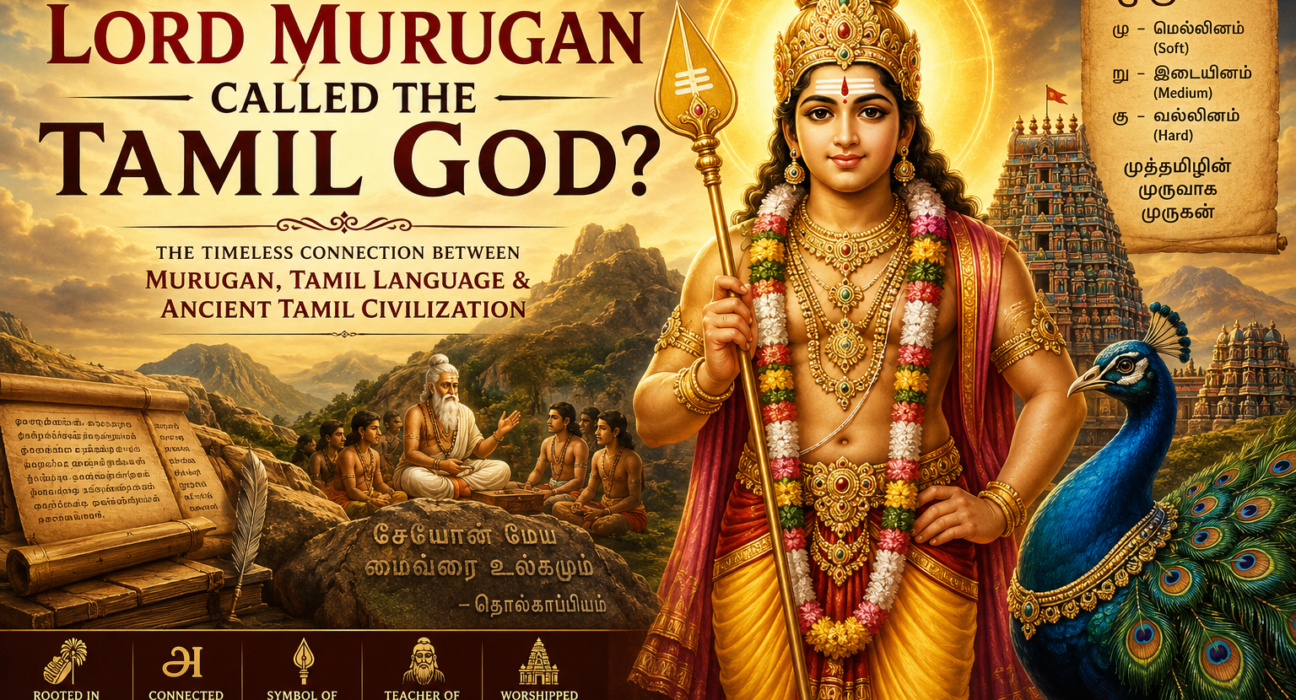
Remarkably, the name “முருகன்” (Murugan) also embodies these three categories:
- மு – Mellinam (Soft)
- று – Idaiyinam (Medium)
- கு – Vallinam (Hard)
This symbolic parallel is often cited by Tamil scholars to illustrate the inseparable relationship between Murugan and the Tamil language.
The Twelve Vowels and Murugan’s Twelve Divine Arms
Tamil possesses 12 Uyir Ezhuthukkal (vowel letters).
Murugan is traditionally depicted with 12 divine arms.
This symbolic correspondence represents the completeness of divine expression through language.
Just as vowels give life to words, Murugan’s twelve arms symbolize the many ways divine grace reaches humanity.
The Eighteen Consonants and Murugan’s Divine Vision
Tamil contains 18 Mei Ezhuthukkal (consonant letters).
Murugan’s iconography is associated with eighteen forms of divine perception, symbolizing complete spiritual awareness.
Tamil tradition often interprets these numerical correspondences as evidence that Murugan is not merely a deity worshipped by Tamils but a divine embodiment of Tamil itself.
Murugan’s Six Faces and the Six Dimensions of Knowledge
Murugan’s six faces (Shanmukha) have many interpretations.
According to Tamil philosophical tradition, they symbolize:
- Perfect awareness
- Six forms of wisdom
- Complete perception
- The six directions
- Six divine powers
- The fullness of consciousness
Thus Murugan is revered as the embodiment of supreme knowledge.
In modern philosophical language, this corresponds to the concept of Omniscience—the One who knows everything.
Murugan in Ancient Tamil Civilization
Ancient Tamils divided the land into five ecological landscapes known as Thinai.
Among them,
Kurinji represented:
- Mountains
- Forests
- Hill tribes
- Heroism
- Love
Murugan was the presiding deity of Kurinji.
The ancient Tamil grammar masterpiece Tolkappiyam declares:
“Seyon Meiya Mai Varai Ulagam.”
This means that the mountainous regions belonged to Seyon (Murugan).
This is one of the earliest literary evidences establishing Murugan’s central place in Tamil civilization.
Murugan and Sangam Society
The ancient Tamils divided life into two broad categories:
- Akam (Inner life)
- Puram (Outer life)
Murugan played an important role in both.
In Puram
Puram celebrated:
- Valor
- Warfare
- Kingship
- Honor
Murugan, the commander of the celestial army (Deva Senapathi), became the supreme symbol of courage and victory.
In Akam
Akam dealt with:
- Love
- Emotions
- Marriage
- Human relationships
Murugan’s divine love for Valli became the ideal expression of romantic love.
Sangam literature repeatedly celebrates this sacred union.
Murugan Never Disappeared from Tamil Worship
Many deities worshipped extensively during the Sangam age gradually faded from public devotion.
Among them:
- Indra
- Varuna
- Other Vedic deities
Yet Murugan remained continuously worshipped by Tamil people for more than two thousand years.
His worship has never been interrupted.
This uninterrupted devotion is one of the strongest reasons he is called the eternal Tamil God.
Murugan as the Teacher of Tamil
Tamil tradition reveres Sage Agastya as the father of Tamil grammar.
Yet many traditions state that Murugan himself became Agastya’s guru, teaching him the deeper mysteries of Tamil.
Thus Murugan is not merely a protector of Tamil.
He is regarded as its divine teacher.
Murugan and the Tamil Sangam
Tamil tradition narrates another fascinating episode.
Lord Shiva himself appeared in the Madurai Tamil Sangam and debated the poet Nakkirar.
Murugan too is believed to have participated in the Sangam under the name Rudrasanman, listening to scholarly interpretations of Iraiyanar Akapporul and judging their excellence.
These traditions further strengthen Murugan’s intimate association with Tamil scholarship.
Arunagirinathar’s Extraordinary Insight
Most saints teach that one attains God’s grace through devotion, tears, surrender, and love.
Arunagirinathar offers an astonishing insight.
He declares that Murugan is so compassionate that even if one “rebukes” Him in pure Tamil poetry, Murugan grants grace.
His famous line suggests that Murugan delights in Muthamizh—the three forms of Tamil:
- Iyal (Literature)
- Isai (Music)
- Natakam (Drama)
Murugan’s love for Tamil transcends ritual.
Murugan as the Embodiment of Universal Principles
Murugan’s six faces are also interpreted symbolically.
Five faces represent the Pancha Bhootas:
- Earth
- Water
- Fire
- Air
- Space
The sixth face represents:
- Intelligence
- Consciousness
- Divine Awareness
Since everything in existence is formed from the five elements, Murugan is understood to be present everywhere.
This corresponds to the philosophical concept of Omnipresence.
The sixth face, representing supreme intelligence guiding creation, also symbolizes Omnipotence—the limitless divine power that governs the universe.
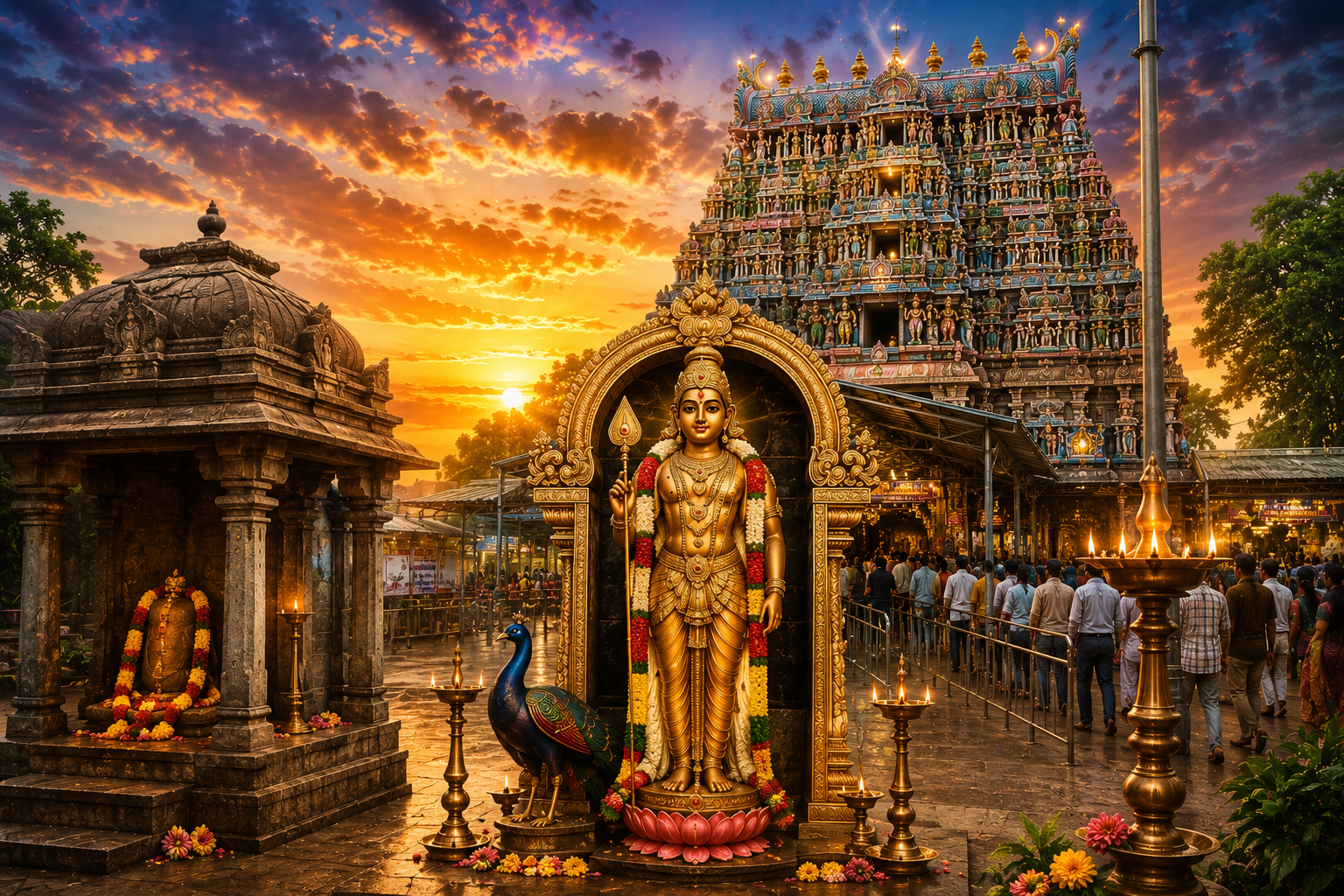
The Symbolism of Murugan’s Divine Form
Every aspect of Murugan’s iconography carries profound philosophical meaning.
The Vel (Divine Spear)
Murugan’s Vel represents Jnana Shakti—the power of wisdom.
Its structure itself conveys spiritual lessons:
- Sharp tip – penetrating insight
- Broad middle – expansive understanding
- Deep base – profound contemplation
True knowledge is not superficial.
It penetrates reality.
The Peacock
Murugan’s peacock symbolizes beauty, majesty, and victory.
The serpent beneath its feet represents primal energy.
Its submission beneath the peacock signifies that all forms of energy remain under divine control.
The Rooster Flag
Murugan’s rooster emblem symbolizes awakening, divine sound (Nada), and the triumph of spiritual consciousness over ignorance.
Kadamba Flower
Murugan is deeply associated with the fragrant Kadamba flower, earning Him the name Kadamban.
The flower blooms during the rainy season and symbolizes fertility, compassion, and divine abundance.
Murugan’s Divine Consorts
Murugan’s two consorts represent two eternal cosmic powers.
Valli
Represents:
- Iccha Shakti
- Divine Will
- Desire directed toward God
Deivanai
Represents:
- Kriya Shakti
- Divine Action
- Cosmic Function
Together with Murugan’s Vel (Jnana Shakti), they complete the three supreme energies of creation:
- Will
- Knowledge
- Action
The Many Forms of Lord Murugan
Agamic scriptures describe numerous sacred manifestations of Murugan.
The Kumara Tantra alone describes sixteen principal forms, including:
- Shaktidhara
- Kandan
- Senapathi
- Subrahmanya
- Gajavahana
- Saravanabhava
- Kartikeya
- Kumara
- Shanmukha
- Tarakari
- Krauncha Bhedana
- Brahma Shasta
- Sasi Vahana
- Bala Swami (Somaskanda)
- Sundara Murti
Other texts, including Tattva Nidhi, describe additional forms such as:
- Agni Jata Subrahmanya
- Saurabheya Subrahmanya
- Gangeya Subrahmanya
- Brahmachari Subrahmanya
- Desika Subrahmanya
Each form represents a distinct spiritual principle, divine function, or cosmic teaching.
The Living Presence of Murugan
Murugan is not simply a deity of mythology.
He lives in:
- Tamil literature
- Tamil grammar
- Sangam poetry
- Temple traditions
- Philosophy
- Music
- Devotional hymns
- Everyday Tamil culture
Few deities possess such a deep and uninterrupted relationship with an entire language and civilization.
For over two thousand years, Murugan has remained the guardian of Tamil identity, the symbol of courage, the master of wisdom, and the compassionate Lord who guides seekers toward spiritual realization.
It is for these profound historical, literary, philosophical, and devotional reasons that generations of devotees continue to lovingly hail Him as “Tamil Kadavul”—the Eternal God of the Tamil People.