
Adi Shankaracharya: The Saint Who Revived Sanatana Dharma
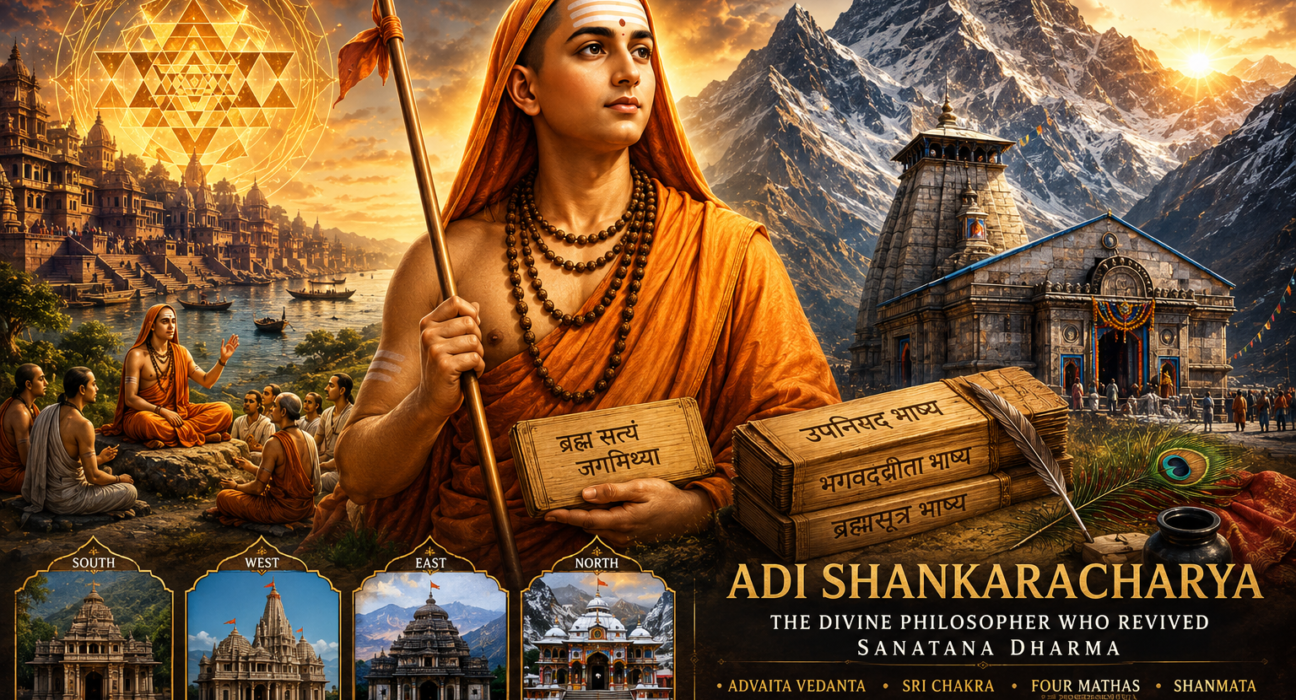
Adi Shankaracharya: The Divine Philosopher Who Revived Sanatana Dharma
The Extraordinary Story of India’s Greatest Spiritual Reformer
There are moments in history when a single individual changes the course of civilization.
India has witnessed many enlightened sages, philosophers, and saints, but only a handful transformed the spiritual destiny of an entire nation. Among them stands one towering figure whose influence continues to shape Hindu philosophy more than twelve centuries later—Jagadguru Adi Shankaracharya.
Although he lived for only thirty-two years, his contribution to Sanatana Dharma remains immeasurable. He revived the wisdom of the Upanishads, established the philosophy of Advaita Vedanta, united diverse traditions of Hindu worship, composed timeless spiritual masterpieces, and travelled thousands of kilometers on foot to restore the spiritual confidence of Bharat.
Who was this extraordinary saint?
How did a young monk accomplish what seemed impossible?
Why do millions still regard him as an incarnation of Lord Shiva?
To answer these questions, we must journey back to a time when India’s spiritual landscape stood at a crossroads.
India Before Adi Shankaracharya
The period preceding Adi Shankaracharya was one of intense philosophical debate.
Across the Indian subcontinent, numerous schools of thought flourished. Among them, Buddhism had become one of the most influential traditions. Various Buddhist philosophical schools, particularly those emphasizing Śūnyavāda (the doctrine of emptiness), had gained widespread acceptance.
According to this philosophical view, everything perceived in the world is ultimately empty of permanent existence. The material universe, individual identity, and all worldly experiences were regarded as transient and without enduring reality.
While these ideas inspired deep contemplation, they also raised profound questions.
If everything is empty…
Who created this universe?
What is the source of consciousness?
What is the force that gives life to every living being?
These were not merely philosophical puzzles—they were questions about existence itself.
The Birth of Advaita Vedanta
Adi Shankaracharya answered these questions with a revolutionary vision that would transform Indian philosophy forever.
He proclaimed the immortal declaration:
“Brahma Satyam, Jagan Mithyā.”
This statement is often misunderstood.
It does not mean that the world does not exist.
Rather, it teaches that the material world is temporary and ever-changing, while Brahman—the Supreme Reality—is eternal, infinite, and unchanging.
Everything in the universe arises from Brahman, exists within Brahman, and ultimately returns to Brahman.
The individual soul (Jīvātman) is not separate from the Supreme Soul (Paramātman).
They are one.
This profound realization became known as Advaita Vedanta, meaning “Non-Dualism”—the philosophy that there is no ultimate separation between the individual and the Absolute.
It was a spiritual revolution that reshaped the intellectual and religious foundations of India.
A Divine Mission
According to traditional accounts, Adi Shankaracharya did not merely appear by chance.
His birth itself is believed to have been divinely ordained.
He is revered as an incarnation of Lord Shiva, born with a sacred mission—to revive Sanatana Dharma and re-establish the eternal wisdom of the Vedas during a time of spiritual uncertainty.
Though his earthly life would last only thirty-two years, his impact would transcend centuries.
The Mystery of His Lifetime
One of the fascinating aspects of Adi Shankaracharya’s life concerns the period in which he lived.
The Sringeri Sharada Peetham traditionally places his lifetime between 788 CE and 820 CE, a chronology accepted by many modern historians.
However, the Kanchi Kamakoti Peetham preserves a different tradition, dating his birth to 509 BCE. Several other traditional lineages also support this earlier chronology.
Although scholars continue to debate the exact dates, one point remains universally accepted across nearly all traditions:
Adi Shankaracharya completed his life’s work in just thirty-two years.
Considering the vastness of his achievements, this remains one of the greatest mysteries in Indian history.
The Divine Birth of Adi Shankaracharya
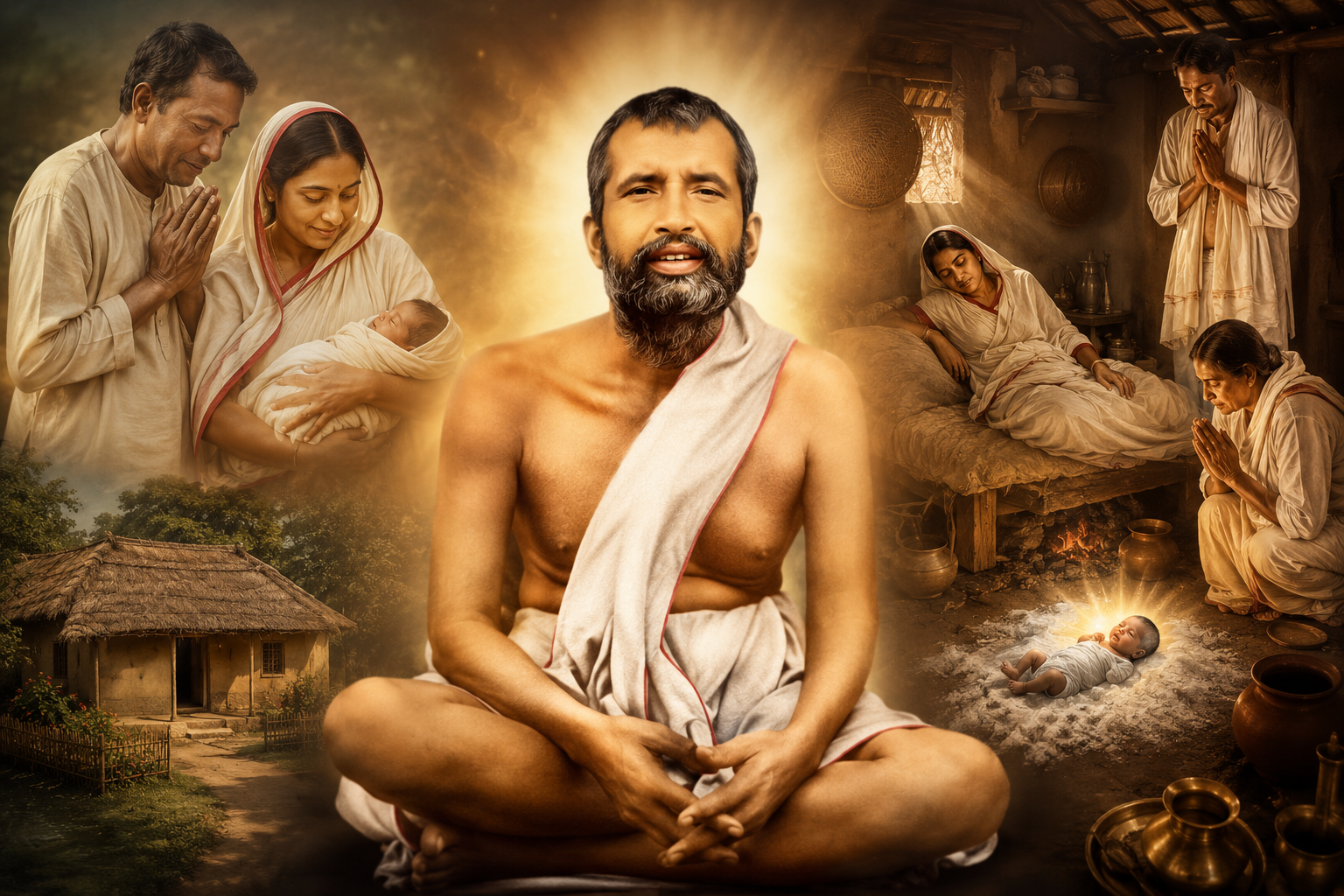
In the peaceful village of Kalady, in present-day Kerala, lived a devout couple named Shivaguru and Aryamba.
Despite years of prayer, they remained childless.
Following the advice of learned elders, they travelled to the sacred temple of Lord Shiva at Vadakkunnathan Temple in Thrissur, where they prayed earnestly for the blessing of a child.
One night, Lord Shiva appeared in Shivaguru’s dream with a remarkable choice.
Would they prefer:
- Many sons with long lives but little wisdom?
Or,
- A single son of extraordinary knowledge and virtue whose earthly life would be brief?
The couple surrendered completely to the will of the Divine.
“O Lord, You know what is best for us. Let Your will be our will.”
Pleased with their unwavering faith, Lord Shiva blessed them, declaring that He Himself would be born as their son.
In due course, Aryamba gave birth to a radiant baby boy.
Believing him to be a manifestation of Shiva, they named him Shankara, meaning “the One who bestows auspiciousness and bliss.”
A Child Blessed with Extraordinary Wisdom
Shankara’s brilliance became evident from an early age.
He began his formal education at the age of three and quickly mastered both his mother tongue and Sanskrit with astonishing ease.
Yet, his childhood was not without sorrow.
When he was only four years old, his father, Shivaguru, passed away.
Aryamba, now a widowed mother, devoted herself entirely to raising her gifted son. She ensured that his Upanayana (sacred thread ceremony) was performed at the appropriate age, after which young Shankara entered the traditional Gurukula to study the Vedas, scriptures, and sacred sciences.
No one could have imagined that this brilliant young student would soon perform one of the most celebrated miracles in Hindu tradition.
And that miracle would give birth to one of the greatest hymns ever composed in praise of Goddess Lakshmi.
The Birth of the Kanakadhara Stotram and the Beginning of Renunciation
By the time young Shankara entered the Gurukula, it had become evident that he was no ordinary child.
His extraordinary memory, profound understanding of the Vedas, and natural inclination toward spiritual inquiry astonished both his teachers and fellow students. Yet, it was not merely his intelligence that made him exceptional—it was his boundless compassion.
That compassion would soon give rise to one of Hinduism’s most beloved hymns: the Kanakadhara Stotram.
The Tradition of Bhiksha
In ancient India, students living in a Gurukula followed a sacred discipline.
Rather than depending on wealth or privilege, they survived by collecting Bhiksha—alms offered by householders.
This practice cultivated humility, gratitude, and detachment while reminding society of its responsibility to support the pursuit of knowledge.
One day, as part of this tradition, the young Shankara approached a humble house and softly called for Bhiksha.
Inside lived a poor woman whose husband was away.
She rushed to welcome the young Brahmachari.
The moment she saw the radiant child standing at her doorstep, she felt as though Lord Shiva Himself had come seeking alms.
But there was a problem.
Her home was completely empty.
A Gift Worth More Than Gold
The woman searched every corner of her house.
She looked into every vessel and every container.
There was nothing.
Finally, she discovered a single dried amla (Indian gooseberry).
It was the only food she possessed.
She hesitated for a moment.
If she gave away this lone fruit, she would have nothing left.
Yet her devotion overcame her poverty.
With folded hands and tears in her eyes, she placed the single gooseberry into Shankara’s begging bowl.
To the world, it was a dried fruit.
To Shankara, it was an offering born of absolute selflessness.
The Miracle of the Golden Gooseberries
Deeply moved by the woman’s generosity, young Shankara could not bear to see such virtue rewarded with suffering.
Standing before her humble home, he entered into profound meditation and composed an extraordinary hymn in praise of Goddess Mahalakshmi.
Verse after verse flowed effortlessly from the lips of the young sage.
His prayer was not for himself.
It was entirely for the woman whose compassion had surpassed her own hunger.
Tradition says that Goddess Lakshmi appeared, pleased by both the woman’s generosity and Shankara’s compassion.
Moments later, an astonishing miracle unfolded.
The roof of the humble house showered golden gooseberries, filling the home with unimaginable prosperity.
This divine hymn later became famous as the Kanakadhara Stotram, one of the most revered prayers dedicated to Goddess Lakshmi.
Even today, devotees across the world recite it seeking divine grace, abundance, and the removal of poverty.
But beyond material wealth, the hymn teaches a timeless truth:
True prosperity begins with compassion.
Returning Home
After completing his education at the Gurukula, Shankara returned to Kalady.
He lovingly cared for his mother, Aryamba, who had sacrificed everything for his upbringing.
According to tradition, this was the stage of life when he was expected to enter Grihastha Ashrama—the life of a householder.
Marriage, family, and social responsibilities lay ahead.
But Shankara’s heart belonged elsewhere.
From childhood, he had felt an irresistible calling toward renunciation.
His destiny was not to build a household.
It was to awaken a civilization.
A Mother’s Greatest Fear
Shankara knew that his desire to become a monk would deeply wound his mother.
Aryamba had already lost her husband.
Her only son was now her entire world.
How could she willingly permit him to renounce everything?
Understanding her love, Shankara remained patient.
He never argued.
He simply waited for the moment destiny would reveal itself.
The Crocodile That Changed History
One morning, Shankara accompanied his mother to the Poorna River, where they regularly bathed.
As he entered the water, an unexpected tragedy struck.
A crocodile suddenly seized his leg and began dragging him deeper into the river.
Aryamba screamed helplessly from the riverbank.
Seeing no other way to save his life, Shankara called out to her.
He explained that according to destiny, death awaited him.
However, there remained one way to overcome that fate.
If she granted him permission to accept Sannyasa, it would symbolically mark the end of his former life and the beginning of a new spiritual birth.
In the tradition of Sanatana Dharma, true renunciation is regarded as a second birth.
If he entered that new birth, the destiny attached to his previous life would no longer bind him.
It was a heartbreaking choice.
Either lose her son forever…
Or allow him to become a monk and perhaps save his life.
With tears flowing, Aryamba gave her consent.
At that very moment, Shankara mentally accepted Sannyasa, vowing that despite his renunciation, he would return to perform her final rites when the time came.
According to tradition, the crocodile immediately released its grip.
Shankara emerged safely from the river.
The incident became one of the defining moments of his life.
Whether viewed literally, symbolically, or spiritually, the crocodile represents the grip of worldly attachment, while renunciation symbolizes liberation into a higher purpose.
The First Step Toward a World-Changing Mission
Because Shankara had accepted renunciation without a guru during an emergency, this initiation is traditionally known as Āpat Sannyasa.
Although he had embraced the life of a monk, he knew that complete spiritual initiation required the blessings of an enlightened master.
That master awaited him far to the north.
On the banks of the sacred Narmada River, an immortal sage named Govinda Bhagavatpada sat absorbed in deep meditation.
Young Shankara now began one of the most remarkable spiritual journeys in Indian history—a journey that would transform him from a gifted monk into the Jagadguru who would reshape the spiritual destiny of Bharat.
Adi Shankaracharya: The Guru Who Unlocked the Wisdom of Advaita
The Journey to Govinda Bhagavatpada and the Dawn of a Spiritual Revolution
Having accepted Āpat Sannyasa, the young monk Shankara had crossed the threshold into a new life.
Yet, according to the sacred traditions of Sanatana Dharma, self-renunciation alone was not enough.
To realize the highest truth, one must surrender at the feet of a Sadguru—an enlightened master who has personally experienced the Supreme Reality.
Shankara knew exactly where his destiny was leading him.
Far to the north, on the banks of the sacred Narmada River, lived the great yogi Govinda Bhagavatpada, a realized master immersed in uninterrupted meditation.
Leaving behind his beloved mother and the village of Kalady, the young ascetic began an extraordinary pilgrimage that would change the spiritual history of India forever.
The Long Walk Across Bharat
Today, a journey from Kerala to central India can be completed in hours.
But in the eighth century, such a journey demanded extraordinary courage.
There were no highways.
No railways.
No vehicles.
No maps.
Only forests, rivers, mountains, wild animals, and endless uncertainty.
Yet the teenage monk walked alone across thousands of kilometers, driven by a single purpose—to find the Guru destined to reveal the highest wisdom.
Every step reflected his unwavering conviction that truth was worth every hardship.
The Sage in the Cave
After months of travel, Shankara finally reached the banks of the Narmada.
There, inside a quiet cave, sat Govinda Bhagavatpada, absorbed in profound Samadhi.
The great master had remained in deep meditation for so long that the world around him seemed to have disappeared.
Without disturbing the silence, Shankara circumambulated the cave three times as a mark of reverence.
Then he stood before the sage and offered a hymn of devotion.
It is said that Govinda Bhagavatpada slowly opened his eyes.
For years they had remained closed to the outer world.
Now they opened to welcome the disciple he had long awaited.
“Who Are You?”
The Guru looked at the young monk and asked a simple question:
“Who are you?”
To an ordinary person, the answer would have been obvious.
“I am Shankara.”
“I am the son of Shivaguru.”
“I come from Kalady.”
But Govinda Bhagavatpada was not asking for a name.
He was asking about identity itself.
Who are you beyond the body?
Beyond the mind?
Beyond your memories and your birth?
It was the ultimate question of Vedanta.
The Birth of the Dasha Shloki
Instead of answering with his name, Shankara responded with ten profound verses.
These verses explained that his true nature was not the body, the senses, the mind, or the ego.
He declared himself to be none other than the eternal Self—the pure consciousness that exists beyond all duality.
These verses later became famous as the Dasha Shloki, one of the earliest and most beautiful expressions of Advaita Vedanta.
Govinda Bhagavatpada immediately recognized that this was no ordinary seeker.
Standing before him was a soul prepared to illuminate the world.
The Sacred Initiation
Accepting Shankara as his disciple, Govinda Bhagavatpada initiated him into the deepest teachings of the Upanishads.
He explained the Mahāvākyas—the great declarations of the Vedas that reveal the identity of the individual Self with the Supreme Reality.
Although Shankara had already embraced renunciation, he now received formal Sannyasa Diksha from his Guru.
His head was ceremonially shaven.
He donned the saffron robes of a monk.
He became not merely a seeker of truth but a guardian of the timeless wisdom of Advaita Vedanta.
For some time, he remained at the Guru’s feet, absorbing the essence of Vedantic knowledge through direct experience rather than intellectual study alone.
The Guru’s Final Command
One day, Govinda Bhagavatpada called his disciple.
“The knowledge you have received is not meant to remain hidden in caves.
The wisdom of the Vedas must once again shine across Bharat.”
He instructed Shankara to travel to Kashi (Varanasi).
There, philosophers from every school gathered to debate the deepest questions of existence.
If Advaita was to be understood throughout India, there could be no better place to begin.
Receiving his Guru’s blessings, Shankara set forth toward the ancient city of Lord Vishwanath.
Kashi: The Intellectual Capital of Ancient India
In those days, Kashi was far more than a sacred city.
It was the intellectual heart of the Indian subcontinent.
Scholars representing diverse traditions gathered there to discuss philosophy, logic, scripture, and spirituality.
Every day, debates unfolded between followers of different schools of thought.
Victory in these debates meant more than personal recognition.
It influenced kingdoms, monasteries, and generations of seekers.
Arriving in Kashi, Shankara took residence near the sacred Manikarnika Ghat, close to the temple of Lord Vishwanath.
From there, he began delivering daily discourses on the Upanishads, the Bhagavad Gita, and Advaita Vedanta.
His clarity of thought, mastery of scripture, and ability to explain profound truths with remarkable simplicity attracted scholars from every corner of India.
Many who came to challenge him left as his disciples.
A spiritual renaissance had begun.
The Beginning of the Digvijaya
Within a short time, Shankara realized that restoring Sanatana Dharma required more than teaching in one city.
The wisdom of Advaita had to reach every corner of Bharat.
He therefore resolved to embark upon a Digvijaya—a spiritual conquest through knowledge, dialogue, and philosophical debate.
Unlike kings who conquered lands with armies, Shankara would conquer hearts through wisdom.
His weapons would be reason.
His shield would be compassion.
His victory would be truth.
And among all the debates he would undertake, one would become legendary—a debate with the great scholar Mandana Mishra, whose outcome would forever alter the course of Indian philosophy.
Mandana Mishra, Ubhaya Bharati, and the Triumph of Advaita Vedanta
By the time Adi Shankaracharya reached Kashi, his reputation had spread across the Indian subcontinent.
Everywhere he travelled, scholars gathered to hear the young monk whose profound understanding of the Vedas, Upanishads, and Brahma Sutras left even the greatest philosophers speechless.
But Shankaracharya knew that his mission was far from complete.
Sanatana Dharma had become divided into numerous philosophical schools, each claiming to represent the highest truth.
If the wisdom of Advaita Vedanta was to become the guiding light of Bharat once again, it would have to withstand the most rigorous intellectual challenges.
Thus began Shankaracharya’s Digvijaya—not a conquest through warfare, but a victory achieved through knowledge, reason, and spiritual realization.
A Spiritual Conquest Without Weapons
Unlike kings who expanded kingdoms with armies, Adi Shankaracharya travelled barefoot across India carrying nothing more than:
- A staff
- A water pot
- The wisdom of the Vedas
- Absolute faith in the Supreme Truth
Wherever he went, he welcomed dialogue rather than conflict.
He debated scholars of diverse philosophical traditions, not to humiliate them, but to illuminate what he believed was the ultimate reality taught by the Upanishads.
Each debate strengthened the revival of Sanatana Dharma and inspired countless seekers to rediscover the teachings of Advaita Vedanta.
The Greatest Scholar of His Time
Among all the philosophers of ancient India, one name stood above the rest.
Mandana Mishra.
He was an unrivalled authority on Purva Mimamsa, a school that emphasized Vedic rituals as the primary means to attain spiritual merit.
His scholarship was so respected that even learned sages hesitated to challenge him.
Shankaracharya knew that if Advaita Vedanta could withstand Mandana Mishra’s arguments, its philosophical foundations would become impossible to ignore.
Thus, he journeyed to the city of Mahishmati, where the legendary scholar resided.
A Debate Unlike Any Other
Mandana Mishra welcomed the challenge.
However, both scholars agreed that the debate required an impartial judge.
The responsibility fell upon Mandana Mishra’s wife, Ubhaya Bharati (also known as Sarasavani), herself an accomplished philosopher with extraordinary mastery of the scriptures.
The conditions were clear.
If Mandana Mishra lost, he would renounce worldly life, embrace monasticism, and accept Advaita Vedanta.
If Shankaracharya lost, he would abandon the path of renunciation, accept the philosophy of Purva Mimamsa, and enter the life of a householder.
It was not merely an academic contest.
The future direction of Indian philosophy rested upon its outcome.
Knowledge Versus Ritual
For days, the debate continued.
Questions flowed from every branch of Hindu philosophy.
The Vedas.
The Upanishads.
Logic.
Metaphysics.
Liberation.
The nature of consciousness.
The means to attain Moksha.
With remarkable clarity, Shankaracharya demonstrated that while rituals possess great value in purifying the mind, true liberation arises only through Self-Knowledge (Jnana).
Drawing upon scripture, reason, and direct spiritual insight, he established that realization of Brahman alone ends the cycle of birth and death.
At last, Mandana Mishra acknowledged defeat.
The audience rejoiced.
But the debate was not over.
The Final Challenge
Before declaring Shankaracharya victorious, Ubhaya Bharati stood and addressed the gathering.
She spoke with remarkable wisdom:
“A husband and wife are two bodies, but one life. If you have defeated only my husband, your victory is incomplete. You must also defeat me.”
The assembly fell silent.
Shankaracharya immediately accepted her challenge.
For him, truth was never afraid of inquiry.
He welcomed every sincere question.
The Question No Monk Could Answer
Ubhaya Bharati possessed mastery over every branch of knowledge.
She understood philosophy.
Poetry.
Scripture.
Ethics.
And the sciences of human relationships.
Recognizing that Shankaracharya had embraced monastic life at an early age, she shifted the discussion toward Kama Shastra—the psychology and philosophy of married life.
Her questions demanded not merely theoretical understanding but experiential knowledge.
Although Shankaracharya possessed immense scriptural wisdom, he recognized that answering such questions required lived experience.
Rather than pretending to know what he had never experienced, he humbly requested one month’s time to respond.
It was an extraordinary moment.
The greatest philosopher in India chose honesty over pride.
The Mystery of Parakaya Pravesha
As Shankaracharya departed with his disciples, unexpected news reached them.
A king named Amaruka had just passed away.
According to traditional biographies, Shankaracharya resolved to employ one of the most mysterious yogic attainments described in ancient Indian texts—Parakaya Pravesha, the ability to consciously enter another body.
Entrusting his own body to the care of his disciples, Shankaracharya is said to have entered the body of the deceased king.
Living temporarily as King Amaruka, he observed royal life and gained practical insight into the aspects of human experience that Ubhaya Bharati had questioned.
After completing this extraordinary mission, he returned to his own body and resumed the debate.
Whether interpreted literally or symbolically, this episode reflects an important principle of Indian spirituality:
True wisdom embraces every dimension of life while remaining untouched by attachment.
The Triumph of Advaita
When the debate resumed, Shankaracharya answered every question with extraordinary depth and clarity.
Satisfied that no further challenge remained unanswered, Ubhaya Bharati acknowledged his complete victory.
Mandana Mishra fulfilled his promise.
He accepted monastic life under Shankaracharya and became one of his foremost disciples, receiving the name Sureshvaracharya.
Far from being defeated, Mandana Mishra became one of Advaita Vedanta’s greatest teachers.
His transformation beautifully illustrates a timeless truth:
The highest purpose of debate is not victory over another person—it is the discovery of truth.
A New Era Begins
With Sureshvaracharya by his side, Shankaracharya’s mission gained unprecedented momentum.
Across the Indian subcontinent, monasteries, scholars, kings, and seekers began embracing Advaita Vedanta.
The philosophy of non-duality, once known only to a few, now spread throughout Bharat.
Yet Shankaracharya’s work was still unfinished.
Beyond philosophical debate, he recognized another challenge.
Many temples had become divided by sectarian differences.
Powerful manifestations of the Divine Mother required spiritual harmonization.
Ancient traditions needed to be united under a common vision.
His next mission would permanently reshape the religious landscape of India.