
Bogar’s Hidden Murugan Idols: Poombarai & Mathikettan Solai
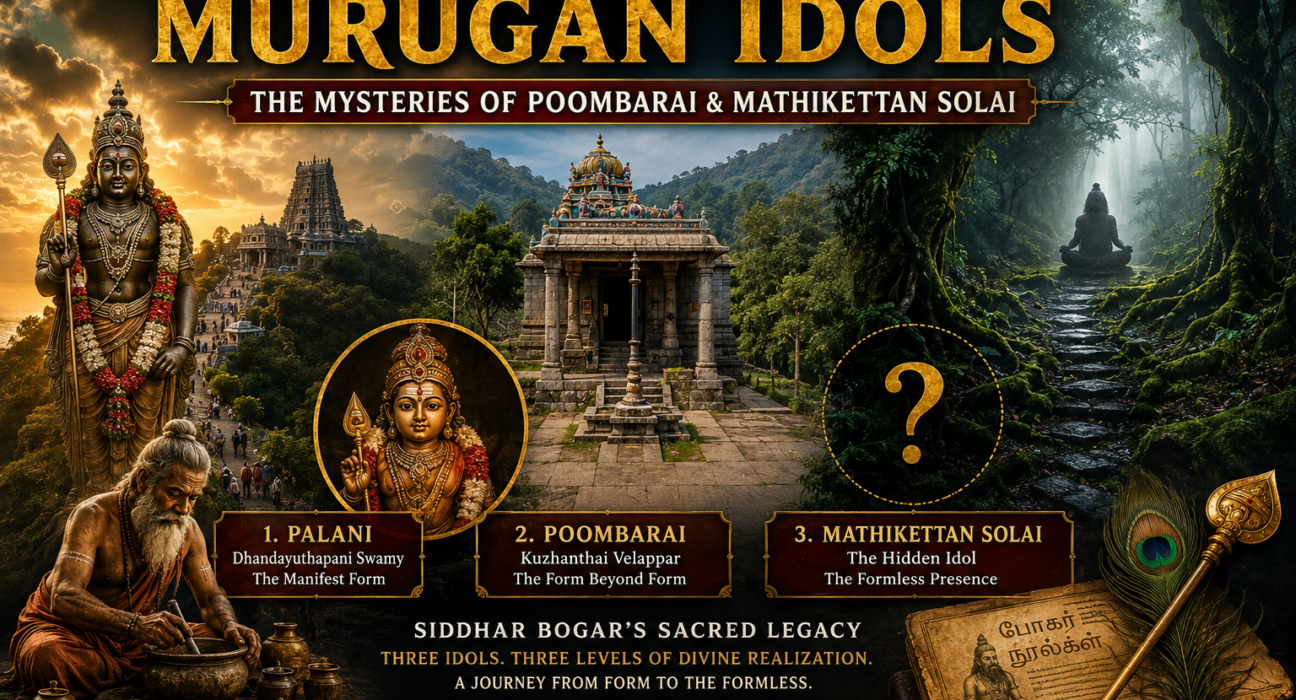
Bogar's Hidden Navapashana Murugan Idols: The Untold Mysteries of Poombarai and Mathikettan Solai
Introduction
Greetings to all spiritual seekers.
In our previous article, we explored one of the greatest mysteries surrounding Siddhar Bogar and the world-famous Palani Dhandayuthapani Swamy Temple.
We discovered why Bogar chose to sculpt Lord Murugan using the mystical Navapashana, a rare combination of powerful medicinal minerals, instead of creating an idol of any other deity.
We also examined why Murugan was installed in the form of an ascetic (Andi Kolam) and uncovered the fascinating relationship between Palani Hill and the Earth’s geomagnetic structure.
If you have not yet read that article, we highly recommend doing so before continuing, as it provides the foundation for the incredible mysteries discussed here.
At the end of the previous article, we briefly mentioned a little-known fact that surprises even many devotees.
Bogar did not create just one Navapashana idol.
Ancient traditions and oral histories suggest that he created three extraordinary Murugan idols, each possessing a unique spiritual purpose.
While millions of devotees visit the famous Navapashana idol at Palani every year, very few know about the second idol.
Even fewer have heard about the mysterious third idol, said to be hidden deep inside one of the most forbidden forests in South India—a place where almost no one has been allowed to enter.
Where are these hidden idols?
What is their history?
Why did Bogar install them in these particular locations?
And what spiritual secret connects all three?
Let us begin this fascinating journey into one of the greatest unsolved mysteries of Siddhar Bogar.
The Second Sacred Idol of Bogar
The second Murugan idol associated with Siddhar Bogar is believed to be located in the peaceful mountain village of Poombarai, about 18 kilometers from Kodaikanal in Tamil Nadu.
Most visitors who travel to Kodaikanal are familiar with the famous Kurinji Andavar Temple.
However, only a small number make the journey to the ancient Kuzhanthai Velappar Temple at Poombarai.
Interestingly, many devotees share a similar experience.
Despite visiting Kodaikanal several times, they somehow never find the opportunity to visit Poombarai.
It appears as though something always prevents the journey.
This is not merely a coincidence.
I too experienced the same phenomenon.
Although I had travelled to Kodaikanal multiple times in the past, I was unable to receive the darshan of Poombarai Murugan.
Only during a later visit did the opportunity finally arise.
When I began researching the temple’s Sthala Puranam (sacred history), I found an explanation that deeply moved me.
According to local belief, Kuzhanthai Velappar Himself decides who should receive His darshan and when.
No matter how close one may be geographically, true darshan is possible only when the Lord calls His devotee.
This belief continues to be cherished by generations of devotees who visit this sacred hill temple.
Did Bogar Really Create Another Navapashana Idol?
After consecrating the famous Navapashana idol of Sri Dhandayuthapani Swamy at Palani, Siddhar Bogar is believed to have travelled to China before returning once again to Tamil Nadu.
It was during this later period that he is said to have created two more extraordinary Murugan idols.
However, scholars and temple traditions differ regarding the composition of the Poombarai idol.
One school of thought believes that the idol is made from Navapashana, just like the Palani deity.
Another tradition claims that it belongs to an even rarer Siddha formulation known as Guru Mooppu Dasa Pashanam, a unique combination of ten highly refined mystical substances.
To this day, no historical evidence conclusively settles this debate.
Perhaps the true answer remains known only to Siddhar Bogar himself.
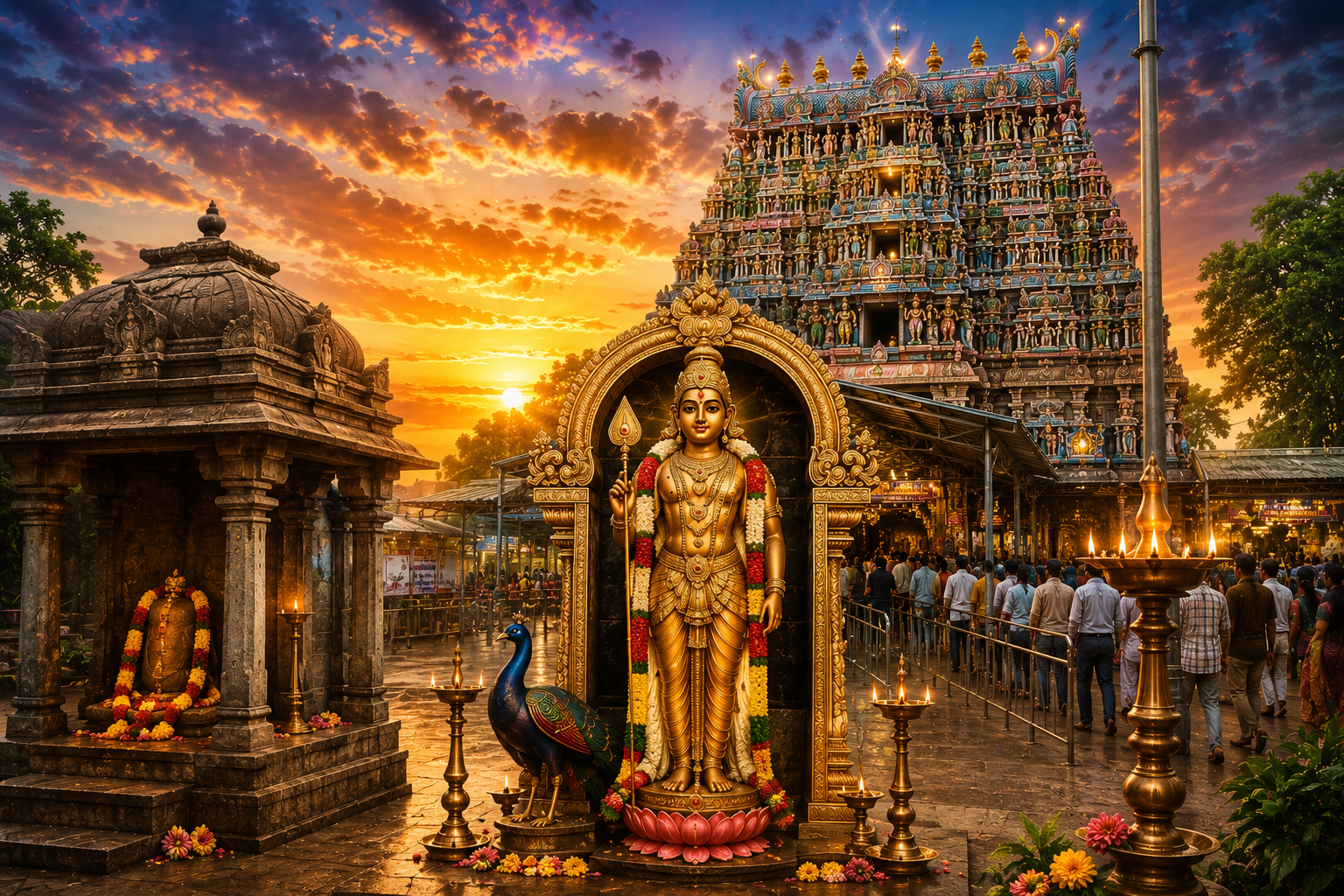
The presiding deity here is worshipped as Sri Kuzhanthai Velappar, Murugan in the divine form of a child.
Why Bogar chose Poombarai for this sacred installation remains one of the greatest mysteries in Siddha tradition.
Yet, when one studies the geography of the region carefully, an intriguing possibility begins to emerge.
Could the answer lie not merely in mythology—but in the very landscape itself?
Why Did Siddhar Bogar Choose Poombarai?
Among the many mysteries surrounding Siddhar Bogar, perhaps the most intriguing is his choice of Poombarai as the location for the second Murugan idol.
At first glance, Poombarai appears to be just another picturesque hill village nestled amidst the Western Ghats.
But Siddhars never selected sacred places by chance.
Every temple they established was aligned with spiritual energy, geography, and cosmic principles.
Could the same be true for Poombarai?
A Hidden Geographical Connection with Palani
As you travel from Kodaikanal to Poombarai, you will come across a scenic viewpoint known as the Palani Temple View Point.
From this location, the distant Palani Hills and the sacred temple can be seen on a clear day.
In our previous article, we explored the fascinating relationship between Palani Murugan and the planetary energy of Mars (Sevvai).
When the geographical alignment of Palani and Poombarai is carefully observed, an interesting pattern begins to emerge.
Some researchers believe that Siddhar Bogar intentionally installed the second idol along the same energetic alignment.
Although there is no historical inscription confirming this theory, the remarkable geographical positioning raises thought-provoking questions.
Was Bogar creating a sacred spiritual network?
Was Poombarai designed to complement the energy of Palani?
These remain unanswered mysteries.
The Temple of Kuzhanthai Velappar
Unlike many famous Murugan temples adorned with towering Rajagopurams, Kuzhanthai Velappar Temple is remarkably simple.
Its simplicity is, perhaps, its greatest beauty.
The temple stands peacefully on one side of a vast open field, surrounded by breathtaking mountain scenery.
There is no grand entrance tower.
Instead, only the Vimana above the sanctum rises gracefully, preserving the ancient character of the shrine.
Inside the sanctum, Lord Murugan faces west, an uncommon orientation among Murugan temples.
He appears as a divine child—Kuzhanthai Velappar—radiating innocence, compassion, and an enchanting smile that instantly melts the hearts of devotees.
Unlike the majestic ascetic form seen at Palani, this Murugan embodies the playful yet profound innocence of divine childhood.
A Temple with More Than 3,000 Years of Sacred Tradition
According to temple tradition, Kuzhanthai Velappar Temple possesses a history extending back nearly three thousand years.
Although historians continue to debate the exact age of the shrine, there is little doubt that it is one of the oldest Murugan temples in the Palani Hills region.
Local traditions associate the temple with one of the ancient Chera kings, who is believed to have recognized the extraordinary spiritual power of the Murugan idol installed by Siddhar Bogar.
To preserve this sacred deity, the king constructed the sanctum and surrounding stone mandapam.
Even today, the architectural style of the inner sanctum reflects remarkable antiquity.
The massive stone walls, weathered pillars, and ancient construction techniques reveal a temple that has witnessed centuries of uninterrupted worship.
Walking around the sanctum feels like stepping back into another age of Tamil civilization.
The Mahabharata Connection
One of the lesser-known traditions associated with Poombarai links the temple to the Mahabharata.
According to local belief, during their exile, the Pandavas travelled through parts of the Western Ghats.
It is said that they visited this sacred hill and offered prayers to Lord Murugan at Poombarai.
While this tradition is preserved through oral history rather than historical documentation, it adds another fascinating layer to the temple’s spiritual heritage.
Many ancient South Indian temples preserve similar associations with the Mahabharata, reflecting the deep cultural memory of these sacred landscapes.
Ancient Inscriptions and Timeless Sculptures
The temple’s antiquity is further reflected in its ancient Grantha inscriptions and beautifully weathered stone sculptures.
These inscriptions, together with the temple’s architectural features, provide valuable evidence of its historical importance.
The sculptures display the refined craftsmanship characteristic of early South Indian temple art.
Every carved pillar and stone wall silently narrates centuries of devotion.
For lovers of history, architecture, and spirituality, Poombarai is not merely a temple—it is a living museum of Tamil heritage.
A Temple Blessed by Arunagirinathar
Among Murugan devotees, a temple attains exceptional significance when it is praised by the great saint-poet Arunagirinathar.
Poombarai is one such blessed shrine.
In his immortal Thiruppugazh, Arunagirinathar glorified Lord Kuzhanthai Velappar with these beautiful lines:
Poonthalirgal veeru Vengaihal Palaasu Poom Kathali Kodi Thigazh Solai…
Poombaraiyil Mevum Perumale…
In this hymn, the saint vividly describes the lush forests filled with flowering trees, jackfruit groves, banana plantations, beautiful ponds, and the famous native hunting dogs that roamed the hills.
His verses paint a breathtaking picture of Poombarai as a divine paradise where nature itself worships Murugan.
Even today, visitors can experience much of the serene beauty that inspired Arunagirinathar centuries ago.
The Thiruppugazh stands as eternal testimony to the spiritual greatness of this sacred temple.
When Lord Murugan Appeared Before Arunagirinathar
The story of Arunagirinathar’s visit to Poombarai is one of the most cherished traditions associated with this sacred temple.
Today, travelling from Kodaikanal to Poombarai takes nearly an hour by road.
But imagine undertaking the same journey several centuries ago.
There were no proper roads.
No vehicles.
Only dense forests, steep mountain paths, wild animals, freezing nights, and unpredictable weather.
Yet none of these hardships discouraged the great saint.
Driven solely by his devotion to Lord Murugan, Arunagirinathar undertook the difficult pilgrimage through the Western Ghats to worship Kuzhanthai Velappar.
Such was the depth of his faith.
A Divine Vision in the Night
After offering prayers at the temple, Arunagirinathar stayed there for the night.
According to temple tradition, while he was resting inside the temple premises, an extraordinary event took place.
Lord Murugan appeared before him—not as the majestic commander of the celestial armies, nor as the ascetic of Palani—but in the charming form of a divine child.
The saint was blessed with the darshan of Kuzhanthai Velappar Himself.
For Murugan devotees, this incident carries a profound spiritual message.
When a devotee undertakes every hardship with unwavering faith, the Lord does not merely accept the worship—He reveals Himself.
Even today, this miraculous event is remembered with deep reverence by devotees visiting Poombarai.
A Temple That Honors Its Great Saints
Near the temple stands a shrine dedicated to Saint Arunagirinathar, commemorating his divine experience at Poombarai.
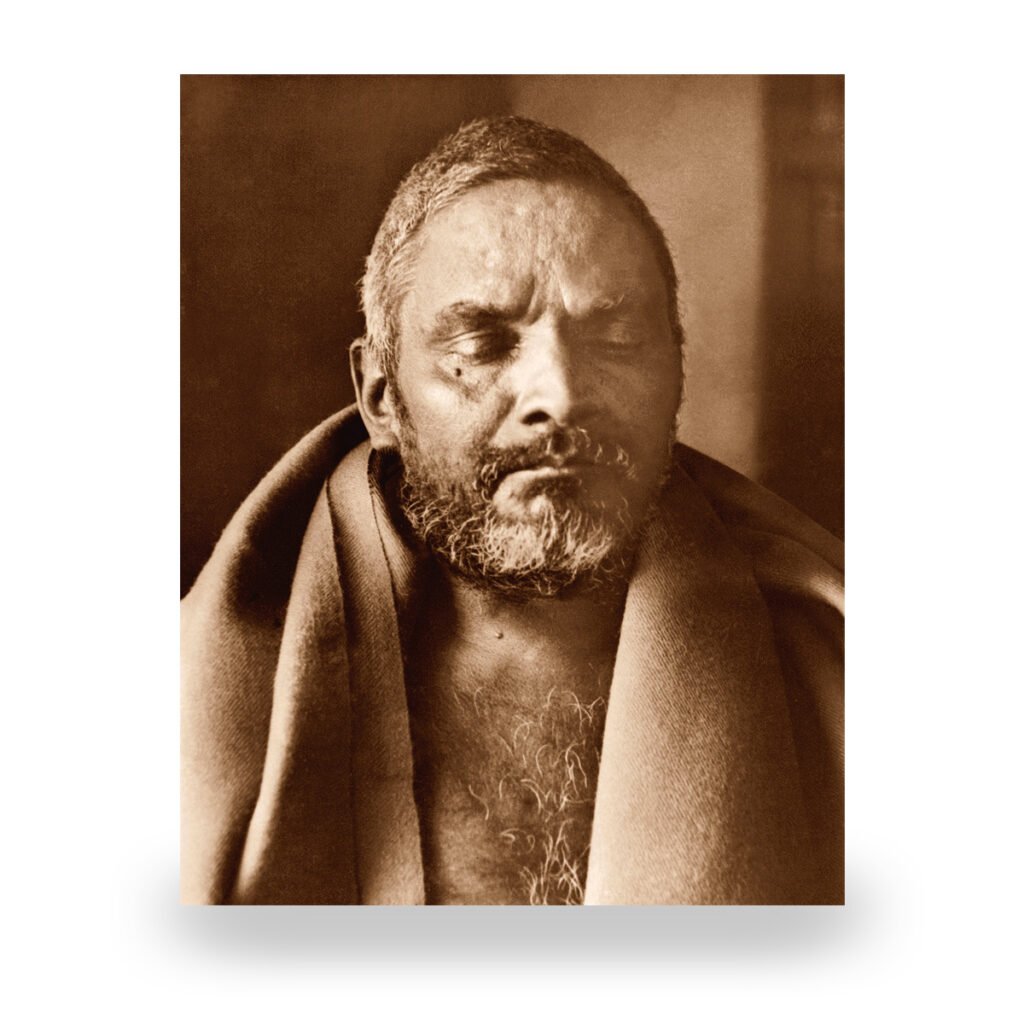
Within the temple complex, devotees can also find an image of Siddhar Bogar, the great mystic who is believed to have installed the sacred Murugan idol.
Standing before these two towering spiritual figures, one cannot help but reflect upon the extraordinary spiritual lineage connected to this temple.
It is not merely a place of worship.
It is a meeting point of Siddha wisdom, Bhakti, and Murugan’s divine grace.
A newly built shrine dedicated to the Divine Mother is also located between these sacred spots, and devotees traditionally visit this temple before concluding their pilgrimage.
Does Murugan Choose His Devotees?
One belief continues to echo among the people of Poombarai.
It is said that no one can receive the darshan of Kuzhanthai Velappar unless the Lord Himself wills it.
Many pilgrims recount stories of unexpected delays, cancelled plans, road closures, or sudden changes in their schedules that prevented them from reaching the temple.
Others describe how, despite having no prior plans, circumstances mysteriously aligned, allowing them to visit the shrine.
Whether one accepts this as faith or coincidence, countless devotees believe that the Lord personally chooses the moment when each devotee is called into His presence.
Perhaps that is why every visit to Poombarai feels deeply personal.
The Greatest Mystery Begins: Mathikettan Solai
If Poombarai itself is mysterious, what lies beyond it is even more astonishing.
According to certain traditions, the third idol associated with Siddhar Bogar is not housed in a temple at all.
Instead, it is believed to be hidden within one of the most mysterious forests in South India.
A place known as Mathikettan Solai.
Located near the Berijam Forest region of Kodaikanal, this dense forest stretches across nearly twelve kilometers of protected wilderness.
Unlike most forests that welcome trekkers and researchers under permission, entry into Mathikettan Solai is strictly prohibited.
For decades, this restriction has fueled endless speculation.
Why is the forest closed?
What secrets does it conceal?
And why is it feared by so many?
The Forest from Which People Never Returned
Local folklore surrounding Mathikettan Solai is both fascinating and unsettling.
One long-standing belief speaks of a mysterious medicinal plant found deep within the forest.
According to the legend, anyone who accidentally steps on this plant gradually loses all sense of direction.
Their mind becomes confused.
No matter which path they choose, they continue wandering aimlessly through the forest until exhaustion overtakes them.
Unable to find their way out, they eventually perish within the wilderness.
Another legend speaks of an even stranger phenomenon.
The forest is said to contain a rare flowering plant known locally as Poonaga Poo.
When its blossoms fall to the ground and begin to decay, they are believed to release a peculiar fragrance.
Anyone who inhales this scent is said to lose mental clarity.
Even if such individuals manage to escape the forest, local stories claim that they never fully recover and eventually lose their lives.
These accounts have been passed down through generations.
However, modern botanists point out that no scientifically recognized plant known as Poonaga Poo has been identified.
Whether these stories are literal truth, symbolic warnings, or folklore born from generations of oral tradition remains uncertain.
Yet one fact continues to intrigue researchers and locals alike.
Mathikettan Solai remains one of the least accessible and most mysterious forests in Tamil Nadu.
Is Bogar’s Third Idol Hidden in Mathikettan Solai?
Among the many legends surrounding Siddhar Bogar, perhaps none is more mysterious than the belief that he installed a third sacred Murugan idol deep within the forbidden forest of Mathikettan Solai.
Unlike the Navapashana idol at Palani or the revered deity at Poombarai, there is no archaeological evidence or temple inscription confirming the existence of this third idol.
The story survives primarily through oral traditions, local folklore, and a handful of spiritual writings.
Whether this legend is historically accurate remains unknown.
Yet the possibility itself continues to fascinate spiritual seekers.
If Bogar truly consecrated an idol within such an inaccessible forest, one cannot help but wonder—what profound spiritual purpose did he intend?
Perhaps the answer has been hidden for centuries, known only to the great Siddhar himself.
A Spiritual Interpretation of the Three Sacred Installations
While no definitive explanation exists, one symbolic interpretation offers a fascinating perspective.
This is only a philosophical reflection, not an established historical fact.
In Sanatana Dharma, the Supreme Divine is understood to manifest in three fundamental states:
1. Arupa – The Formless
In Chidambaram, Lord Shiva is worshipped in the mysterious Chidambara Rahasya, where the Divine is represented not by an idol but by empty space, symbolizing the infinite, formless reality.
2. Aruvuruvam – Form Beyond Form
In most Shiva temples, the Lord is worshipped as the Shiva Linga, a sacred form that transcends ordinary human representation.
3. Uruvam – The Manifest Form
The same Lord finally reveals Himself in a complete anthropomorphic form as Lord Nataraja, the Cosmic Dancer.
Could Siddhar Bogar have followed a similar spiritual pattern for Lord Murugan?
If so, the three sacred locations begin to reveal an extraordinary symbolism.
Palani – The Fully Manifest Murugan
At Palani, Murugan stands before devotees in the complete form of Sri Dhandayuthapani Swamy, allowing millions of devotees to receive His grace with ease.
The path is open.
The temple is accessible.
His blessings are available to all who come with devotion.
Poombarai – The Child Form of Divine Wisdom
At Poombarai, Murugan appears as Kuzhanthai Velappar, representing innocence, purity, and the early stages of spiritual awakening.
The journey is more demanding.
One must intentionally seek Him.
Devotees often say that the Lord Himself calls those who are destined to receive His darshan.
Mathikettan Solai – The Invisible Presence
If the legends surrounding Mathikettan Solai are true, the third installation represents something even deeper.
Not a deity easily seen.
Not a temple crowded with pilgrims.
But the unseen, formless presence of Murugan.
A divine reality beyond ordinary perception.
A state that cannot be reached through physical effort alone but through profound spiritual realization.
Whether Bogar intended such symbolism remains unknown.
Yet it offers a beautiful way of understanding the spiritual journey—from visible worship to inner realization.
Murugan’s Twenty-Two Divine Forms
Although Lord Murugan is considered a single divine incarnation, the Agamic traditions describe twenty-two sacred forms through which He reveals Himself.
Among the most celebrated are:
- Senadhipathi
- Saravanabhava
- Kartikeya
- Shanmukha
- Tarakari
- Krauncha Bhedanar
- Sonani
These forms are generally depicted with six divine faces, representing Murugan’s omniscience and His ability to guide devotees in every direction.
Other forms include:
- Agni Jata Subrahmanya, portrayed with two faces.
- Saurabheya Subrahmanya, portrayed with four faces.
Each manifestation reflects a unique aspect of divine wisdom, protection, courage, and spiritual evolution.
The Rare Four-Faced Murugan
Among Murugan’s many manifestations, one of the rarest is Saurabheya Subrahmanya, also known as Chaturmukha Murugan.
Unlike the familiar six-faced form worshipped across Tamil Nadu, this extraordinary manifestation possesses four faces, making it one of the least-known iconographic forms of Lord Murugan.
A rare temple dedicated to this form is located in Chinnalapatti, Dindigul District, where devotees can witness this unique representation of the Lord.
The symbolism of this form, its history, and its spiritual significance deserve a detailed exploration of their own.
Final Thoughts
The life of Siddhar Bogar continues to inspire wonder even after countless centuries.
Scientist.
Alchemist.
Yogi.
Mystic.
Temple architect.
Philosopher.
Every creation attributed to him appears to conceal layers of knowledge that modern minds are only beginning to appreciate.
Whether it is the medicinal mystery of Navapashana, the sacred geometry of Palani, the hidden spiritual energy of Poombarai, or the enigmatic legends surrounding Mathikettan Solai, each story invites us to look beyond the surface.
Not every mystery demands an immediate answer.
Some mysteries are meant to awaken curiosity.
Others are meant to inspire devotion.
Perhaps that is exactly what Siddhar Bogar intended.
As spiritual seekers, our task is not merely to search for hidden idols in distant forests, but to discover the hidden divinity within ourselves.
And as the Siddhars have always taught, when the seeker is truly ready, the Guru—and the Divine—will reveal themselves.