
Thillai Kali Amman Temple: History, Legend & Divine Blessings

Thillai Kali Amman Temple: Why Did Goddess Kali Leave Lord Shiva and Reside on the Edge of Chidambaram?
The Forgotten Story Behind One of Tamil Nadu’s Most Powerful Shakti Temples
When people think of Chidambaram, the first temple that comes to mind is the world-famous Sri Nataraja Temple, one of the five Pancha Bhoota Sthalams representing the Akasha (Ether) element.
It is here that Lord Shiva performed the divine Ananda Tandava, the Cosmic Dance of Bliss, symbolizing the eternal rhythm of creation, preservation, and dissolution.
However, hidden just a short distance from this sacred temple lies another extraordinary shrine—Thillai Kali Amman Temple—a place that preserves one of the most fascinating legends in Hindu mythology.
Why did Goddess Kali challenge Lord Shiva to a dance?
Why did she leave the very Lord whose other half she was?
Why does the guardian deity of Chidambaram reside outside the town instead of beside Lord Nataraja?
What spiritual benefits await devotees who worship Thillai Kali?
And why did a Chola king build this temple after receiving the Goddess’s divine grace?
Let us journey into the remarkable history, mythology, architecture, and spiritual significance of the sacred Thillai Kali Amman Temple.
The Sacred Temple of the Goddess Who Guards Chidambaram
Located about 500 meters north of the Chidambaram Nataraja Temple, Thillai Kali Amman Temple is one of the revered Ashta Kali Temples of Tamil Nadu.
More than just a Shakti shrine, the Goddess is regarded as the Kshetra Palika—the divine guardian and protector of Chidambaram.
According to temple inscriptions, the present temple was built by the Chola ruler Kopperunjinga I between 1229 CE and 1278 CE. Later, significant renovations were carried out by the Pandya king Jatavarman Sundara Pandyan, preserving the temple for future generations.
Even today, devotees believe that the Goddess continues to protect Chidambaram and bless those who surrender to her with unwavering faith.
The Divine Plan Behind Kali’s Manifestation
Long ago, the universe was plunged into chaos.
Powerful demons began tormenting the Devas, sages, and righteous beings. Unable to withstand their cruelty, the celestial beings approached Lord Brahma and Lord Vishnu, seeking protection.
After careful deliberation, the gods concluded that only Lord Shiva could resolve the crisis.
However, destiny had already ordained that the demons could only be destroyed if Goddess Parvati assumed her fierce form as Kali.
There was one problem.
As long as Goddess Parvati remained inseparable from Lord Shiva, she could not manifest the intense cosmic energy required to become Kali.
Moreover, an earlier divine curse required the Goddess to live separately from Lord Shiva for a period of time.
To fulfill both cosmic destiny and divine justice, Lord Shiva orchestrated one of His mysterious Thiruvilayadals—a divine play that would change the course of history.
When Shiva and Parvati Appeared to Quarrel
One day on Mount Kailash, Lord Shiva and Goddess Parvati entered into what appeared to be a heated debate.
The discussion gradually transformed into an argument over who was supreme.
Parvati declared that without Shakti (Divine Energy), even Shiva Himself could not function.
Angered—not out of ego but as part of His divine plan—Lord Shiva pronounced a curse upon the Goddess.
“You shall assume the fierce form of Ugra Kali.”
Instantly, Parvati transformed into the terrifying Goddess Kali.
Realizing the deeper significance of what had happened, the Goddess sought forgiveness and prayed for liberation from the curse.
Lord Shiva lovingly explained that His curse was never intended as punishment.
Instead, it was a sacred mission.
He instructed Her to destroy the powerful demons, fulfill Her cosmic responsibility, and later perform penance in the forests of Thillai.
“When the proper time arrives,” Lord Shiva assured Her, “you shall reunite with Me once again.”
Thus began one of the greatest chapters in the sacred history of Chidambaram.
The Dance That Changed the Destiny of Chidambaram
Kali’s Victory Over Evil
Obeying Lord Shiva’s command, Goddess Kali set out to fulfill her divine mission.
With immeasurable power and unmatched ferocity, she waged war against the demonic forces that had brought suffering to the universe. One by one, the mighty asuras fell before her. The heavens rejoiced, the sages regained their peace, and dharma was restored.
Although her mission had been accomplished, Kali’s fierce energy had not yet subsided.
Deep within her heart remained only one desire—to reunite with Lord Shiva.
Following His instructions, she travelled to the sacred forests of Thillai, the ancient name of present-day Chidambaram, where dense mangrove trees once covered the land. There, she entered into intense meditation, longing for the day she would once again stand beside her beloved Lord.
Shiva Reveals the Cosmic Dance
Around this same time, two of Lord Shiva’s greatest devotees—the sage Patanjali and the tiger-footed sage Vyaghrapada—had completed years of rigorous penance.
Their only wish was to witness the Lord’s celestial dance.
Moved by their unwavering devotion, Lord Shiva appeared in Chidambaram and performed the magnificent Ananda Tandava, the Dance of Supreme Bliss.
This was no ordinary dance.
It represented the eternal rhythm of the cosmos—creation, preservation, destruction, concealment, and divine grace. Every movement carried profound spiritual meaning, revealing the mysteries of existence itself.
The sages stood overwhelmed, witnessing a vision that very few souls have ever been blessed to see.
Why Did Kali Become Angry?
As Kali continued her penance nearby, news of Shiva’s divine dance reached her.
Instead of joy, it awakened a deep sense of disappointment.
“I have been performing severe penance, longing for His darshan,” she thought.
“Yet He chose to reveal Himself first to His devotees instead of coming to me.”
The Goddess, still carrying the intensity of her fierce form, approached the sacred hall where Lord Shiva was dancing.
There she challenged Him before the assembled gods and sages.
“If You truly are the greatest dancer,” she declared, “then dance with me.”
She proposed a condition.
Whoever stopped dancing first would accept defeat.
The loser would leave the sacred center of the city and reside at its boundary forever.
Lord Shiva accepted.
Thus began one of the most celebrated dance contests in Hindu tradition.
The Greatest Dance Competition in Hindu Mythology
The entire universe gathered to witness the extraordinary event.
The Devas, sages, celestial musicians, Brahma, Vishnu, and countless divine beings assembled in anticipation.
The dance began.
Every step performed by Shiva was matched perfectly by Kali.
Every graceful movement of the Goddess was answered effortlessly by the Lord.
Neither showed the slightest sign of exhaustion.
The contest continued endlessly.
Neither victory nor defeat seemed possible.
The gods watched in amazement, unable to determine who would prevail.
The Urdhva Tandava
As the divine dance intensified, the ornaments adorning both Shiva and Kali loosened from their bodies.
During the performance, one of Lord Shiva’s earrings slipped from His ear and fell to the ground.
Without interrupting His dance for even a single moment, Shiva performed an astonishing feat.
Using only the toes of His raised foot, He lifted the fallen earring from the floor and effortlessly placed it back into His ear.
In the same fluid motion, He raised His leg high above His head and entered the majestic Urdhva Tandava, the Dance of the Raised Foot.
The entire universe fell silent.
It was a movement beyond imagination—one that symbolized the complete transcendence of the ego and the limitless freedom of divine consciousness.
Kali Accepts Defeat
Goddess Kali witnessed the extraordinary posture.
Although she possessed the strength to perform any cosmic act, she chose not to imitate the movement.
According to the traditional legend, out of modesty and feminine dignity, she refrained from raising her leg in the same manner before the gathered assembly.
At that very moment, the contest came to an end.
Lord Shiva emerged victorious.
Keeping her word, Kali accepted defeat with humility.
Yet the fierce energy within her had still not completely subsided.
She withdrew from the center of Chidambaram and took her place at the northern boundary of the sacred town, where she remained in her powerful Ugra (fierce) form.
From that day onward, the Goddess became known as Thillai Kali, the divine guardian of Chidambaram.
The Universe Trembles
Although the contest had ended, a greater concern now arose.
Lord Shiva and Goddess Shakti, who together symbolize the inseparable union of consciousness and energy, were no longer together.
The gods became anxious.
Without Shiva and Shakti united, how could the universe continue to function in perfect balance?
Recognizing the cosmic significance of their separation, Brahma, Vishnu, and the assembled Devas approached Goddess Kali.
With humility and devotion, they prayed for her anger to subside and requested that she once again reveal her compassionate nature for the welfare of all creation.
What happened next transformed the fierce Goddess into one of the most unique and spiritually significant forms of the Divine Mother worshipped anywhere in India.
From Fierce Kali to Brahma Chamundeeswari: The Divine Transformation
The Gods Appease the Divine Mother
The separation of Lord Shiva and Goddess Kali was not merely an event between two divine beings—it had cosmic consequences.
In Hindu philosophy, Shiva represents pure consciousness, while Shakti represents divine energy. Neither is complete without the other. Together, they sustain the universe.
Fearing an imbalance in creation, the Devas, along with Lord Brahma and Lord Vishnu, approached the fierce Goddess with folded hands. They prayed for her anger to subside and requested that she reveal her compassionate form once again.
Among them, Lord Brahma offered a unique prayer.
He praised the Goddess as Deva Nayaki, the Mother of the Universe, and requested that she assume a form symbolizing the wisdom of the four Vedas.
Accepting his prayer, the Goddess transformed.
Her fierce expression softened into one of boundless compassion. She manifested with four faces, representing the four Vedas, and came to be worshipped as Sri Brahma Chamundeeswari.
This remarkable transformation symbolizes an important spiritual truth: even the fiercest divine energy ultimately becomes an ocean of compassion for those who surrender with devotion.
The Unique Temple of Two Divine Forms
One of the most extraordinary features of the Thillai Kali Amman Temple is that devotees can worship two completely different manifestations of the Divine Mother within the same temple complex.
Thillai Kali – The Fierce Protector
In one sanctum, the Goddess appears as Ugra Kali, radiating immense power.
She is depicted with eight arms, each holding divine weapons that symbolize her victory over evil and her role as the protector of righteousness.
Her intense gaze reminds devotees that she destroys negativity, injustice, fear, and ignorance.
Brahma Chamundeeswari – The Compassionate Mother
In another sanctum, the same Goddess appears in a completely different form.
Here she is worshipped as Brahma Chamundeeswari, seated peacefully with four faces and four arms.
Each aspect of her iconography carries profound symbolism:
- A Rudraksha rosary, representing spiritual wisdom and meditation.
- A bowl of Kumkum, symbolizing prosperity, auspiciousness, and divine grace.
- A Trident (Trishula), representing the destruction of ego, ignorance, and evil.
- A sacred vessel held in another hand, signifying nourishment, abundance, and the preservation of life.
This rare combination of fierce and peaceful manifestations makes Thillai Kali Temple one of the most spiritually significant Shakti temples in South India.
The King Who Built the Temple
Temple inscriptions reveal an inspiring historical connection between the Goddess and the Chola ruler Kopperunjinga I.
During a difficult period of political instability, the king prayed earnestly to Thillai Kali, seeking her blessings to overcome the obstacles threatening his kingdom.
Tradition holds that the Goddess answered his prayers, granting him victory over his enemies and helping him establish his rule successfully.
Out of gratitude, the king constructed this magnificent temple in her honor.
Later, the temple received renovations and patronage from the Pandya king Jatavarman Sundara Pandyan, whose contributions helped preserve the shrine for future generations.
Thus, the temple stands today not only as a center of devotion but also as a monument to medieval South Indian history.
A Temple Worshipped by Both the Sun and the Moon
Among the many wonders associated with Thillai Kali Amman Temple, one of the most fascinating is a rare astronomical phenomenon.
Most Shiva temples where the Sun’s rays fall directly upon the deity are known as Bhaskara Kshetrams.
However, Thillai Kali Amman Temple is unique because both the Moon and the Sun are believed to worship the Goddess.
The Moon’s Worship
Every year, on Masi Pournami (Full Moon Day), the rays of the full moon are believed to fall directly upon the deity in the early morning, creating a deeply sacred moment cherished by devotees.
The Sun’s Worship
A few days later, during the Tritiya Tithi, the setting Sun’s golden rays illuminate the Goddess in the evening, producing another extraordinary spectacle.
These celestial alignments are regarded as symbols of the Divine Mother’s universal supremacy, where even the cosmic luminaries offer their worship.
A Temple Rich in Sacred Architecture
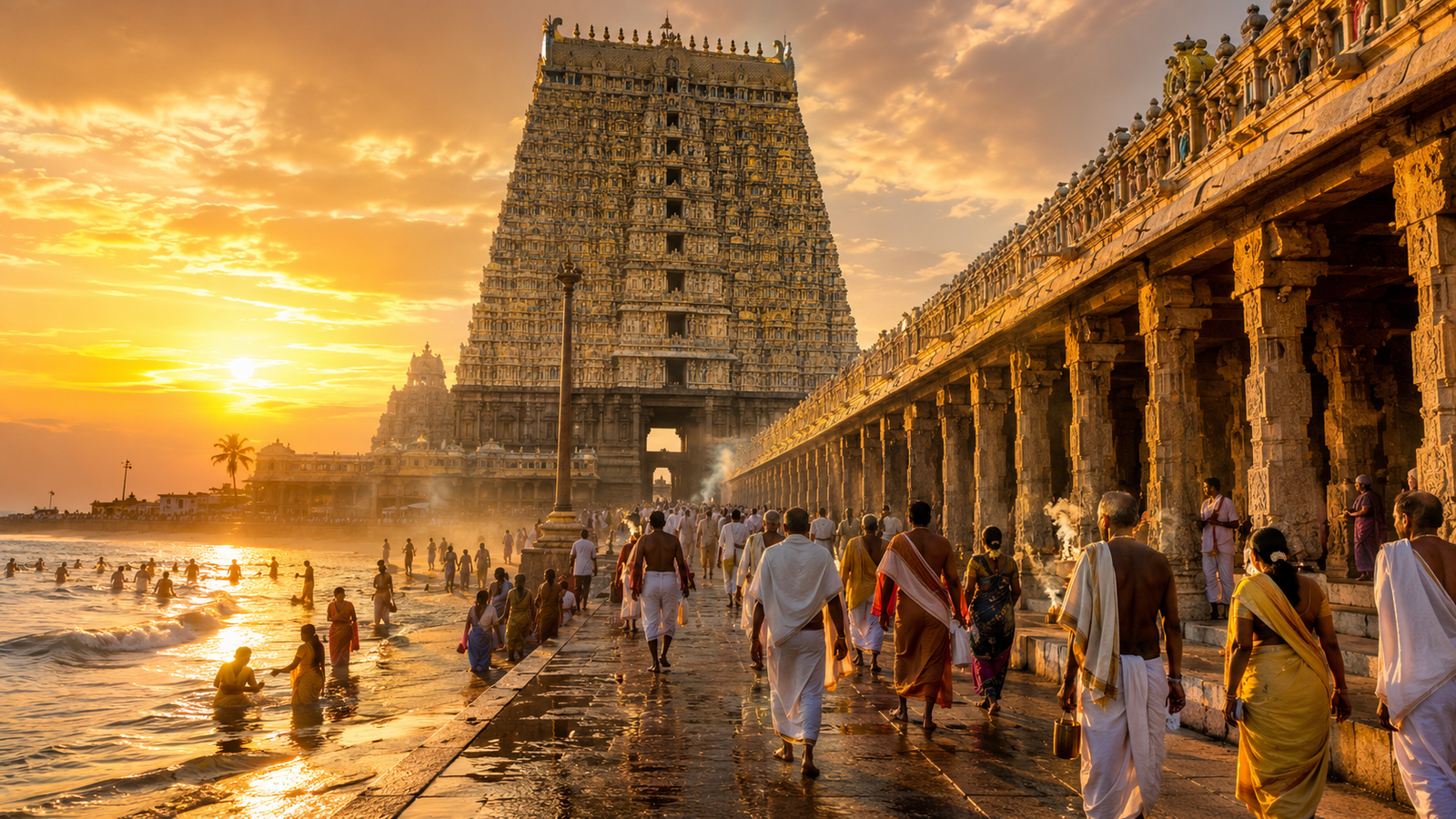
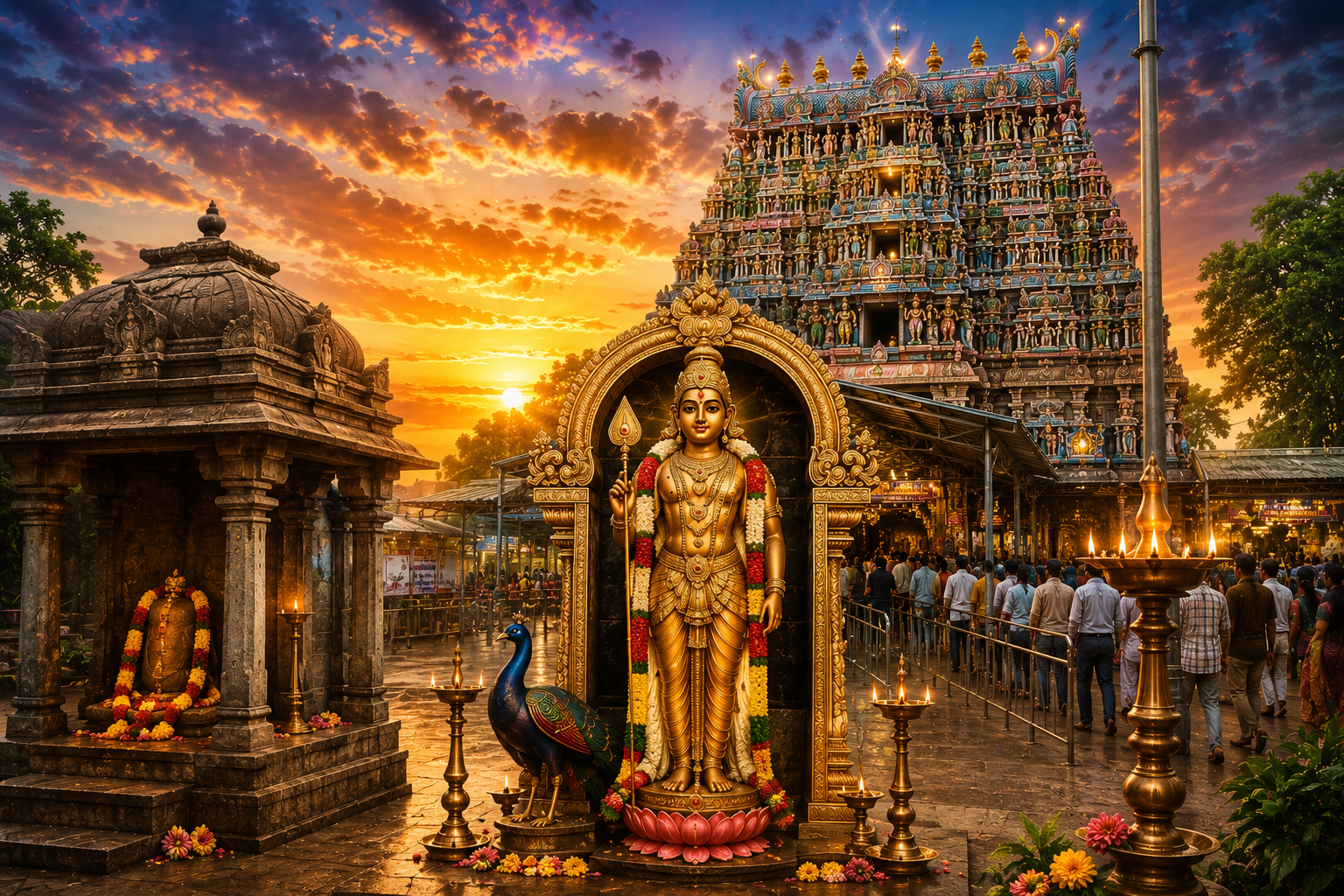
The temple welcomes devotees through an imposing west-facing Rajagopuram, reflecting the grandeur of traditional Chola architecture.
In front of the entrance lies the sacred temple tank, known as Sivapriya Theertham, which is also regarded as one of the ten holy water bodies associated with Lord Nataraja.
Passing through the entrance, devotees encounter:
- The spacious Maha Mandapam.
- A shrine dedicated to Lord Ganesha.
- A shrine for Lord Murugan with Valli and Deivanai.
- Guardian deities protecting the inner sanctum.
- The peaceful sanctum of Brahma Chamundeeswari.
- The powerful sanctum of Thillai Kali, the fierce protector of Chidambaram.
Every corner of the temple reflects centuries of devotion, craftsmanship, and spiritual symbolism, making it a place where mythology, architecture, and history come together in perfect harmony.
Festivals, Rituals, and the Divine Blessings of Thillai Kali Amman
Sacred Festivals Celebrated at the Temple
Throughout the year, Thillai Kali Amman Temple comes alive with vibrant festivals that draw thousands of devotees from across India.
Vaikasi Brahmotsavam
One of the grandest celebrations is the ten-day Brahmotsavam, which begins after the ceremonial Kappu Kattudhal (sacred protection ritual) on the Shashti preceding the New Moon (Amavasya) in the Tamil month of Vaikasi.
During this festival, the Goddess is adorned in magnificent decorations, special processions are conducted, and devotees witness elaborate rituals that celebrate her divine power and compassion.
Aadi Month Celebrations
The Tamil month of Aadi, considered especially auspicious for the worship of the Divine Mother, is observed with great devotion.
Every day of the month features:
- Special Abhishekams (sacred ablutions)
- Kumkum Archana
- Deeparadhana
- Unique Alankarams (decorations)
- Special prayers seeking the Goddess’s blessings
Thousands of devotees visit during Aadi to seek relief from obstacles, illnesses, and family problems.
Navaratri and Thai Pongal
The temple also celebrates Navaratri, honoring the nine forms of the Divine Mother, with grand decorations, cultural programs, and special worship.
Thai Pongal is another important occasion, during which devotees offer heartfelt prayers for prosperity, good harvests, and family well-being.
Unique Worship Traditions
Thillai Kali Amman is worshipped in a manner unlike most other Goddess temples.
White Saree Offering
The Goddess is traditionally adorned only with a white saree, symbolizing purity, peace, and spiritual transformation.
Gingelly Oil Abhishekam
The primary abhishekam performed for the Goddess is with gingelly (sesame) oil, a ritual believed to cool her fierce energy and invoke her compassionate blessings.
Kumkum and Turmeric
The deity is richly covered with turmeric and kumkum, with only her radiant eyes visible to devotees.
This powerful appearance reminds worshippers that although she is fierce against evil, she watches over her devotees with the loving eyes of a divine mother.
The Spiritual Benefits of Worshipping Thillai Kali
For centuries, devotees have believed that sincere prayers offered at Thillai Kali Amman Temple bring profound spiritual and worldly blessings.
Relief from Illness
Offering gingelly oil abhishekam, dressing the Goddess in a white saree, performing Kumkum Archana, and lighting a Mavilakku (rice-flour lamp) are believed to help devotees seek relief from physical ailments and long-standing health issues.
Removal of Marriage Obstacles
Many unmarried men and women visit the temple praying for suitable marriages. Devotees believe that the Goddess removes obstacles delaying matrimonial alliances and blesses them with harmonious married life.
Blessings for Children
Couples longing for children often tie a small cradle within the temple precincts as a symbol of their prayer.
Countless devotees believe that the compassionate Mother blesses them with the joy of parenthood.
Protection from Negative Energies
The temple has long been regarded as a powerful place for those suffering from the effects of negative energies, evil influences, black magic, or fear.
Devotees believe that sincere worship at this sacred shrine grants protection and restores inner peace.
Freedom from Debt and Financial Difficulties
Many worshippers offer prayers seeking relief from financial burdens, business failures, and overwhelming debt.
The Goddess is believed to remove obstacles and open new paths toward prosperity.
Victory Over Enemies and Obstacles
Just as she blessed King Kopperunjinga with victory, devotees pray to Thillai Kali for protection from adversaries, legal challenges, and seemingly insurmountable obstacles in life.
Peace of Mind
Those struggling with anxiety, fear, confusion, or emotional distress believe that the compassionate Mother grants mental strength, courage, and clarity.
The Divine Mother Who Understands Separation
Perhaps the most touching aspect of Thillai Kali’s legend is her own experience of separation.
She willingly accepted separation from Lord Shiva in order to fulfill a divine mission.
She endured longing, misunderstanding, sacrifice, and solitude before eventually regaining her place beside Him.
Because of this sacred story, many devotees believe that the Goddess deeply understands the pain of separation.
Couples living apart due to misunderstandings, family disputes, careers, or circumstances often pray to Thillai Kali, seeking reunion and harmony.
It is said that those who worship her with unwavering faith are blessed with renewed love, reconciliation, and a fresh beginning in life.
Temple Timings and Location
Location
Thillai Kali Amman Temple is situated approximately one kilometer from the famous Chidambaram Nataraja Temple, on the road leading toward Cuddalore in Tamil Nadu.
Temple Timings
- Morning: 6:30 AM to 12:00 PM
- Evening: 4:30 PM to 8:30 PM
Visitors are encouraged to verify timings during festival seasons, as they may vary on special occasions.
Final Thoughts
The story of Thillai Kali is far more than a legend of divine rivalry.
It is a profound spiritual teaching about duty, sacrifice, humility, transformation, and unconditional grace.
She left Lord Shiva not out of anger alone, but to fulfill a cosmic responsibility. She accepted defeat not as humiliation, but as an expression of humility. She transformed from the fierce destroyer of evil into the compassionate Mother who protects and blesses all who seek refuge in her.
Today, Thillai Kali stands as the gu