
The Hidden Mystery of Palani Murugan’s Navapashanam Idol | The Untold Story of Siddhar Bogar
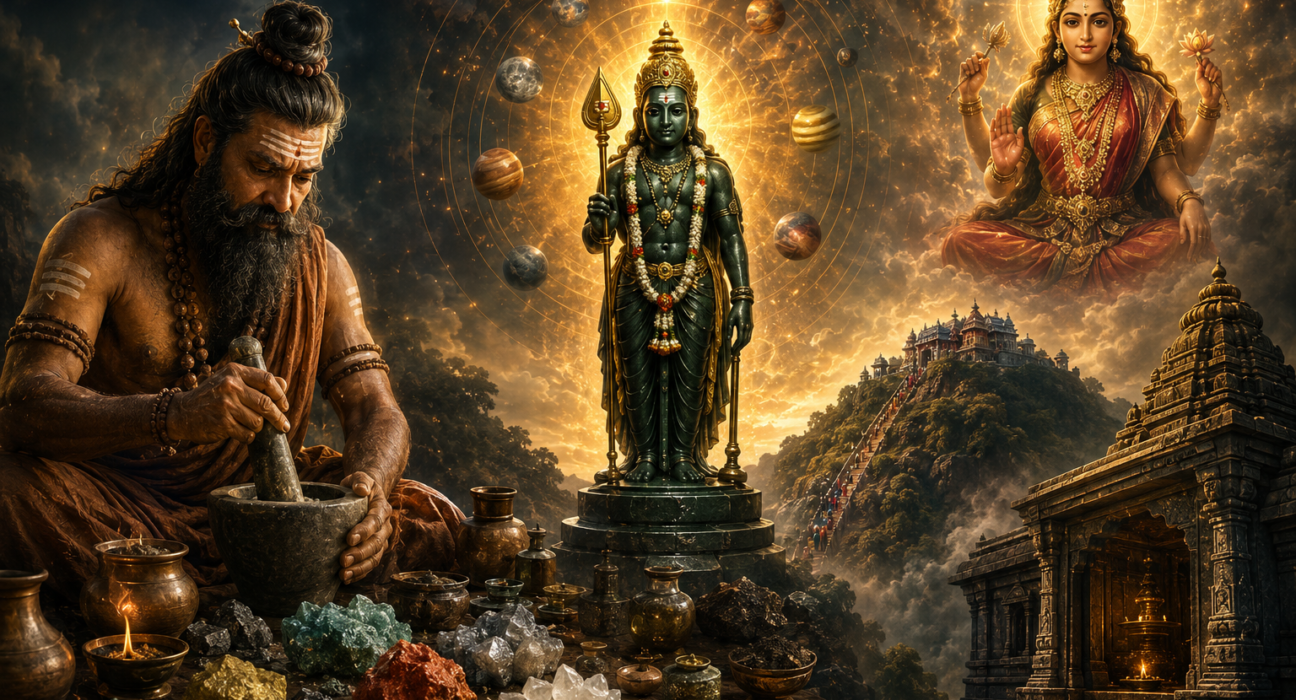
Palani Murugan's Idol: The Hidden Mystery of Navapashanam and the Spiritual Vision of Siddhar Bogar
The Idol of Palani Murugan Is Not an Ordinary Stone
Millions of devotees climb the sacred hill of Palani every year to worship Lord Dhandayuthapani. Almost everyone has heard one extraordinary claim about the deity—the idol is not carved from ordinary stone. It is made of Navapashanam.
But how many truly understand the mystery hidden behind that single word?
According to the Siddha tradition, a great Siddhar combined nine powerful poisonous minerals using an extraordinary process of ancient alchemy known as Rasavatham. These minerals, which could be deadly to humans in their natural form, were transformed through a secret spiritual and scientific process into something entirely different.
The result was not merely an idol.
It became a divine form.
That sacred form continues to stand today on the summit of Palani Hill as Lord Murugan, worshipped by millions.
Many devotees believe that the Navapashanam idol continues to possess medicinal and spiritual properties even today, making it far more than a simple representation of a deity.
But this raises an important question.
Why did Siddhar Bogar create this idol?
Was it simply an object of worship?
Or was it designed to preserve one of humanity’s greatest spiritual secrets?
To understand the answer, we must travel back in time—not merely to the history of Palani, but into the extraordinary life of the Siddhar who stood at the center of this mystery.
That Siddhar was Bogar.
Who Was Siddhar Bogar?
Among all the Siddhars of the Tamil Siddha tradition, Bogar occupies a unique place.
He was not merely a saint or a yogi.
He was:
- A master physician
- A brilliant alchemist
- A scientist of ancient spiritual chemistry
- A realized yogi
- A spiritual master who combined medicine, yoga, and divine wisdom
The Siddha tradition describes Bogar as a traveler who journeyed far beyond the boundaries of Tamil Nadu, carrying spiritual knowledge across the world.
One of the most mysterious chapters of his life concerns his journey to China.
Why Did Bogar Travel to China?
According to Siddha literature, Bogar traveled to China under the command of his guru, Kalangi Nathar.
This was not an ordinary journey.
It was a sacred mission to spread higher spiritual knowledge.
Traditional accounts state that Bogar introduced Siddha medicine, alchemy, Kayakalpa rejuvenation techniques, yogic sciences, and mystical wisdom to the people there.
Some traditions even claim that he lived in China under another name:
Bo-Yang.
An even more fascinating theory proposed by certain researchers suggests that this Bo-Yang may later have become the legendary Taoist sage Lao Tzu, the founder of Taoism.
Certain references found in Siddha works such as the Saptha Kandam are often cited in support of this theory.
However, historians continue to debate these claims, and no definitive historical evidence exists to confirm them. As with many aspects of Bogar’s life, they remain part of the enduring mystery surrounding this remarkable Siddhar.
Bogar’s Greatest Realization
Although Bogar traveled widely, some of the most significant discoveries of his life took place in Tamil Nadu.
He developed numerous Siddha medicines, including:
- Bhasmas (sacred medicinal ashes)
- Kayakalpa rejuvenation therapies
- Mineral preparations
- Powerful herbal and alchemical pills
His medical knowledge was extraordinary.
He could cure diseases that seemed impossible to treat.
Yet, despite all his achievements, Bogar eventually realized something profound.
Medicine can heal the body.
But it cannot completely remove the deeper cause of human suffering.
According to Siddha philosophy, physical illness, suffering, disability, and hardship are often linked to accumulated karma.
No medicine alone can erase the consequences of karma.
This realization deeply transformed Bogar’s thinking.
The Questions That Changed Bogar’s Life
One day, many people came seeking Bogar’s help.
They came asking for medicines.
But the questions they asked revealed something much deeper.
Some asked:
“Can you give us a medicine that prevents old age?”
Others wanted:
“Is there a medicine that keeps us forever young?”
Some even asked:
“Can you give us something that prolongs worldly pleasure?”
These questions troubled Bogar.
The people were not merely seeking health.
They were searching for lasting pleasure.
Only a handful of seekers asked entirely different questions.
Instead of asking about medicine, they asked:
- How can one realize God?
- How should one meditate?
- What is the true goal of a spiritual seeker?
Watching the crowd silently, Bogar understood an uncomfortable truth.
Most people were not searching for liberation.
They only wanted relief from suffering while continuing the same cycle of attachment.
Very few wished to remove karma.
Many unknowingly continued creating more of it.
This realization filled him with deep compassion.
He asked himself:
“I have discovered medicines for diseases of the body. But what is the medicine for the greatest disease of all—the endless cycle of birth and rebirth?”
Bogar’s Deep Meditation
With this question burning within him, Bogar entered intense meditation.
He devoted himself to the worship of his chosen deity,
Goddess Bhuvaneshwari.
Days passed.
Months passed.
During his deep tapas, the Divine Mother is believed to have appeared before him.
According to Siddha tradition, she blessed Bogar and spoke:
“Your purpose is noble. The knowledge you have discovered will never be wasted.”
But she gave him an even greater mission.
She instructed him:
“You have created medicines for bodily diseases. Now create a remedy for the disease of repeated birth.”
This remedy, she said, should not be an ordinary medicine.
It should become a powerful divine manifestation.
The Divine Origin of Navapashanam
The Goddess instructed Bogar to unite the powers of the nine planetary energies into a single divine form.
For this purpose, he was told to use Navapashanam.
According to traditional belief:
- Nine mysterious minerals
- Representing nine planetary energies
- United through an extraordinary alchemical process
The Goddess further revealed that the perfect divine form for holding these energies would be Lord Murugan.
With this divine instruction, Bogar began one of the greatest spiritual and scientific undertakings in Indian history.
Evidence That Continues at Palani
For many devotees, this is not merely mythology.
Even today, visitors to the Palani Dhandayuthapani Temple can visit the Jeeva Samadhi of Siddhar Bogar, located in the southwestern prakaram of the hill temple.
There is also a shrine dedicated to Goddess Bhuvaneshwari, whom tradition says Bogar worshipped during his spiritual practices.
These sacred sites continue to remind pilgrims of the Siddhar’s extraordinary legacy.
Why Did Bogar Enter Jeeva Samadhi?
After completing the Navapashanam idol, Bogar made another remarkable decision.
He wanted the divine energy within the idol to remain eternally active.
For this purpose, he chose one of the highest yogic attainments known in the Siddha tradition.
He did not simply die.
He entered Jeeva Samadhi.
In Siddha philosophy, Jeeva Samadhi is not ordinary death.
It is the conscious preservation of life force through advanced yogic mastery, allowing the realized being’s spiritual presence to remain active even after withdrawing from ordinary physical life.
According to Siddha tradition, Bogar entered Jeeva Samadhi near the Navapashanam Murugan idol itself.
His Jeeva Samadhi at Palani continues to be revered by devotees to this day.
Many Siddha traditions believe that Bogar still remains in a subtle meditative state, spiritually protecting the divine energy of Lord Dhandayuthapani.
The True Medicine According to the Siddhars
The Siddhars often expressed a profound truth.
Medicines exist for diseases of the body.
But for the disease of repeated birth, there is only one ultimate remedy.
According to this tradition,
that remedy is Palani Dhandayuthapani.
The Lord is not worshipped merely as a deity who grants worldly blessings.
He is revered as the embodiment of divine wisdom capable of removing ignorance, dissolving fear, reducing the burden of karma, and leading seekers toward liberation.
For those who understand this deeper symbolism, Palani is far more than a famous temple.
It becomes:
- A center of spiritual wisdom.
- A sacred field of transformative energy.
- A reminder of humanity’s highest purpose.
Conclusion
The story of Bogar and the Navapashanam Murugan is one of the most fascinating narratives preserved in the Siddha tradition. It blends spirituality, alchemy, medicine, philosophy, and devotion into a single timeless legacy.
While many aspects of this tradition remain matters of faith rather than historically verified fact, the impact of Bogar’s teachings and the enduring reverence for the Palani Murugan temple continue to inspire millions of devotees.
Whether viewed as history, sacred tradition, or spiritual symbolism, the mystery of Navapashanam invites every seeker to ask a deeper question:
Are we merely seeking relief from life’s problems—or are we seeking freedom from the cycle of suffering itself?