


Ayodhya Ram Mandir History: 500 Years of Faith & Devotion
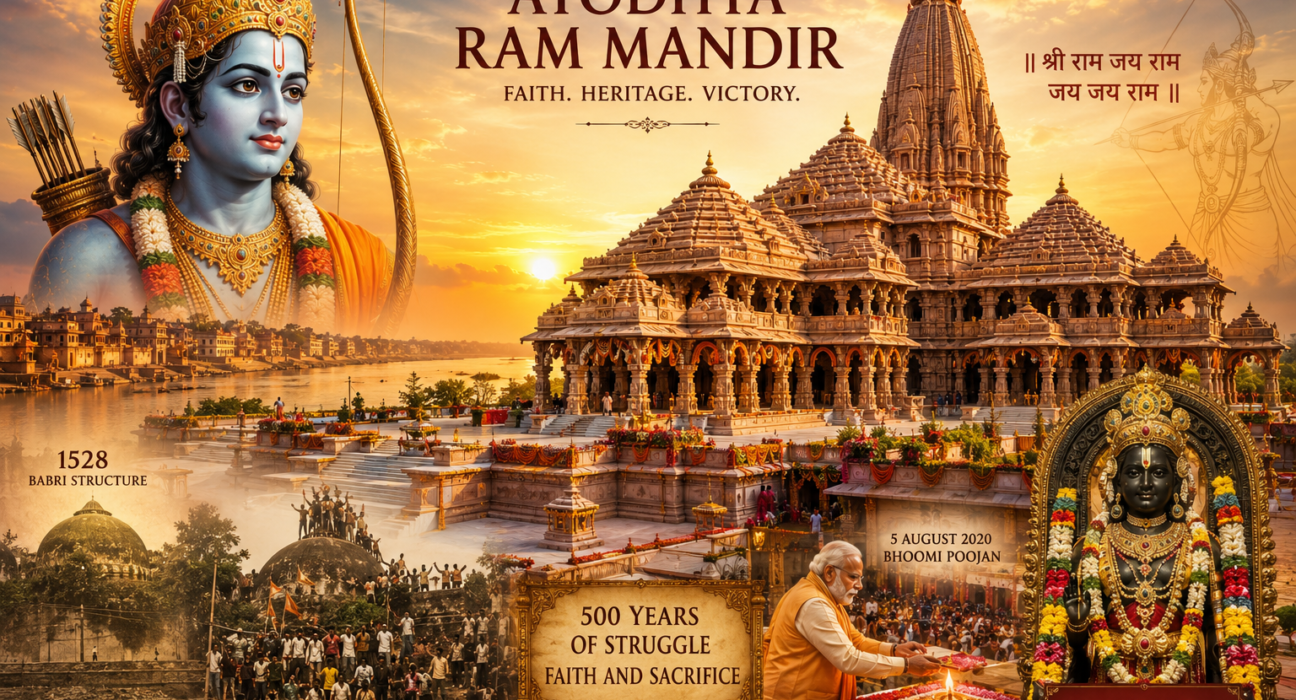
Ayodhya Ram Mandir: The 500-Year Journey of India's Most Sacred Temple
Introduction
Few moments in modern Indian history have stirred the emotions of millions as profoundly as the consecration of the Ayodhya Ram Mandir.
For many, witnessing the inauguration of Lord Rama’s birthplace temple felt like experiencing a new chapter of India’s spiritual freedom.
While earlier generations witnessed India’s political independence, today’s generation has witnessed the revival of one of Hinduism’s most sacred pilgrimage sites—Sri Ram Janmabhoomi.
But the history of Ayodhya is far older than five centuries.
Its story stretches back through the Vedas, the Ramayana, and thousands of years of Indian civilization.
Ayodhya – The Eternal City
Ayodhya is not merely an ancient city.
It is one of the oldest continuously revered cities in the world.
References to Ayodhya appear in both the Rig Veda and the Atharva Veda, where it is described as the City of the Gods.
For Hindus, Ayodhya is the birthplace of Lord Rama, the seventh incarnation of Lord Vishnu and the embodiment of Dharma.
For thousands of years, it has remained one of India’s holiest pilgrimage destinations.
The Sacred Bond Between Ayodhya and Tamil Nadu
One of the lesser-known but fascinating aspects of Ayodhya’s history is its deep connection with Tamil Nadu.
According to the Ramayana, Sri Ranganathar of Srirangam was the Kuladeivam (family deity) of Lord Rama’s Ikshvaku dynasty.
Long before Rama was born, Lord Vishnu is believed to have bestowed the reclining form of Sri Ranganathar upon the Ikshvaku kings.
Lord Rama himself worshipped this sacred deity in Ayodhya.
After the victory over Ravana, Rama gifted the idol to Vibhishana as a token of gratitude.
While carrying it to Lanka, Vibhishana installed the deity on the banks of the River Kaveri, where it became the world-famous Sri Ranganathaswamy Temple at Srirangam.
This beautiful legend creates an everlasting spiritual bridge between Ayodhya and Tamil Nadu.
Was There a Temple at Rama’s Birthplace?
Many wonder whether a temple existed at Rama’s birthplace before the modern Ram Mandir.
Traditional accounts state that an ancient shrine known as the Ram Lalla Temple stood at the Janmabhoomi.
Some traditions attribute its construction to King Harishchandra, while others believe it was built by Kusha, the son of Lord Rama.
Regardless of its exact origins, the birthplace of Lord Rama remained an object of devotion for centuries.
The Babri Structure and the Beginning of a Long Dispute
In the early 16th century, Mughal emperor Babur established his rule in India.
Historical records state that in 1528 CE, his commander Mir Baqi constructed a mosque at Ayodhya.
Many Hindus have long believed that this structure was built after demolishing the earlier Ram Janmabhoomi temple.
This belief became the foundation of one of the longest religious and legal disputes in Indian history.
Over the centuries, local rulers, devotees, saints, and ordinary citizens continued efforts to reclaim the sacred birthplace.
The Legal Battle
The modern phase of the dispute intensified during the 19th century.
Numerous legal cases, religious movements, public demonstrations, and negotiations continued for decades.
Archaeological investigations later uncovered structural remains and artifacts beneath the disputed site, contributing to the legal proceedings.
In 2019, the Supreme Court of India delivered its historic judgment permitting the construction of the Ram Temple at the Janmabhoomi site.
This landmark verdict paved the way for one of India’s most significant temple reconstruction projects.
Foundation of the New Ram Mandir
On 5 August 2020, Prime Minister Narendra Modi performed the Bhoomi Pujan and laid the foundation stone for the new temple.
The ceremony was witnessed by millions across India and around the world, marking the beginning of a new era in the temple’s history.
Architecture of the Ayodhya Ram Mandir
The new Ram Mandir is a masterpiece of traditional Indian temple architecture.
Some remarkable features include:
- Length: 360 feet
- Width: 235 feet
- Height: 161 feet
- Three-storey structure
- Five grand mandapas surrounding the sanctum
- Octagonal Garbhagriha
- Hundreds of beautifully carved pillars
The design follows the principles of Vastu Shastra and Shilpa Shastra, preserving classical temple architecture while ensuring structural longevity.
A Temple Built to Last for Centuries
One of the most extraordinary aspects of the Ram Mandir is its engineering.
The temple has been constructed:
- Without steel reinforcement
- Without cement in the main structural framework
- Using massive sandstone blocks
- With thousands of copper plates joining the stone sections
The foundation has been specially engineered to withstand earthquakes and natural disasters for generations to come.
The Idol of Ram Lalla
Three magnificent idols of Ram Lalla were sculpted for the temple.
The idols stand approximately four feet tall, while the sanctum’s pedestal elevates the divine presence to nearly seven feet.
On 22 January 2024, one of these idols was ceremonially consecrated through the sacred Prana Pratishtha, becoming the presiding deity of the temple.
Contributions from Across India
The Ram Mandir represents the devotion of the entire nation.
Its construction includes contributions from many parts of India:
- Granite and sandstone from Rajasthan
- Bells from Tamil Nadu
- Temple doors crafted by artisans
- Sacred waters collected from major rivers
- Holy soil brought from countless pilgrimage sites
Even countries associated with the Ramayana, including Nepal and Thailand, contributed sacred offerings, symbolizing the temple’s global spiritual significance.
The Extraordinary Sacrifice of the Suryavanshis
Perhaps the most moving chapter in the Ram Mandir story belongs to the Suryavanshi Kshatriya families living around Ayodhya.
According to tradition, after the destruction of the original temple centuries ago, these families took a solemn vow:
- They would not wear footwear.
- They would not wear turbans.
- They would not use umbrellas.
They observed this vow for nearly 500 years, even during weddings and family celebrations, until the construction of the new Ram Mandir became a reality.
Only after the temple’s consecration were they said to have resumed these customs, making their sacrifice one of the most remarkable acts of devotion in recent history.
Conclusion
The Ayodhya Ram Mandir is far more than a magnificent temple. It stands as a symbol of faith, perseverance, cultural continuity, and devotion that spans millennia.
From the Vedic references to Ayodhya, the sacred legacy of Lord Rama, the enduring bond with Srirangam, centuries of legal and social struggles, and the remarkable contributions of devotees across India, the temple embodies a story unlike any other.
Today, the Ayodhya Ram Mandir welcomes pilgrims from around the world, reminding every visitor that Dharma, patience, and unwavering faith can overcome even the greatest trials. It is not merely a monument of stone—it is a living testament to one of the world’s oldest spiritual traditions and the timeless legacy of Lord Rama.