
Akka Mahadevi: The Fearless Woman Saint Who Renounced Everything for Lord Shiva
Akka Mahadevi: The Woman Who Renounced Everything for Lord Shiva
The Extraordinary Prayer of a Mystic Who Desired Nothing but God
Most people approach God with a long list of desires.
Some pray for wealth.
Others ask for success, good health, a happy family, or protection from suffering.
Very few stand before the Divine asking for less.
But nearly a thousand years ago, a young woman offered one of the most astonishing prayers ever recorded in Indian spirituality—a prayer so radical that even today it challenges our understanding of devotion.
She did not ask for prosperity.
She did not ask for comfort.
She did not even ask for liberation.
Instead, she prayed:
“O Lord, let me never find food to satisfy my hunger. Let my body experience the same unbearable longing that my soul feels in its separation from You. If food somehow reaches my hands, let it fall to the ground before I can eat it. And before this foolish mind attempts to pick it up, send a dog to carry it away.”
To an ordinary person, such a prayer appears strange—perhaps even unimaginable.
Why would anyone willingly reject food?
Why would someone pray for hunger instead of abundance?
The answer lies in the life of one of India’s greatest women mystics—Akka Mahadevi.
For her, every earthly satisfaction weakened the intensity of her longing for Lord Shiva. Hunger was not suffering; it was a reminder that only union with the Divine could truly satisfy the soul.
A Saint Consumed by Divine Love
Akka Mahadevi was not merely a poet or an ascetic.
She was a Mahayogini whose entire existence revolved around one unwavering truth:
Nothing in this universe was worth desiring except Shiva.
Her devotion was so absolute that she regarded every worldly relationship, every possession, and every social identity as temporary shadows before the eternal presence of God.
To understand her extraordinary life, one must first understand the intensity of her love for Shiva.
It was not symbolic.
It was not philosophical.
It was deeply personal.
She lived every moment as though she already belonged to Him alone.
Born into a Family of Devotees
Akka Mahadevi was born in Udutadi, a village near Banavasi in present-day Karnataka’s Shivamogga district.
Her parents, Nirmala Shetty (often identified in traditional accounts as Sumati or Annamma) and Nirmala/Prabhu family traditions are remembered in different historical sources, but all traditions agree on one point:
She was born into a deeply Shaivite household where worship of Lord Shiva formed the very foundation of daily life.
Growing up in such an atmosphere, Mahadevi naturally developed an intense attraction toward spirituality.
While other children found joy in games and worldly pleasures, her heart was drawn toward temples, hymns, and meditation.
From a remarkably young age, Shiva became the center of her universe.
A Divine Gift from Childhood
Tradition says that Akka Mahadevi possessed extraordinary spiritual qualities from birth.
She displayed remarkable poetic brilliance while still very young.
Her compositions flowed effortlessly, expressing profound mystical truths with astonishing simplicity.
She was also blessed with a melodious voice.
Whenever she sang devotional hymns, listeners were captivated—not merely by the beauty of her music but by the sincerity of her devotion.
Her songs did not entertain.
They awakened hearts.
People felt that the words arose not from intellectual effort but from direct spiritual experience.
A Heart Belonging to Mallikarjuna
Among the countless forms of Lord Shiva worshipped throughout India, one captured Mahadevi’s entire heart.
It was Lord Mallikarjuna, the presiding deity of Srisailam.
Located in present-day Andhra Pradesh, Srisailam is one of the twelve sacred Jyotirlingas, making it one of the holiest Shaivite pilgrimage centers in India.
It is also revered as one of the Shakti Peethas, where the Divine Mother is worshipped alongside Lord Shiva.
For Akka Mahadevi, however, Mallikarjuna was not merely a deity residing in a distant temple.
He was her eternal beloved.
Her only companion.
Her true husband.
“Only Chennamallikarjuna Is My Companion”
One of her most celebrated vachanas beautifully expresses this extraordinary relationship:
“There are villages where food may be received in a begging bowl.
There are wells and ponds that quench one’s thirst.
There are abandoned temples where one may sleep.
But for my heart, there is only one companion—
Chenna Mallikarjuna.”
These words reveal the foundation of her entire spiritual life.
Food could come from anyone.
Shelter could be found anywhere.
Water was available to all.
But true companionship belonged only to the Eternal.
Every human relationship, she believed, was bound by birth and death.
Only Shiva remained forever.
Living in Constant Remembrance
As she grew older, Akka Mahadevi’s devotion deepened further.
Every evening, she visited the Shiva temple in her village and sang before the Lord.
Villagers slowly gathered around her.
They were moved not only by the sweetness of her voice but also by the intensity of the devotion radiating through every word.
Her fame spread far beyond her village.
People travelled simply to hear the young devotee sing.
Many sensed that this was no ordinary girl.
She carried within her the unmistakable fire of divine love.
A Fame That Reached the Royal Court
Eventually, news of the beautiful young poet reached the ears of King Kaushika, the ruler of the region.
Curious about the reports, the king decided to see her for himself.
Disguised as an ordinary man, he attended one of her devotional gatherings.
He expected to hear an accomplished singer.
Instead, he encountered something far greater.
He witnessed a young woman whose entire being had dissolved into devotion.
Yet instead of understanding her spiritual greatness, the king became captivated by her extraordinary beauty.
What he mistook for physical attraction was, in truth, the radiance of divine consciousness.
From that moment, he resolved to marry her—setting in motion one of the most dramatic chapters in the history of Indian spirituality.
The Queen Who Walked Away from a Kingdom
King Kaushika could not forget the young woman he had seen singing in the temple.
Her beauty captivated him.
But more than her appearance, it was the mysterious radiance that surrounded her that left an unforgettable impression.
He decided that Akka Mahadevi must become his queen.
What began as admiration soon became determination.
The king sent his proposal.
When it was politely refused, he applied increasing pressure upon her parents, making it clear that he would not accept rejection.
Why Akka Mahadevi Refused the King
Akka Mahadevi’s refusal had nothing to do with wealth, power, or status.
King Kaushika ruled a prosperous kingdom.
He could offer luxury beyond imagination.
But Mahadevi’s heart had already chosen another.
She had long regarded Lord Chennamallikarjuna of Srisailam as her eternal husband.
In her eyes, every earthly marriage was temporary.
Only union with Shiva was eternal.
There was another reason for her hesitation.
According to traditional accounts, King Kaushika followed the Jain faith, while Mahadevi’s entire life revolved around Shaivism.
She feared that marriage would interfere with her worship of Lord Shiva.
To her, abandoning devotion was impossible.
A Difficult Decision
As the king’s insistence grew stronger, Mahadevi’s parents found themselves trapped in an impossible situation.
Refusing the ruler could bring danger upon the entire family.
Unable to bear the thought that her parents might suffer because of her decision, Mahadevi finally agreed to the marriage.
It was not a decision born of personal desire.
It was an act of compassion toward her parents.
According to society’s laws, she became the queen.
But within her heart, nothing had changed.
She continued to belong only to Shiva.
A Marriage That Could Never Possess Her
Life inside the royal palace offered every imaginable comfort.
Jewels.
Silks.
Servants.
Royal privileges.
Yet none of these held any attraction for Mahadevi.
While others admired the splendour of palace life, she remained immersed in meditation.
Her lips constantly repeated the name of Shiva.
Her thoughts never wandered toward worldly pleasures.
To the king’s growing frustration, his queen seemed completely indifferent to the life he had built around her.
Her body lived in the palace.
Her soul dwelt at Srisailam.
“I Belong Only to Shiva”
Years passed.
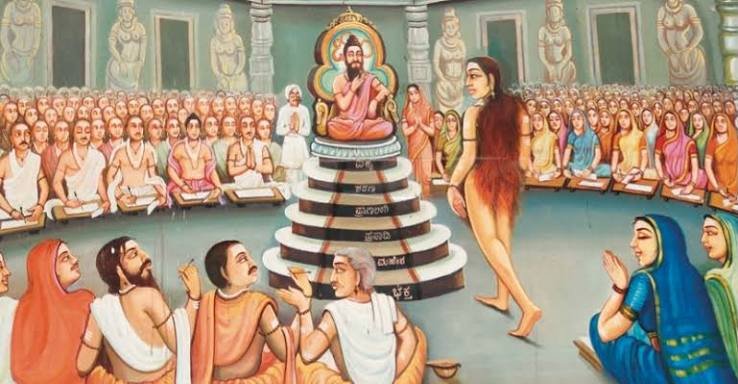
Unable to understand his wife’s complete detachment, King Kaushika finally confronted her before the entire royal court.
Ministers, scholars, nobles, and attendants gathered to witness the proceedings.
Perhaps the king believed public pressure would compel her to accept her duties as queen.
Instead, history witnessed one of the boldest declarations ever made by a spiritual seeker.
Standing fearlessly before the assembled court, the young Mahadevi spoke with extraordinary clarity.
She said:
“You are mistaken. I am not your wife.”
The entire court fell silent.
She continued,
“A social ceremony may have made you believe that I belong to you. But long before that, I had already offered everything that I am to Lord Shiva. My body, my mind, my heart, and my soul belong only to Him. I have nothing left to give anyone else.”
There was no anger in her voice.
Only absolute certainty.
She was not rebelling against the king.
She was affirming a truth she had lived since childhood.
The King’s Challenge
Humiliated before his court, King Kaushika responded in anger.
He declared:
“You are my queen. I feed you. I clothe you. I provide your palace, your jewels, and your comforts. Everything you possess comes from me. How then can you claim to belong to another?”
To the king, ownership was measured through material provision.
To Mahadevi, ownership belonged only to the One who had created the soul.
Two completely different worlds stood facing one another.
One represented worldly authority.
The other represented absolute spiritual freedom.
The Moment That Changed Everything
Mahadevi did not argue.
She did not defend herself.
She did not attempt to persuade anyone.
Instead, she quietly began removing her ornaments.
One by one, the jewels given by the king were placed upon the floor.
The necklaces.
The bangles.
The earrings.
The anklets.
Everything that belonged to the palace.
The court watched in stunned silence.
Then, in an act that no one could have imagined, she removed the royal garments themselves.
Standing before the entire assembly, she declared:
“These belong to you. Take back everything that is yours.”
At that moment, she renounced not merely wealth but every worldly identity that society had imposed upon her.
Queen.
Wife.
Royal consort.
Status.
Honour.
Power.
All of it was left behind in a single instant.
Beyond Shame and Social Boundaries
To many, this event appears shocking.
But to understand Akka Mahadevi’s action, one must understand her spiritual vision.
She later expressed it beautifully in one of her vachanas:
“When the entire universe is the gaze of the Lord, when nothing is hidden from Him, what is there that you imagine you can conceal?”
For Mahadevi, the body was neither an object of pride nor a source of shame.
It was simply another temporary covering of the eternal soul.
If the Divine already witnessed everything, then social ideas of concealment lost their ultimate significance.
This was not an act of defiance against society.
It was the complete transcendence of worldly identity.
Clothed Only in Divine Grace
Traditional accounts say that after leaving the palace, Akka Mahadevi never again wore ordinary clothing.
Instead, her long, flowing hair covered her body like a natural garment.
Devotees regarded this not merely as coincidence but as a sign of Shiva’s divine protection.
To them, it symbolized that the Lord Himself had become her only covering.
From that day onward, she possessed nothing.
No palace.
No wealth.
No family.
No earthly security.
Only unwavering devotion to Lord Chennamallikarjuna.
She had exchanged a kingdom for freedom.
And she never looked back.
.
The Wandering Mystic Who Became the Mother of Virashaiva Devotion
Having renounced the palace, wealth, royal privilege, and even her worldly identity, Akka Mahadevi stepped into an entirely different life.
She no longer belonged to any kingdom.
The world itself became her home.
With nothing but unwavering devotion to Lord Chennamallikarjuna, she wandered from village to village, singing of the Divine with a freedom few human beings have ever known.
To some, she appeared as a homeless ascetic.
To others, she was a living saint.
To those who could truly see, she was a soul already liberated while still walking the earth.
A Life Without Possessions
Most people spend their lives acquiring.
Akka Mahadevi spent hers letting go.
She owned no house.
No ornaments.
No wealth.
No social status.
Even food meant little to her.
She survived on alms, accepting only what was necessary to keep the body alive.
For Mahadevi, the body was merely an instrument for realizing Shiva.
It deserved neither indulgence nor neglect.
It simply had to be sustained until its purpose was fulfilled.
Every step she took became a prayer.
Every breath became remembrance.
Every moment became worship.
A Mystic Who Spoke Through Poetry
As she travelled across Karnataka, Akka Mahadevi composed hundreds of mystical poems known as Vachanas.
Unlike elaborate classical poetry, Vachanas were simple, direct, and deeply personal.
They did not describe distant philosophies.
They revealed lived spiritual experience.
Her words carried the intensity of someone who had seen the Divine firsthand.
One of her most moving declarations captures the depth of her longing:
“Embrace the body of the Lord so completely that your very bones may break beneath the intensity of that embrace.”
Such expressions cannot be understood merely as poetic exaggeration.
They describe a soul yearning to dissolve completely into the Divine, leaving no trace of individuality behind.
Even today, her Vachanas continue to awaken seekers with their uncompromising honesty and spiritual power.
Why She Was Called “Akka”
As her fame spread, people stopped addressing her simply as Mahadevi.
Instead, they lovingly began calling her “Akka,” meaning “Elder Sister.”
The title reflected far more than affection.
People experienced her as someone who guided, protected, and inspired all who came to her.
Over time, within the Virashaiva tradition, the word “Akka” came to refer to Akka Mahadevi alone.
It became not merely a title but a recognition of her unique place among India’s great women saints.
Many devotees even believed that she was a manifestation of the Divine Mother herself.
The Great Saints Who Revered Her
Akka Mahadevi lived during one of the greatest spiritual movements in Karnataka—the Virashaiva (Lingayat) movement.
This remarkable renaissance was led by towering spiritual personalities such as:
- Basavanna
- Allama Prabhu
- Chenna Basavanna
- Kinnari Bommayya
These enlightened masters recognized Akka Mahadevi’s extraordinary spiritual realization.
Rather than treating her as merely another devotee, they revered her as a saint of exceptional purity and wisdom.
Among them, Allama Prabhu held profound philosophical discussions with her, and tradition remembers these dialogues as some of the deepest spiritual conversations in medieval Indian history.
Their mutual respect demonstrated that true spiritual realization transcends distinctions of gender, age, and social status.
The Courage of a Woman Ahead of Her Time
It is difficult for the modern world to fully appreciate Akka Mahadevi’s courage.
She lived nearly a thousand years ago.
Society imposed strict expectations upon women.
A woman’s identity was largely defined by her family, marriage, and social duties.
To reject all these conventions required extraordinary inner strength.
Yet Mahadevi did exactly that.
She did not reject society out of anger.
She rejected anything that prevented her complete union with Shiva.
She chose the uncertainty of wandering over the security of a palace.
She chose begging over royal luxury.
She chose divine love over worldly approval.
Such choices continue to inspire spiritual seekers even today.
The Final Journey to Srisailam
Throughout her life, one destination remained constantly alive within her heart.
Srisailam.
It was there that Lord Chennamallikarjuna, the beloved of her soul, resided.
After years of wandering, singing, and inspiring countless devotees, Akka Mahadevi finally reached the sacred mountain shrine.
For her, this was not merely another pilgrimage.
It was the fulfilment of a lifelong longing.
She had always regarded Chennamallikarjuna as her eternal husband.
Now she had come home.
Union in the Cave of Silence
Traditional accounts describe her final days with profound reverence.
Near the sacred temple of Srisailam lies a cave associated with Akka Mahadevi.
It is believed that she spent her final period there immersed in uninterrupted meditation upon Lord Shiva.
The outside world slowly disappeared.
The distinction between devotee and deity dissolved.
According to tradition, Akka Mahadevi did not merely die.
She attained Sayujya Mukti—complete union with Lord Chennamallikarjuna.
The soul that had spent every moment longing for Shiva finally merged with Him forever.
She is believed to have been only twenty-five years old when this supreme union took place.
Though her earthly life was brief, her spiritual influence has endured for centuries.
A Legacy That Continues to Inspire
Akka Mahadevi’s contribution extends far beyond her own lifetime.
Her Vachanas occupy a place of honour in Kannada literature, where they are celebrated not only for their poetic beauty but also for their profound spiritual insight.
Her life became a cornerstone of the Virashaiva movement, inspiring generations of saints, philosophers, and devotees.
Even today, her words challenge readers to question attachment, ego, and fear while awakening an intense longing for direct experience of the Divine.
She demonstrated that true spirituality is not measured by rituals alone but by the courage to surrender everything for the sake of Truth.
A Timeless Symbol of Spiritual Freedom and Absolute Devotion
Akka Mahadevi’s story is far more than the biography of a medieval saint.
It is the story of a human being who refused to compromise her deepest truth.
Her life compels us to ask uncomfortable yet profound questions.
What do we truly love?
What are we willing to sacrifice for it?
Is our devotion strong enough to withstand the pressures of society, family, comfort, and fear?
For Akka Mahadevi, these questions were never theoretical.
She answered them through the way she lived.
A Woman Centuries Ahead of Her Time
Even in the twenty-first century, many women around the world continue to face social expectations regarding marriage, family, career, and personal choices.
Nearly a thousand years ago, those expectations were even stronger.
Yet Akka Mahadevi dared to choose an entirely different path.
She declared that her life belonged to God alone.
She did not reject marriage because she opposed family life.
She rejected anything that stood between her and the Divine.
Her decision was not an act of rebellion.
It was an act of total surrender.
This distinction is important.
True renunciation is not born from hatred of the world.
It is born from overwhelming love for God.
The Right to Choose a Spiritual Life
Akka Mahadevi’s life also reminds us of an important truth that is often overlooked.
Every individual has the freedom to choose the path that calls to their soul.
Just as a person has the right to marry, they also have the right to embrace a life of spiritual renunciation.
History remembers several extraordinary women saints who walked this path, including:
- Karaikkal Ammaiyar
- Akka Mahadevi
- Sivakami Paradesi Ammaiyar
Their lives demonstrate that the pursuit of God is not limited by gender, social status, or worldly roles.
Spiritual realization belongs equally to all who seek it with sincerity.
Renunciation Is More Than Giving Up Possessions
Many people imagine that renunciation simply means owning fewer things.
Akka Mahadevi teaches something much deeper.
Real renunciation begins within.
It is the willingness to let go of:
- Ego.
- Pride.
- Social identity.
- Fear of public opinion.
- Attachment to praise.
- Dependence on worldly approval.
When she walked out of the royal court, she did not merely abandon jewels and silk garments.
She abandoned every label that society had placed upon her.
Only then could she stand before Shiva with complete freedom.
The Fire of Divine Longing
Perhaps the greatest lesson Akka Mahadevi offers is the intensity of spiritual longing.
Her famous prayer asking that food never satisfy her hunger may seem extreme.
Yet it reveals an extraordinary insight.
She feared physical satisfaction because it might weaken her longing for God.
For her, every hunger of the body pointed toward a far deeper hunger—the soul’s longing to reunite with its eternal source.
That longing became the force that transformed an ordinary village girl into one of India’s greatest mystics.
A Legacy That Continues to Live
Although Akka Mahadevi lived for only about twenty-five years, her influence has endured for nearly a millennium.
Her Vachanas continue to be studied as masterpieces of Kannada literature.
Her life remains a source of inspiration within the Virashaiva (Lingayat) tradition and beyond.
Saints such as Basavanna, Allama Prabhu, Chenna Basavanna, and Kinnari Bommayya revered her spiritual greatness, and generations of devotees have continued to celebrate her as one of India’s foremost women saints.
Today, pilgrims still visit the cave at Srisailam associated with her final meditation, remembering the woman whose only desire was to become one with Lord Mallikarjuna.
Akka Mahadevi’s Message for Modern Seekers
In a world driven by achievement, wealth, and constant distraction, Akka Mahadevi offers a radically different vision of fulfilment.
She reminds us that:
- Possessions cannot satisfy the soul.
- Social approval is temporary.
- Beauty fades.
- Power passes.
- Relationships change.
- The body itself is impermanent.
Only the Divine remains eternal.
Whether one follows the path of renunciation or continues a household life, her example teaches that genuine spirituality begins when God becomes the highest priority.
Her life is not an invitation for everyone to abandon society.
It is an invitation to examine what truly governs our hearts.
Conclusion
Akka Mahadevi was far more than a poet, philosopher, or saint.
She was the embodiment of fearless devotion.
She transformed longing into prayer, prayer into poetry, poetry into realization, and realization into eternal union with the Divine.
Her unwavering love for Lord Chennamallikarjuna shattered every limitation imposed by society, proving that the human soul can rise above fear, attachment, and convention when it is consumed by divine love.
Centuries have passed since her earthly life, yet her voice still echoes through her immortal Vachanas, calling every seeker toward the same timeless truth:
When the heart belongs entirely to God, nothing else remains to be conquered.
Akka Mahadevi’s life is not merely a chapter in spiritual history—it is an enduring reminder that the greatest freedom is found not in possessing the world, but in surrendering completely to the Divine.