
Arunagirinathar and the Nalvar: The Saint Who Embodied the Four Great Saivite Saints
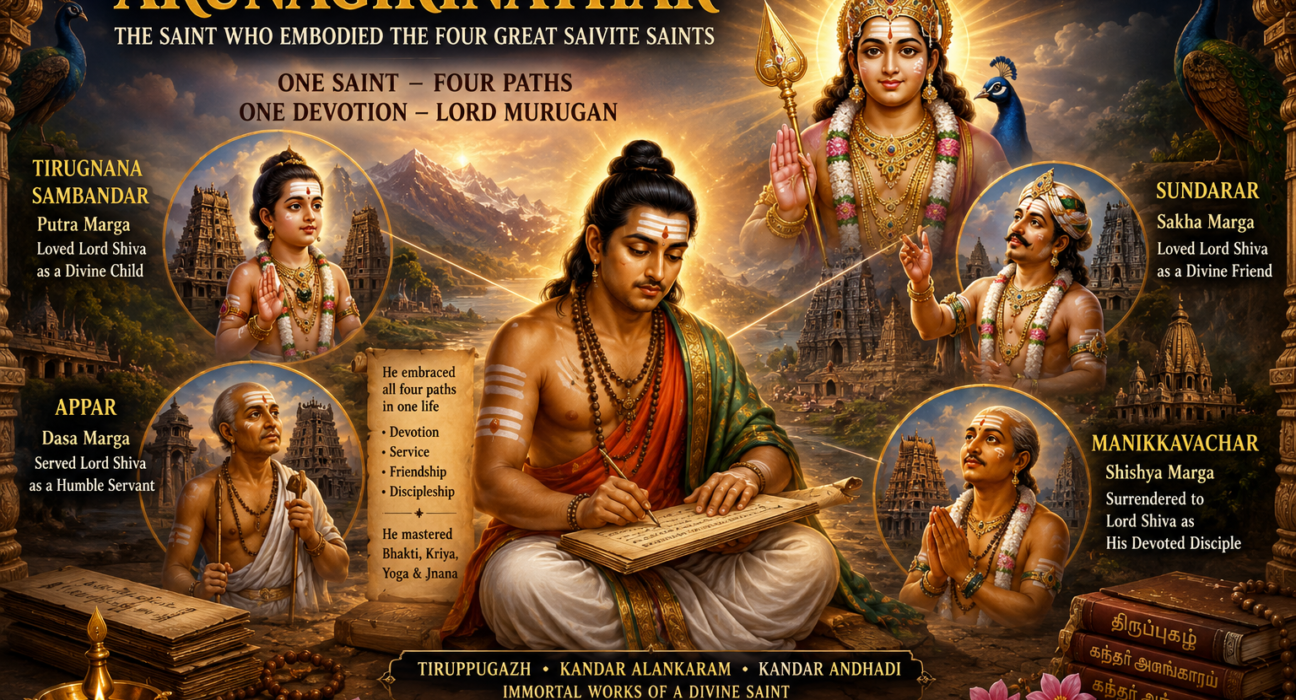
Arunagirinathar: The Saint Who Embodied the Four Great Saivite Saints
How Arunagirinathar United the Spiritual Paths of Sambandar, Appar, Sundarar, and Manikkavachakar
Tamil Saivism has been illuminated by countless saints whose lives became living examples of devotion, wisdom, and divine grace. Among them, the Nalvar—Tirugnana Sambandar, Appar (Tirunavukkarasar), Sundarar, and Manikkavachakar—occupy a unique place in the hearts of devotees. Each attained Lord Shiva through a distinct spiritual path and enriched Tamil spirituality with immortal hymns.
Centuries later, another extraordinary saint emerged—not merely to follow one of these paths, but to embrace all of them simultaneously.
That saint was Sri Arunagirinathar, the great devotee of Lord Murugan and the immortal composer of Tiruppugazh.
Many scholars and spiritual masters have observed that Arunagirinathar shares an astonishing resemblance with the Nalvar. His life, teachings, miracles, and literary contributions reflect the essence of all four great Saivite saints, making him a unique spiritual phenomenon in Tamil religious history.
The Four Spiritual Paths to God
Saivite philosophy describes four principal approaches through which a devotee may attain the Divine:
- Putra Marga – Approaching God as a loving child.
- Dasa Marga – Serving God as a humble servant.
- Sakha Marga – Loving God as an intimate friend.
- Shishya Marga – Receiving divine wisdom as a devoted disciple.
Remarkably, each of the Nalvar became the perfect embodiment of one of these paths.
- Tirugnana Sambandar reached Lord Shiva through the innocent love of a child.
- Appar attained the Lord through tireless service and selfless devotion.
- Sundarar shared an intimate friendship with Lord Shiva, addressing Him as a beloved companion.
- Manikkavachakar attained supreme wisdom through complete surrender as a disciple receiving divine instruction.
Each saint perfected one path.
Arunagirinathar alone embraced all four.
Arunagirinathar: The Saint Who Walked Every Path
One of the most extraordinary aspects of Arunagirinathar’s spiritual life is that his hymns reveal every one of these devotional attitudes toward Lord Murugan.
At times he speaks to Murugan as a loving child would speak to a compassionate father and mother.
In other verses, he longs to become the Lord’s humble servant, praying for the privilege of serving His divine feet.
Elsewhere, he affectionately addresses Murugan as his dearest companion and eternal friend, expressing a relationship filled with intimacy and trust.
In many hymns, Arunagirinathar also stands before Murugan as an obedient disciple, humbly seeking divine instruction and spiritual realization.
Thus, unlike the Nalvar—who each became renowned for a single spiritual relationship with God—Arunagirinathar experienced every one of them within his own life.
Master of the Four Great Spiritual Disciplines
Saiva Siddhanta also teaches four major stages of spiritual evolution:
- Bhakti (Devotion)
- Kriya (Sacred Worship and Ritual Practice)
- Yoga (Inner Spiritual Discipline)
- Jnana (Supreme Wisdom)
Traditional scholars often associate these four disciplines with the Nalvar:
- Appar represents Bhakti.
- Sambandar exemplifies Kriya.
- Sundarar reflects Yoga.
- Manikkavachakar embodies Jnana.
Yet once again, Arunagirinathar stands apart.
His compositions contain profound expressions of every one of these disciplines.
He sings with overflowing devotion.
He glorifies worship through sacred hymns.
He describes subtle yogic experiences, including meditation, breath control, and inner illumination.
Finally, he longs to dissolve into the boundless ocean of divine wisdom bestowed by Lord Murugan.
His works reveal not merely poetic brilliance but the complete spiritual journey from devotion to enlightenment.
A Pilgrim, Worshipper, Yogi, and Jnani
Arunagirinathar’s life itself mirrors these four spiritual disciplines.
His pilgrimage to numerous Murugan temples across South India made him an unparalleled devotee.
His continuous singing of Tiruppugazh before the Lord transformed every temple visit into an act of sacred worship.
Through Murugan’s grace, he received profound yogic teachings and practiced the highest forms of Shiva Yoga.
Finally, he attained Shiva Jnana, the supreme spiritual knowledge that liberates the soul.
Thus, he became not only a poet but also:
- A great devotee.
- A master of ritual worship.
- A realized yogi.
- A true enlightened sage.
Lord Murugan Became His Divine Guru
One of the defining moments in Arunagirinathar’s spiritual life was his direct initiation by Lord Murugan Himself.
Unlike ordinary disciples who receive instruction from human gurus, Arunagirinathar received divine upadesa directly from Murugan.
His own hymns repeatedly acknowledge Murugan as the supreme teacher who revealed the secrets of yoga and liberation.
This sacred relationship closely parallels the life of Manikkavachakar, who likewise received direct spiritual instruction from Lord Shiva.
For Arunagirinathar, Murugan was not merely a deity to worship.
He was the eternal Guru.
Remarkable Similarities Between Arunagirinathar and the Nalvar
The parallels between Arunagirinathar and the four great Saivite saints are truly astonishing.
Like Tirugnana Sambandar, who received divine cymbals from Lord Shiva, Arunagirinathar received a sacred japa mala directly from Lord Murugan.
Like Appar, whose unwavering faith enabled him to survive miraculous ordeals, Arunagirinathar too experienced divine protection when he leapt from a temple tower and emerged unharmed through Murugan’s grace.
Just as Lord Shiva lovingly called Appar to Tiruvaymur, Lord Murugan personally summoned Arunagirinathar from Vayalur to Viralimalai, guiding his spiritual mission.
Like Appar and Sambandar, who received divine gifts from Lord Shiva, Arunagirinathar was blessed with sacred offerings by Lord Murugan.
Revealing the Divine Before Kings
A particularly remarkable similarity exists between Arunagirinathar and Sundarar.
Tradition records that Sundarar invoked Lord Shiva to appear before his devotee Somaasi Mara Nayanar.
Likewise, Arunagirinathar is believed to have invoked Lord Murugan in the royal court to bless his devoted friend, King Prabuda Devarajan, demonstrating the Lord’s living presence before an entire assembly.
These miraculous events reinforced the unshakable faith of countless devotees.
Defender of the True Faith
Like Manikkavachakar, Arunagirinathar also became a fearless defender of spiritual truth.
Tradition recounts that Manikkavachakar defeated learned Buddhist scholars through divine wisdom.
Similarly, Arunagirinathar overcame celebrated scholars such as Villiputhurar and Sambandandan in philosophical debates, establishing the supremacy of Murugan’s grace and Saivite philosophy.
His victories were never motivated by pride.
They were acts of preserving the spiritual heritage of Tamil Saivism.
The Literary Legacy of Arunagirinathar
The similarities extend beyond miracles.
Like Sambandar, who composed thousands of devotional hymns, Arunagirinathar is traditionally believed to have composed nearly 16,000 songs, though only a portion survives today.
His literary masterpieces transformed Tamil devotional literature forever.
Among his greatest works are:
Tiruppugazh
A magnificent collection of musical hymns dedicated to Lord Murugan, celebrated for their intricate rhythms, profound philosophy, and unmatched poetic beauty.
Kandar Alankaram
A devotional masterpiece comparable to Tiruvasagam, overflowing with refined Tamil expression and deep spiritual emotion.
Kandar Andhadi
An exquisite work rich in philosophical symbolism and poetic elegance, often compared to the classical style of Tirukkovaiyar.
Together, these works established Arunagirinathar as one of the greatest poet-saints in Tamil history.
The Nalvar of Murugan
The Nalvar dedicated their entire lives to serving Lord Shiva.
Arunagirinathar rendered the very same service to Lord Murugan.
If the Nalvar became the pillars of Saivism through their devotion to Shiva, Arunagirinathar became the supreme devotee who carried that same spiritual tradition into Murugan worship.
His life uniquely reflects the devotion of Sambandar, the service of Appar, the friendship of Sundarar, and the wisdom of Manikkavachakar.
For this reason, many devotees affectionately regard Arunagirinathar as “the Nalvar in one form”—the single saint who embodied the virtues of all four
Conclusion
Sri Arunagirinathar occupies a truly unparalleled place in Tamil spirituality. He was not merely a gifted poet or an ardent devotee of Lord Murugan. He was a mystic who integrated every major path of Saiva Siddhanta into a single, luminous life.
His hymns continue to guide seekers through devotion, worship, yoga, and wisdom. His miracles inspire unwavering faith, while his literary masterpieces remain timeless treasures of Tamil civilization.
More than six centuries after his earthly life, Arunagirinathar still calls devotees toward the same destination he reached—complete union with the Divine through the boundless grace of Lord Murugan.
In him, the spirit of the Nalvar shines again, united in a single saint whose legacy continues to illuminate the path of countless seekers.