
Sadasiva Brahmendra: The Yogi Who Transcended the Body | The Incredible Story of India’s Enlightened Sage
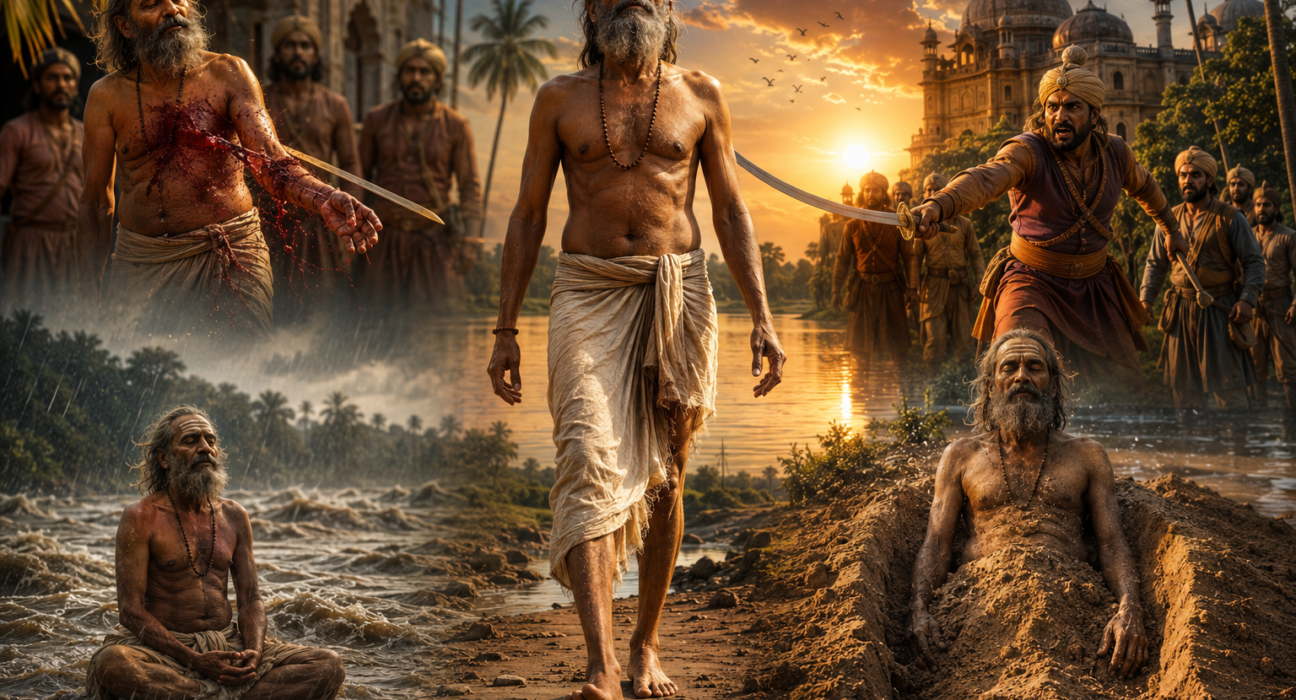
Sadasiva Brahmendra: The Yogi Who Transcended the Body | The Incredible Story of India's Enlightened Sage
Introduction: The Yogi Who Didn’t React Even After Losing His Hand
Imagine you are walking peacefully along a road.
Suddenly, a man armed with a sharp sword blocks your path and orders you to follow him.
What would you do?
Most people would react in one of two ways.
Either they would obey out of fear…
Or they would run for their lives.
It is the most natural human response.
Fear is deeply wired into our survival instincts.
But nearly 250 years ago, something happened in South India that challenged everything we believe about fear, pain, and the limits of the human body.
A wandering yogi was quietly walking along a path.
Without warning, an armed guard stopped him and demanded that he come along.
The yogi neither looked at the guard nor responded to his command.
He simply continued walking in complete silence.
The guard became furious.
Believing that the stranger had insulted the authority of the king, he drew his sword and, in a single powerful strike, severed the yogi’s right arm.
The hand fell to the ground.
Blood flowed freely.
Anyone witnessing such a scene would expect screams of agony.
Shock.
Fear.
Desperation.
Instead…
The yogi did something that left everyone speechless.
He continued walking exactly as he had before.
There was no cry of pain.
No attempt to stop the bleeding.
No expression of anger.
No sign that anything extraordinary had even happened.
It was as though the body that had just been wounded did not belong to him.
The soldier froze.
Within moments, he realized that the man standing before him was no ordinary human being.
He immediately fell at the yogi’s feet, begging for forgiveness.
That sacred place, where this astonishing event is believed to have occurred, later became the site of the yogi’s Jeeva Samadhi, drawing spiritual seekers even today.
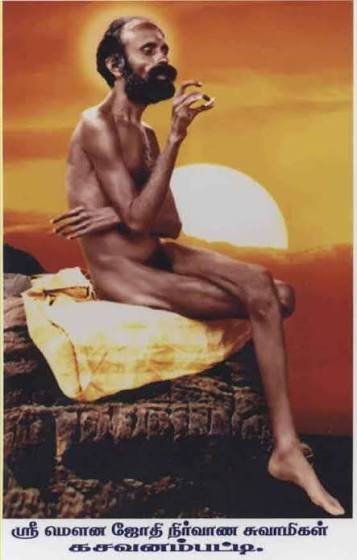
That extraordinary master was Sri Sadasiva Brahmendra.
Was This Really Possible?
To modern readers, this story may sound impossible.
How can someone continue walking after losing an arm?
How could a human being feel no pain?
How could anyone remain completely detached while blood poured from their body?
These are reasonable questions.
From the perspective of modern biology, such an event appears beyond explanation.
Yet throughout India’s spiritual history, countless accounts describe yogis and siddhas demonstrating remarkable mastery over their own bodies.
These accounts are not presented merely as miracles.
They are described as the natural consequence of profound yogic realization.
Among these great masters, Sadasiva Brahmendra occupies a unique place.
He was revered not because he performed miracles, but because he had attained complete mastery over his body, mind, and senses through intense spiritual discipline.
For him, the body was no longer his identity.
It had become nothing more than an instrument.
This remarkable state of consciousness allowed him to experience reality in a way that ordinary human beings can scarcely imagine.
The Questions That Continue to Fascinate Seekers
The story raises many extraordinary questions.
Why was Sadasiva Brahmendra attacked?
Who was the king whose soldiers confronted him?
How did his severed arm become whole again according to traditional accounts?
Was this simply a legend…
Or does it point toward forgotten dimensions of yogic science?
More importantly…
How did Sadasiva Brahmendra transcend pain, fear, and bodily awareness itself?
To understand these mysteries, we must first understand the life of the saint who walked beyond the ordinary limitations of human existence.
His story is not merely about miracles.
It is about discovering what becomes possible when human consciousness completely transcends the boundaries of the physical body.
In the following sections, we will explore the remarkable life of Sri Sadasiva Brahmendra, the astonishing incident that made him one of India’s greatest yogis, and the profound yogic science that may explain how such extraordinary events became possible.
The Nawab's Palace and the Day a Sword Could Not Disturb a Yogi
To understand why this extraordinary event unfolded, we must first understand the state in which Sri Sadasiva Brahmendra lived.
He was not an ordinary saint.
Nor was he simply a wandering monk.
He lived in a state where the body itself had almost disappeared from his experience.
Hunger…
Heat…
Cold…
Praise…
Insult…
Even clothing…
None of these occupied his awareness.
His consciousness remained absorbed in an uninterrupted state of divine bliss.
To the outside world, he appeared absent-minded.
But inwardly, he was immersed in a reality far beyond the senses.
The Day Everything Changed
One day, Sadasiva Brahmendra was peacefully walking along the banks of the sacred River Kaveri.
Like countless days before, he wandered without any destination.
He carried nothing.
He desired nothing.
His entire existence flowed effortlessly with life itself.
But on that particular day, his path unknowingly crossed into a place where no outsider was permitted.
It was not an ordinary garden.
It was the private royal garden of a Nawab, a heavily guarded section of the palace reserved exclusively for the women of the royal household.
No stranger was ever allowed to enter.
Yet Sadasiva Brahmendra walked through its entrance without even realizing where he was.
Not because he intended to break the rules…
But because the external world barely registered in his awareness.
A King Consumed by Anger
At that very moment, the Nawab was spending time with members of his royal family inside the secluded garden.
Suddenly, the guards noticed an unclothed ascetic calmly walking through the protected grounds.
The atmosphere changed instantly.
The Nawab was outraged.
“Who is this man?”
“How did he enter this sacred enclosure?”
“And how dare he walk here without even wearing clothes?”
To the king, it appeared to be an unforgivable insult to the dignity of the royal household.
Without waiting for an explanation, he issued an immediate command:
“Capture him at once!”
Neither the king nor his soldiers knew that they were about to witness an event that would be remembered for centuries.
The Soldiers Gave Chase
The palace guards rushed after the silent yogi.
They shouted repeatedly for him to stop.
But Sadasiva Brahmendra continued walking.
Not because he wished to defy them…
But because he simply did not hear them.
His awareness was turned inward.
The noise of the outside world no longer held his attention.
The guards mistook his silence for arrogance.
Their frustration grew with every passing moment.
Finally, one of the soldiers made a decision that would change his life forever.
He drew his sword.
With all his strength, he swung the blade toward the yogi.
The razor-sharp weapon struck Sadasiva Brahmendra’s right arm.
In a single stroke, the arm was completely severed.
It fell to the ground.
Blood flowed from the wound.
For everyone watching, the next moment should have been filled with screams of unbearable pain.
Instead…
Silence.
The Yogi Who Never Stopped Walking
Sadasiva Brahmendra did not even turn around.
He did not look at the wound.
He did not attempt to stop the bleeding.
He did not show surprise.
He did not express anger.
He simply continued walking exactly as before.
His pace never changed.
His breathing remained calm.
His face reflected the same deep serenity.
It was as though nothing had happened.
The soldiers stood frozen.
The sword had cut through flesh.
But it had failed to disturb the consciousness of the man before them.
In that single moment, they understood that this was no ordinary ascetic.
This was someone who had gone beyond the ordinary limitations of the human body.
Fear gave way to reverence.
The very soldiers who had attacked him rushed forward, fell at his feet, and begged for forgiveness.
When the Nawab himself witnessed the astonishing composure of the yogi, his anger instantly disappeared.
Replacing it was deep humility.
According to traditional accounts, the king personally requested forgiveness and respectfully brought the great yogi back into the palace gardens.
What happened next became one of the most extraordinary episodes associated with Sadasiva Brahmendra.
How could a severed arm be restored?
Was it truly a miracle?
Or does yogic science offer another way of understanding this astonishing event?
To answer that, we must first explore how enlightened yogis viewed the human body—not as their identity, but as an instrument completely under their mastery.
The Forgotten Yogic Science: How Sadasiva Brahmendra Transcended the Body
The story of Sadasiva Brahmendra raises a profound question.
How could a human being continue walking after losing an arm?
Was it simply an extraordinary miracle?
Or did it arise from a level of yogic mastery that modern society has largely forgotten?
According to India’s ancient yogic traditions, the answer lies not in supernatural powers, but in a complete transformation of human consciousness.
To understand Sadasiva Brahmendra, we must first understand how yogis viewed the human body.
The Human Body Is More Than Flesh and Bone
Modern science sees the human body as a remarkable biological machine.
It consists of muscles, bones, nerves, organs, blood vessels, and an incredibly sophisticated brain.
Yogic science agrees with this—but says it is only one layer of human existence.
According to the ancient sages, beneath the physical body exists a vast network of subtle energy known as the Pranic Body.
Flowing through this invisible body are thousands of energy pathways called Nadis.
These Nadis cannot be seen with the physical eye.
Nor can they be dissected in a laboratory.
Yet for thousands of years, yogis have described them as the channels through which life itself flows.
Ancient yogic scriptures state that the human system contains approximately 72,000 Nadis, carrying Prana—the life force that animates every living being.
When these energy pathways function in harmony, the body, mind, and consciousness operate as one integrated system.
The Mystery of the 114 Chakras
Where these Nadis intersect, powerful energy centers are formed.
These are known as Chakras.
Most people today are familiar with the Seven Chakras because they are widely discussed in books and popular spirituality.
But according to classical yogic science, the human system actually contains 114 Chakras.
Of these:
112 Chakras exist within the human body.
2 Chakras exist beyond the physical body.
Among these, the seven major chakras serve as the primary centers governing human consciousness.
They are:
Muladhara – The Root Chakra
Swadhisthana – The Sacral Chakra
Manipura – The Solar Plexus Chakra
Anahata – The Heart Chakra
Vishuddha – The Throat Chakra
Ajna – The Third Eye Chakra
Sahasrara – The Crown Chakra
For most people, only the lower energy centers function with any significant intensity.
This is why ordinary human life revolves around survival, security, emotions, desires, and personal identity.
But enlightened yogis dedicate their lives to awakening the entire energy system.
As more chakras become fully active, consciousness begins expanding beyond the limitations of the physical body.
When the Body Is No Longer Your Identity
Imagine wearing a set of clothes.
You know they belong to you.
But you also know they are not you.
If the clothes become damaged, your true identity remains untouched.
According to yogic realization, an enlightened master experiences the body in a similar way.
The body becomes a useful instrument…
But it is no longer the center of one’s identity.
Sadasiva Brahmendra is believed to have lived permanently in this state.
His awareness was no longer confined to muscles, bones, skin, or nerves.
Instead, his consciousness rested in something far deeper.
Because of this, bodily sensations that dominate ordinary human experience no longer held the same power over him.
Pain may still occur within the nervous system.
But the one experiencing that pain was no longer identified with the body.
This state is sometimes described in yogic literature as complete freedom from bodily identification.
It is not that the body disappears.
Rather, the attachment to it disappears.
Why He Never Reacted to the Sword
From this perspective, the famous incident begins to make sense.
The sword certainly cut his physical arm.
Blood undoubtedly flowed.
The body was injured.
But Sadasiva Brahmendra himself remained established in a level of awareness untouched by physical injury.
To those around him, this appeared miraculous.
To an enlightened yogi, it was simply the natural consequence of living beyond the limitations of bodily identity.
This is precisely why eyewitnesses were left speechless.
The sword had injured the body.
It had not disturbed the consciousness residing beyond it.
This extraordinary freedom was not acquired overnight.
It was the result of years—perhaps decades—of intense meditation, unwavering discipline, and complete mastery over the inner dimensions of life.
But one mystery still remains.
Traditional accounts state that the severed arm was eventually restored.
How could such an astonishing event have occurred?
Was it purely symbolic, a miraculous blessing, or does yogic science preserve an even deeper explanation?
That remarkable chapter of Sadasiva Brahmendra’s life is one of the most fascinating stories in India’s spiritual history.
A Life Beyond Time, Hunger, and Sleep
When we hear stories of yogis remaining in meditation for months—or even years—they often sound impossible.
How can a human being survive without food?
How can someone sit motionless for such long periods?
How can the body continue functioning without the ordinary needs that govern every human life?
To answer these questions, we must once again look through the lens of yogic science.
According to the ancient masters, the human body consumes enormous amounts of energy every day.
Not merely for physical activity…
But for constant mental chatter.
Desires.
Fears.
Anxieties.
Emotions.
Endless thoughts.
These invisible activities consume far more life energy than most people realize.
A realized yogi, however, lives in profound inner stillness.
When the mind becomes completely silent, the body no longer wastes energy through unnecessary mental activity.
Instead, every aspect of the human system functions with extraordinary efficiency.
This is why enlightened beings often require very little food, very little sleep, and can remain effortlessly absorbed in meditation for astonishing lengths of time.
Mastery Over the Body
For an ordinary person, the body dictates life.
Hunger commands us to eat.
Fatigue forces us to sleep.
Pleasure attracts us.
Pain repels us.
Our decisions are constantly influenced by the body’s demands.
A realized yogi reverses this relationship.
Instead of being controlled by the body…
The body becomes completely obedient to consciousness.
It is no longer the master.
It becomes the servant.
This is one of the highest achievements described in yogic literature.
Sadasiva Brahmendra was regarded as one of those rare masters who had attained this extraordinary freedom.
To him, the body was simply a vehicle for spiritual work.
Nothing more.
The State Beyond Physical Awareness
Ancient traditions describe Sadasiva Brahmendra as living in Sahaja Samadhi—a spontaneous and effortless state of enlightenment.
Unlike ordinary meditation, which begins and ends, Sahaja Samadhi becomes one’s natural way of being.
Whether walking…
Speaking…
Sleeping…
Or sitting silently…
The yogi remains established in the same limitless awareness.
In this state, the distinction between the inner and outer worlds begins to dissolve.
The body continues to exist.
People can see it.
Touch it.
Speak to it.
Yet the yogi no longer experiences himself as the body.
This explains why Sadasiva Brahmendra wandered unclothed through villages and forests.
It was never an act of rebellion against society.
Nor was it an attempt to attract attention.
He had simply transcended body-consciousness to such an extent that concepts like appearance, status, shame, and social identity no longer occupied his awareness.
To him, the body was as insignificant as a garment.
The Living Presence at Nerur
Although centuries have passed since Sadasiva Brahmendra left his physical body, devotees believe his spiritual presence continues to be experienced at his Jeeva Samadhi in Nerur, near Karur in Tamil Nadu.
Unlike an ordinary tomb, a Jeeva Samadhi is traditionally believed to preserve the spiritual energy of an enlightened master who consciously left the body while remaining absorbed in the highest state of realization.
Thousands of devotees, meditators, and spiritual seekers visit this sacred shrine every year.
Many describe experiencing an overwhelming sense of peace the moment they enter the temple.
Some speak of an inexplicable stillness.
Others report a profound meditative silence that is difficult to describe in words.
Whether one interprets these experiences through faith, psychology, or spirituality, there is no denying that the Samadhi of Sadasiva Brahmendra continues to inspire countless seekers even today.
For many, it is not merely a historical monument.
It is a living center of spiritual energy.
Freedom Begins When the Body No Longer Rules
The life of Sadasiva Brahmendra teaches a timeless lesson.
Most human beings spend their entire lives believing they are the body.
Every joy…
Every sorrow…
Every fear…
Every attachment…
Every conflict…
Begins with this single identification.
The great yogis of India dedicated their lives to breaking this illusion.
They discovered that beyond the body lies an infinite dimension of consciousness—one that is untouched by pain, fear, aging, or death.
Sadasiva Brahmendra was one such master.
His extraordinary life reminds us that the greatest miracle is not the healing of a severed arm.
Nor is it walking without reacting to pain.
The greatest miracle is discovering that our true nature is far greater than the physical body we temporarily inhabit.
Yet this was not the only astonishing event associated with Sadasiva Brahmendra.
Near Tiruchirappalli, another remarkable incident unfolded—one that revealed an entirely different dimension of his yogic mastery and left generations of devotees in awe.
That story is perhaps even more extraordinary.
The Miracle at Kodumudi: When the River Revealed a Saint
The incident at the Nawab’s palace made Sadasiva Brahmendra known as the yogi who had transcended the body.
But another remarkable event, preserved in the oral traditions of Tamil Nadu, revealed a different dimension of his spiritual greatness.
It was not about enduring pain.
It was about becoming one with nature itself.
This extraordinary episode unfolded near the sacred town of Kodumudi, on the banks of the River Kaveri.
A Meditation That Defied Time
Like many enlightened masters, Sadasiva Brahmendra often entered states of meditation so profound that all awareness of the external world disappeared.
During one such occasion, he chose a quiet spot near the River Kaveri.
Sitting peacefully on the riverbank, he entered deep meditation.
Hours passed.
Then days.
His body remained perfectly still.
His breathing became almost imperceptible.
To an ordinary observer, he appeared lifeless.
But inwardly, he was immersed in the limitless bliss of Samadhi.
When Nature Tested the Yogi
As Sadasiva Brahmendra remained absorbed in meditation, dark clouds gathered across the sky.
The southwest monsoon arrived with tremendous force.
Rain poured relentlessly over the Kaveri basin.
Soon, the gentle river transformed into a raging torrent.
The floodwaters rose rapidly.
Trees were uprooted.
The riverbanks disappeared beneath the powerful current.
Villagers rushed to higher ground, desperately trying to save themselves and their belongings.
In the chaos, no one noticed the silent yogi seated on the riverbank.
Within moments, the surging waters swallowed him completely.
The powerful current carried enormous quantities of sand, mud, and debris downstream.
Gradually, layer upon layer of sand settled over the place where Sadasiva Brahmendra had been meditating.
Before long, he was entirely buried beneath the earth.
The flood eventually receded.
Life returned to normal.
The villagers rebuilt their homes.
Seasons changed.
People forgot that a great yogi had once sat in meditation there.
Hidden beneath several feet of sand, Sadasiva Brahmendra remained exactly where he had been—still absorbed in the deepest state of Samadhi.
Months Later… An Impossible Discovery
Many months passed.
One day, local laborers arrived to dig sand from the riverbank.
As they worked, one of their tools struck something unexpectedly soft.
Thinking they had uncovered an animal or a buried object, they began clearing away the surrounding sand.
To their astonishment, they discovered the body of a man seated in perfect meditation.
His posture had not changed.
His expression remained serene.
His body showed no signs of panic or struggle.
Even more astonishing…
As the final layers of sand were removed, Sadasiva Brahmendra slowly opened his eyes, rose to his feet, and quietly walked away—as though only a few minutes had passed.
The laborers stood frozen in disbelief.
For them, it was nothing short of a miracle.
But for the great yogi, nothing extraordinary had occurred.
He had never experienced the passage of time.
The Timeless Nature of Samadhi
How can someone remain buried for months and emerge alive?
Modern science naturally questions such accounts, and historians debate the literal details of these traditional narratives.
However, within the yogic tradition, these stories are understood differently.
They are not presented merely to inspire wonder.
They illustrate the extraordinary potential of a consciousness that has transcended ordinary bodily limitations.
Ancient yogic texts describe Samadhi as a state in which the mind becomes completely still and one’s awareness merges with pure consciousness.
In its highest forms, the experience of time itself begins to dissolve.
Minutes may feel like seconds.
Days may pass unnoticed.
For an ordinary person, remaining motionless even for an hour can be uncomfortable.
For a realized master like Sadasiva Brahmendra, time had lost its hold.
His awareness no longer measured existence through the ticking of a clock.
It rested in something eternal.
Whether one accepts these accounts as literal history, symbolic teaching, or sacred tradition, they continue to convey a profound spiritual truth:
When consciousness is no longer confined to the body, the ordinary limits of human experience begin to lose their power.
The Saint Who Left Behind Songs of Pure Wisdom
Sadasiva Brahmendra was not remembered only for extraordinary yogic experiences.
He was also one of India’s greatest philosopher-saints and composers.
The same yogi who wandered unclothed in complete detachment also composed timeless Sanskrit hymns that continue to be sung in temples, classical concerts, and spiritual gatherings across India.
His life reminds us that true enlightenment is not measured by miracles.
It is reflected in wisdom, compassion, inner freedom, and the ability to awaken the same longing for truth in countless others—even centuries after leaving the physical world.
The Legacy of Sadasiva Brahmendra: A Saint Who Continues to Inspire the World
More than two centuries have passed since Sri Sadasiva Brahmendra walked across the sacred lands of South India.
Kingdoms have disappeared.
Empires have risen and fallen.
Technology has transformed human civilization.
Yet the silent presence of this extraordinary yogi continues to inspire countless spiritual seekers.
Unlike many saints remembered only through stories, Sadasiva Brahmendra left behind something even more enduring—his spiritual wisdom.
The Saint Who Sang the Truth
While many people know him for the miraculous stories surrounding his life, Sadasiva Brahmendra was also one of the greatest Advaita philosophers and Sanskrit composers in Indian history.
His compositions are not merely devotional songs.
They are profound expressions of Self-realization.
Each verse reflects the experience of someone who had completely dissolved the boundaries between the individual self and the Absolute.
Even today, his compositions are performed by some of India’s greatest Carnatic musicians.
Among his best-known works are:
- Manasa Sancharare
- Bhajare Gopalam
- Sarvam Brahmamayam
- Pibare Rama Rasam
These compositions continue to fill temples, concert halls, and homes with the timeless wisdom of Sanatana Dharma.
Their melodies are beautiful.
But their deeper purpose is to guide the listener inward.
Every song points toward the same truth:
The Divine is not somewhere outside us—it is our very nature.
The Jeeva Samadhi at Nerur
Today, thousands of devotees travel to the peaceful village of Nerur, near Karur in Tamil Nadu.
Hidden away from the noise of modern life stands the sacred Jeeva Samadhi of Sadasiva Brahmendra.
The atmosphere here is unlike that of an ordinary temple.
There are no grand towers dominating the skyline.
No elaborate displays of wealth.
Instead…
There is silence.
A silence that many devotees describe as deeply transformative.
Meditators often spend hours sitting quietly within the temple premises.
Many visitors speak of experiencing an indescribable stillness the moment they enter.
Others describe a powerful spiritual vibration that seems to quiet the restless mind.
Whether one approaches with devotion, curiosity, or meditation, the Samadhi continues to serve as a place of profound inner reflection.
For countless seekers, it is not simply a memorial to a saint.
It is a living spiritual presence.
The True Miracle Was Never the Severed Hand
The story of the severed arm has fascinated generations.
It captures our imagination because it appears to defy the ordinary laws of human experience.
But if we focus only on the miracle, we risk missing the deeper message.
Sadasiva Brahmendra never sought fame through miracles.
He never performed extraordinary acts to attract followers.
In fact, he spent much of his life avoiding public attention altogether.
The true miracle was not that a sword could not disturb him.
The true miracle was that he had completely conquered fear.
He had transcended anger.
He had dissolved attachment.
He had gone beyond the limitations of the physical body and discovered an unshakable inner freedom.
That is the real teaching of his life.
What Can We Learn from Sadasiva Brahmendra Today?
Most of us live under the constant influence of the body and the mind.
A single harsh word can disturb our peace.
A small inconvenience can ruin our entire day.
We spend our lives chasing comfort while running away from discomfort.
Sadasiva Brahmendra’s life offers a radically different perspective.
He reminds us that lasting peace does not come from controlling the outside world.
It comes from mastering the inner world.
His life teaches us:
- The body is a precious instrument, but it is not our true identity.
- Inner silence is more powerful than external success.
- Freedom begins when we stop identifying with every thought, emotion, and sensation.
- Spiritual realization is not about escaping life—it is about experiencing life without fear or attachment.
These teachings remain as relevant today as they were three centuries ago.
Conclusion: The Yogi Who Walked Beyond the Body
Was Sadasiva Brahmendra truly untouched by pain?
Did his severed arm really become whole again?
Could a yogi remain buried beneath sand for months in deep meditation?
History may never answer every question with certainty.
But perhaps these stories were never meant to convince us through proof alone.
Instead, they invite us to ask a far more important question:
What are the true limits of human consciousness?
Ancient India’s yogis believed that the greatest journey was not across mountains or kingdoms—but inward, toward the limitless Self.
Few embodied that truth more completely than Sri Sadasiva Brahmendra.
His life continues to inspire millions because it reminds us that beyond the restless mind…
Beyond the fragile body…
Beyond fear, pleasure, and pain…
Lies an infinite dimension of peace that every human being has the potential to discover.
Perhaps that is why, even after centuries, pilgrims still travel to Nerur—not merely to remember a saint…
But to experience, however briefly, the profound silence that he became.
For in that silence, they do not simply encounter the legacy of Sadasiva Brahmendra.
They begin the journey toward discovering their own.