
Polali Rajarajeshwari Temple: The Sacred Clay Goddess of Karnataka
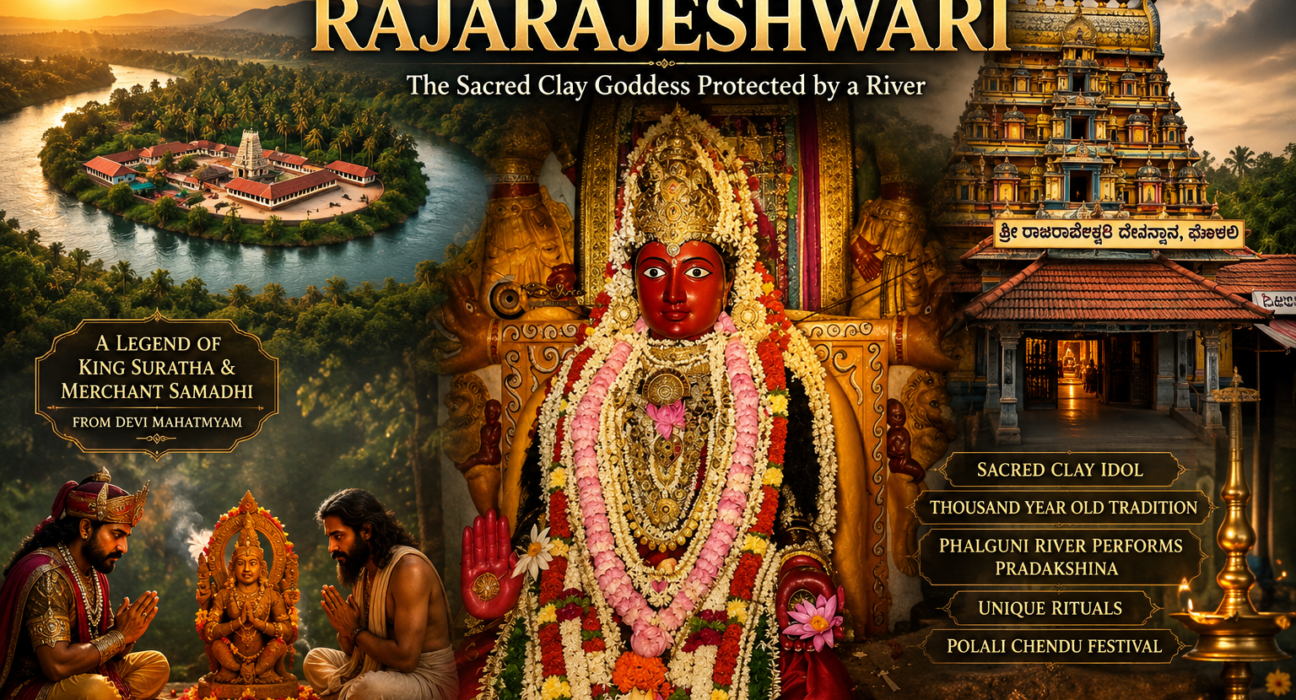
Polali Rajarajeshwari Temple: The Sacred Clay Goddess Protected by a River for Over a Thousand Years
Some temples inspire devotion through their towering architecture. Others captivate visitors with miraculous legends or ancient history. But there are a few sacred shrines whose very existence seems to blur the line between history, faith, and divine mystery.
In Tamil Nadu, millions of devotees worship Samayapuram Mariamman and Punnainallur Mariamman, two of South India’s most revered goddesses. Despite their immense popularity, many devotees are unaware that these temples share an extraordinary feature—the principal deities are not carved from granite or marble. Instead, they are sacred clay (Sudhai) idols, carefully preserved according to centuries-old traditions.
Yet, hidden away in the lush coastal landscape of Karnataka is another equally remarkable shrine that shares this unique heritage.
It is the Polali Sri Rajarajeshwari Temple.
Unlike many famous temples, Polali remains relatively unknown outside Karnataka. However, those who visit soon realise that this is no ordinary temple. Here, the Goddess is worshipped in a sacred clay form believed to have been fashioned through intense penance by two legendary devotees. The temple is embraced by the gentle curve of the Phalguni River, which flows around it as though nature itself is performing pradakshina around the Divine Mother.
For over a thousand years, this sacred tradition has continued uninterrupted.
Is it merely a coincidence of geography?
Or does it preserve the memory of an ancient act of devotion that still echoes through the ages?
To understand the mystery of Polali Rajarajeshwari, we must travel back to one of the most profound stories found in the Devi Mahatmyam—a story of a defeated king, a betrayed merchant, and the eternal power of Mahamaya, the Divine Mother who governs both bondage and liberation.
The Temple Where a River Bows to the Goddess
India is home to many sacred temples where rivers are believed to share a divine relationship with the deity enshrined within.
At Thiruvanaikaval, devotees believe that the River Kaveri divides into two streams to embrace Lord Jambukeswarar. At Srikalahasti, tradition says the Swarnamukhi River altered its course to worship Lord Shiva. In Srisailam, the mighty Krishna River bends toward the temple of Lord Mallikarjuna. At Bhavani, the confluence of the Kaveri, Bhavani, and the mystical Amudha River is regarded as one of South India’s holiest meeting points. Likewise, at Omkareshwar, the sacred Narmada River is believed to flow in the shape of the sacred syllable “Om,” encircling the island temple dedicated to Lord Shiva.
These traditions have inspired devotees for centuries, symbolising the belief that nature itself recognises the presence of the Divine.
Among these extraordinary sacred sites stands another temple that receives far less attention but carries an equally fascinating tradition.
The Polali Sri Rajarajeshwari Temple, located in Karnataka’s Dakshina Kannada district, is embraced by the Phalguni River, which curves gracefully around the temple before continuing its journey.
Seen from above, the river appears almost as though it is performing pradakshina—the sacred act of circumambulation around the Goddess.
To a geographer, this may simply be the natural course of a river shaped over thousands of years.
To a devotee, however, it is something far more profound.
It is believed that the river itself changed its path out of reverence for the Divine Mother, eternally circling Her sacred abode.
This beautiful belief has been passed down through generations, becoming an inseparable part of the temple’s identity.
But why is this temple so special?
Why is the Goddess worshipped in a clay form instead of the traditional granite idol found in most Hindu temples?
And what is the connection between this sacred shrine and one of the greatest scriptures dedicated to the Divine Mother—the Devi Mahatmyam?
To uncover those answers, we must travel back thousands of years to an ancient forest, where two broken men searched not for wealth or power, but for the truth behind human suffering.
One was a mighty king who had lost his kingdom.
The other was a wealthy merchant betrayed by his own family.
Their meeting with a great sage would give birth to one of the most profound spiritual teachings in Hinduism—and, according to temple tradition, would eventually lead to the origin of the Polali Rajarajeshwari Temple.
The King Who Lost Everything… Except His Attachment
Deep within an ancient forest, where towering trees concealed the sunlight and silence was broken only by the sounds of nature, a weary man wandered alone.
His name was King Suratha.
Not long before, he had ruled a prosperous kingdom. Thousands of soldiers stood ready to defend him. Mighty war elephants carried his banners into battle. His treasury overflowed with wealth, and his subjects once praised him as their protector.
But fortune had changed.
Enemy kings had invaded his kingdom, and those he trusted the most had turned against him. His own ministers betrayed him, his armies were defeated, and the throne that had once symbolised his power was lost.
Now, the mighty king possessed nothing.
No palace.
No army.
No crown.
Only painful memories.
Yet what troubled Suratha most was not the loss of his kingdom.
It was something far more mysterious.
Although he knew that his ministers had betrayed him and his subjects had abandoned him, his mind refused to let go of them.
He constantly wondered:
“Are my elephants being cared for?”
“Is my kingdom safe?”
“Are my people living peacefully?”
Even after losing everything, his heart remained deeply attached to the very people who had rejected him.
Again and again, one question echoed within him.
“Why can’t I free myself from this attachment?”
Unable to find an answer, the defeated king continued wandering through the forest.
Little did he know that destiny was leading him toward another soul burdened by the very same question.
A Merchant Betrayed by His Own Family
Elsewhere in that same forest walked another broken man.
His name was Samadhi.
Unlike Suratha, he had never worn a crown.
He was a wealthy merchant whose success had earned him great respect in society.
But wealth alone cannot guarantee loyalty.
Blinded by greed, his own wife, sons, and relatives conspired against him. They seized his possessions, drove him out of his own home, and abandoned him without compassion.
The man who had spent his life building prosperity for his family suddenly found himself with nothing.
Homeless.
Friendless.
Alone.
Yet, strangely, his greatest suffering was not the loss of his wealth.
It was the love he still felt for the very people who had betrayed him.
As he walked through the wilderness, thoughts of his family refused to leave his mind.
“Have they eaten today?”
“Are they safe?”
“Who is looking after them?”
Even after being rejected, his heart continued to care for them.
He knew they had wronged him.
Yet he could not stop loving them.
The contradiction tormented him.
A Meeting Destined by the Divine
Fate has a mysterious way of bringing together those who seek the same truth.
One evening, as darkness settled over the forest, King Suratha and the merchant Samadhi arrived at the same place.
It was the peaceful ashram of Sage Medhas.
Though strangers to one another, they quickly realised that they shared the same inner struggle.
One had lost a kingdom.
The other had lost a family.
Yet both suffered from the same invisible chain—
Attachment.
They approached the venerable sage with folded hands and poured out their stories.
Finally, they asked the question that had consumed both their hearts:
“Those who betrayed us have caused us immense suffering. We understand that. Yet why does our mind continue to love them? Why does this attachment refuse to leave us?”
It was not merely a question about personal sorrow.
It was one of the deepest questions in all of human existence.
The answer that Sage Medhas was about to give would reveal one of the greatest spiritual truths contained in the Devi Mahatmyam—a truth that continues to inspire seekers even today.
Sage Medhas Reveals the Mystery of Mahamaya
Sage Medhas listened patiently as the king and the merchant poured out their grief.
When they finished speaking, the old sage smiled—not because he dismissed their suffering, but because he recognised the deeper truth hidden behind their question.
He looked at them with compassion and said,
“The question you ask is not yours alone. It is a mystery that has puzzled humanity since the beginning of creation.”
After a brief silence, he continued,
“This attachment that binds you is not unique to kings or merchants. It binds every living being. The learned and the ignorant, the wealthy and the poor, humans, animals, and even birds—all are influenced by the same invisible power.”
Suratha and Samadhi listened intently.
If everyone was bound by the same force, then what was that force?
The sage answered with a single name.
Mahamaya.
The Great Divine Power.
The cosmic energy through which the Supreme manifests the universe.
The force that makes a mother sacrifice everything for her child.
The power that makes a person cling to wealth, relationships, status, and identity.
The same power that creates attachment is also the power that eventually leads a sincere seeker toward liberation.
Mahamaya is not merely illusion.
She is the Divine Mother herself.
She binds.
She protects.
She guides.
And when the time is right, she sets the soul free.
The Story Begins Before Creation
To explain this profound truth, Sage Medhas did not answer with philosophy alone.
Instead, he began narrating an ancient event that took place long before human history.
He spoke of a time when the universe itself was still in its infancy.
Everything was immersed in the endless cosmic ocean.
Lord Vishnu rested upon Adi Shesha, absorbed in Yoga Nidra—a divine state of transcendental sleep.
During that mysterious moment, two powerful asuras emerged from the wax of Vishnu’s ears.
Their names were Madhu and Kaitabha.
Possessing immense strength but blinded by arrogance, they soon turned their attention toward Lord Brahma, who was engaged in the work of creation.
Realising that he could not defeat them alone, Brahma searched desperately for a way to awaken Lord Vishnu.
But there was a problem.
Vishnu was not asleep through ordinary fatigue.
He was enveloped by the divine power of Yoga Nidra Devi—the very manifestation of Mahamaya.
Until She withdrew, even the Preserver of the Universe would remain in deep yogic slumber.
The Goddess Who Awakens the Divine
Understanding this cosmic truth, Brahma folded his hands and began praising the Divine Mother.
His hymns were not directed toward Vishnu.
They were offered to the supreme feminine power that governed even the gods.
Moved by Brahma’s devotion, the Goddess emerged from Vishnu’s eyes, face, heart, and every part of His divine form.
The moment She withdrew, Lord Vishnu opened His eyes.
Awakened from Yoga Nidra, He confronted Madhu and Kaitabha and ultimately destroyed the two demons, restoring balance to creation.
Sage Medhas paused for a moment before looking at Suratha and Samadhi.
Then he said,
“Do you understand now?”
“The same Divine Mother who awakens Vishnu… who empowers Brahma to create… and who stands beside Shiva as His eternal Shakti… is also the One who governs every thought within your heart.”
“The love you feel.”
“The attachment you cannot overcome.”
“The pride of being a king.”
“The identity of being a wealthy merchant.”
“All of these arise through Her divine power.”
Bondage and Liberation Come from the Same Divine Mother
The king and the merchant sat in silence.
For the first time, they realised that their suffering was not simply the result of betrayal.
It was the consequence of identifying themselves with things that were never truly permanent.
Their kingdom.
Their wealth.
Their family.
Their reputation.
All were gifts of Mahamaya.
And all could disappear in a single moment.
Yet the same Divine Mother who veiled the truth also possessed the power to reveal it.
She alone could remove the ignorance that caused suffering.
Seeing the transformation taking place within them, Sage Medhas spoke gently.
“If you truly seek freedom—not merely from your present sorrow, but from the cycle of attachment itself—then surrender to the Divine Mother.”
“She has appeared in every age to protect Dharma.”
“She destroyed Mahishasura.”
“She defeated Shumbha and Nishumbha.”
“She consumed the countless forms of Raktabija.”
“And even today, She waits for those who approach Her with sincere devotion.”
Those words changed everything.
Suratha no longer sought only his lost kingdom.
Samadhi no longer sought only relief from betrayal.
Both now desired something far greater.
They wished to seek the grace of the Divine Mother herself.
And with folded hands, they made a humble request to Sage Medhas:
“Master… show us the path.”
Three Years of Unwavering Penance
Sage Medhas rose from his seat and slowly pointed towards the bank of a nearby river.
“Go there,” he said.
“Fashion the Divine Mother with your own hands from the sacred earth of the riverbank. Worship Her with flowers, pure water, and unwavering devotion. Observe strict austerities and meditate upon Her without distraction.”
“Do this with complete faith.”
“The Divine Mother never ignores sincere devotion.”
These were not merely instructions for a ritual.
They were a path of transformation.
King Suratha and the merchant Samadhi bowed before the sage and immediately set out to follow his guidance.
A Goddess Shaped from the Earth
Reaching the tranquil riverbank, the two devotees began collecting the soft clay that had been nourished by the sacred waters for centuries.
With no sculptor to guide them and no royal craftsmen to assist them, they moulded the image of the Divine Mother using only their own hands.
Every handful of clay carried their hope.
Every touch reflected their devotion.
This was not simply the creation of an idol.
It was the shaping of their own faith.
When the image was complete, they decorated it with wildflowers gathered from the forest, offered pure river water, and began worshipping the Goddess with complete surrender.
That humble clay image would one day become one of the most enduring symbols in the worship of the Divine Mother.
Three Years That Changed Two Lives
Days became weeks.
Weeks became months.
Months became years.
The seasons changed around them, but the two seekers remained steadfast.
The scorching summer sun burned the earth beneath their feet.
Monsoon rains drenched their bodies.
Winter winds swept through the forest with biting cold.
Yet neither Suratha nor Samadhi abandoned their vow.
Every sunrise began with prayer.
Every sunset ended with meditation.
The clay image before them was no longer merely an object of worship.
It had become the centre of their lives.
The king who had once commanded armies now conquered his own restless mind.
The merchant who had once measured wealth in gold now measured life through devotion.
The hardships that had once broken them were slowly transforming them into seekers worthy of divine grace.
The Dawn That Changed Everything
Then, after three long years, the day finally arrived.
It was unlike any other morning.
The forest seemed unusually still.
The songs of birds faded into silence.
Even the gentle breeze appeared to pause, as though nature itself sensed that something extraordinary was about to unfold.
An indescribable radiance began to spread across the riverbank.
It did not resemble the light of the rising sun.
Nor was it the glow of fire.
It was a brilliance that seemed to emerge from every direction at once.
The sacred clay image before which they had prayed for three years was now surrounded by an overwhelming divine presence.
The earth itself seemed alive.
The river shimmered.
Time stood still.
The Divine Mother Reveals Herself
From that radiant light, a magnificent form slowly emerged.
She was neither born from the clay nor separate from it.
She appeared as the eternal Divine Mother, revealing Herself through the devotion of Her children.
Her splendour defied human imagination.
Her brilliance rivalled the rising sun.
Her serenity reflected the coolness of the full moon.
Her compassion radiated like the endless flow of the sacred river beside Her.
This was Adi Parashakti.
The Supreme Mother.
The source of creation.
The power behind every god and every universe.
Looking lovingly at the two exhausted devotees, She spoke—not with the terrifying roar of a warrior Goddess, but with the gentle affection of a mother welcoming her children.
Her voice carried both infinite authority and boundless compassion.
“My children…”
“Tell Me… what do you seek?”
At that moment, every hardship they had endured, every tear they had shed, and every prayer they had offered found its answer in the compassionate gaze of the Divine Mother.
Their years of penance had not been in vain.
The Goddess had come.
And with Her arrival, the destiny of both men—and the sacred tradition that would one day be remembered at Polali Rajarajeshwari Temple—was about to change forever.
The Boons That Reflected Their True Destiny
For a few moments, neither King Suratha nor the merchant Samadhi could speak.
Three years of relentless austerity had culminated in this single, divine moment. The Supreme Mother stood before them—not as a vision of the mind, but as the living embodiment of infinite compassion.
The Goddess looked upon them with a mother’s affection and asked once more,
“Tell Me, My children… what is it that you desire?”
The question was simple.
But the answers would reveal the true nature of their souls.
The King’s Prayer
Three years earlier, Suratha had entered the forest as a defeated king, consumed by the pain of losing his kingdom.
Now he stood transformed.
His years of penance had purified his mind.
His desire was no longer driven by pride or ambition.
With folded hands, he bowed before the Divine Mother and said,
“O Mother, if it is Your will, grant me back my kingdom—not for my own glory, but so that I may establish Dharma and protect my people.”
The Goddess smiled.
She had witnessed the transformation that had taken place within him.
The man who once sought power had become a ruler worthy of it.
With boundless grace, She blessed him.
“Your kingdom shall be restored.”
“And when this lifetime comes to an end, you shall be born again as Savarni Manu, one of the great Manus destined to guide humanity in a future age.”
It was far more than the return of a lost throne.
It was a promise that Suratha would one day occupy an eternal place in the cosmic order itself.
The Merchant’s Prayer
Then the Divine Mother turned toward Samadhi.
Unlike the king, he did not ask for the return of his wealth.
He did not ask that his family accept him again.
He did not ask for revenge against those who had betrayed him.
The suffering he had endured had awakened a deeper longing.
With tears in his eyes, he prayed,
“Mother, I seek neither riches nor relationships. Grant me only the wisdom to know the Truth. Bless me with the knowledge that frees one from ignorance and the cycle of suffering.”
The Goddess gazed upon him with profound compassion.
This was the prayer of a soul ready for liberation.
She granted him the highest blessing that any seeker can receive—
Atma Jnana.
The knowledge of the Self.
The wisdom that dissolves ignorance.
The realisation that the eternal Self is beyond birth, death, gain, loss, pleasure, and pain.
In that sacred moment, the merchant who had once measured success through wealth became a true seeker of the Eternal.
One Goddess… Two Different Blessings
At first glance, it might seem that the Divine Mother treated the two devotees differently.
One received a kingdom.
The other received enlightenment.
But the deeper truth is far more beautiful.
The Goddess did not grant what they wanted.
She granted what each soul was truly destined for.
Suratha’s path was to restore Dharma through righteous leadership.
Samadhi’s path was to attain liberation through Self-knowledge.
Different lives.
Different responsibilities.
Different blessings.
Yet both were expressions of the same divine grace.
This profound teaching remains one of the central messages of the Devi Mahatmyam.
The Divine Mother responds not merely to our desires, but to the deepest purpose for which each soul has taken birth.
The Beginning of an Eternal Tradition
The sacred clay image before which Suratha and Samadhi had worshipped for three long years did not disappear with the Goddess’s divine vision.
According to temple tradition, it continued to be revered by generations of devotees.
Its sanctity was carefully preserved, passing from one generation to the next as a living reminder of the extraordinary penance performed on that riverbank.
Over time, this sacred tradition came to be associated with what is today worshipped as the Polali Sri Rajarajeshwari Temple.
Unlike most temples, where the presiding deity is sculpted from granite, the Divine Mother at Polali continues to be worshipped in a sacred clay form, preserving the memory of the ancient tradition described in the Devi Mahatmyam and cherished in local temple lore.
For devotees, the Goddess is not merely represented by clay.
She is believed to be eternally present within it.
The humble earth shaped by two devoted seekers became a symbol of faith that has endured for centuries.
The story, however, does not end there.
For the temple itself preserves several extraordinary traditions that continue even today—including the absence of the usual water abhishekam, the periodic renewal of the clay image using sacred herbal preparations, and the enduring belief that the Phalguni River still flows around the temple as though it is performing pradakshina to the Divine Mother.
These living traditions continue to draw thousands of devotees, keeping alive a legend that has been passed down for more than a thousand years.
A Living Tradition That Continues Even Today
The story of King Suratha and the merchant Samadhi did not end with the Goddess granting them her blessings.
According to the sacred tradition associated with Polali Sri Rajarajeshwari Temple, the clay image they lovingly fashioned on the banks of the river became the foundation of a living tradition that has continued for centuries.
Unlike most Hindu temples, where the presiding deity is carved from granite or black stone, the Goddess at Polali is worshipped in a sacred clay (Sudhai) form.
This is not an artistic choice.
It is a spiritual legacy.
Devotees believe that the Divine Mother chose to remain in the very form through which She first accepted the devotion of Suratha and Samadhi.
For this reason, the temple follows rituals that are unlike those of almost any other major Shakti shrine in South India.
Why Water Abhishekam Is Not Performed
In most Hindu temples, Abhishekam—the ceremonial bathing of the deity with water, milk, turmeric, sandalwood, honey, and other sacred substances—is one of the most important daily rituals.
At Polali, however, the principal deity is made of clay.
Pouring large quantities of water over the idol would gradually damage the sacred form.
Instead, the Goddess is worshipped with great care using traditional herbal preparations, fragrant oils, sandal paste, turmeric, kumkum, flowers, and other sacred offerings prescribed by temple tradition.
Over specific intervals, the clay form is ceremonially renewed using natural materials and herbs.
This is not considered the creation of a new idol.
Rather, it is regarded as the loving preservation of a divine form that has been worshipped for generations.
Just as a lamp requires fresh oil to continue burning, the sacred clay image is periodically restored so that the ancient tradition remains alive for future generations.
Does the River Really Worship the Goddess?
Among all the temple’s mysteries, none captures the imagination more than the Phalguni River.
Standing on the temple grounds, devotees observe how the river gracefully bends around the shrine before continuing its journey.
From a scientific perspective, geologists explain that rivers naturally change course over centuries because of erosion, sediment deposits, and the contours of the land.
Such changes are part of the Earth’s natural processes.
For devotees, however, the river tells a different story.
They believe the Phalguni River itself performs Pradakshina around the Goddess.
Just as pilgrims walk clockwise around a temple as an act of devotion, the river is believed to eternally circumambulate Rajarajeshwari, protecting the sacred clay deity that has been worshipped for more than a thousand years.
Whether one views this through the lens of geography or faith depends upon one’s perspective.
Yet for countless devotees, the river is not merely flowing.
It is offering worship.
And that belief has become an inseparable part of Polali’s identity.
The Grand Festival of Polali
Every year, the quiet temple town transforms into a vibrant centre of devotion during the annual temple festival.
Thousands of devotees from Karnataka, Kerala, and neighbouring states gather to seek the blessings of the Divine Mother.
The temple echoes with the chanting of Vedic hymns.
The rhythmic beats of traditional drums fill the air.
Rows of oil lamps illuminate the temple complex as priests perform elaborate Deepa Aradhana, creating an atmosphere of profound spiritual energy.
Among the many celebrations, one event stands out above all others.
It is known as the Polali Chendu.
More than a festival, it is a centuries-old cultural tradition that reflects the deep bond between the Goddess and the local community.
For the people of the region, it is not merely an annual celebration.
It is an expression of identity, gratitude, and unwavering faith passed down from one generation to the next.
The Spiritual Message of Polali Rajarajeshwari
Beyond its legends, rituals, and unique traditions, the story of Polali Rajarajeshwari offers a timeless spiritual lesson.
King Suratha lost his kingdom.
The merchant Samadhi lost his wealth and family.
At first, they believed their greatest tragedy was what had been taken away from them.
But through devotion, they discovered something far greater.
The Divine Mother did not immediately change their circumstances.
She first transformed them.
Suratha became worthy of ruling before his kingdom was restored.
Samadhi became worthy of Self-knowledge before liberation was granted.
That is perhaps the greatest teaching of this sacred story.
When we pray, we often ask God to change our lives.
The Divine, however, often begins by changing our hearts.
When the heart changes, our understanding changes.
When understanding changes, our entire life changes.
That is the miracle celebrated at Polali—not merely the appearance of the Goddess, but the transformation of two ordinary human beings into souls touched by divine grace.
Conclusion
A river.
A handful of sacred clay.
A defeated king.
A betrayed merchant.
A realised sage.
These seemingly unrelated elements came together to create one of South India’s most fascinating spiritual traditions.
For more than a thousand years, the Polali Sri Rajarajeshwari Temple has stood as a symbol of unwavering devotion, preserving a sacred clay deity whose origins are linked by temple tradition to the timeless teachings of the Devi Mahatmyam.
Empires have risen and fallen.
Kings have disappeared into history.
Generations have come and gone.
Yet the Phalguni River continues to flow beside the temple, and the devotion of countless pilgrims remains unchanged.
Whether one visits Polali as a historian, a traveller, or a devotee, the temple leaves behind a profound reminder:
The greatest miracles are not always those that change the world around us—they are the ones that transform the world within us.
And perhaps that is why, even today, thousands continue to bow before the clay form of Sri Rajarajeshwari, believing that the Divine Mother who blessed Suratha and Samadhi still listens to every sincere prayer offered with faith.