
Sri Dayananda Saraswati Biography | Life, Teachings & Legacy
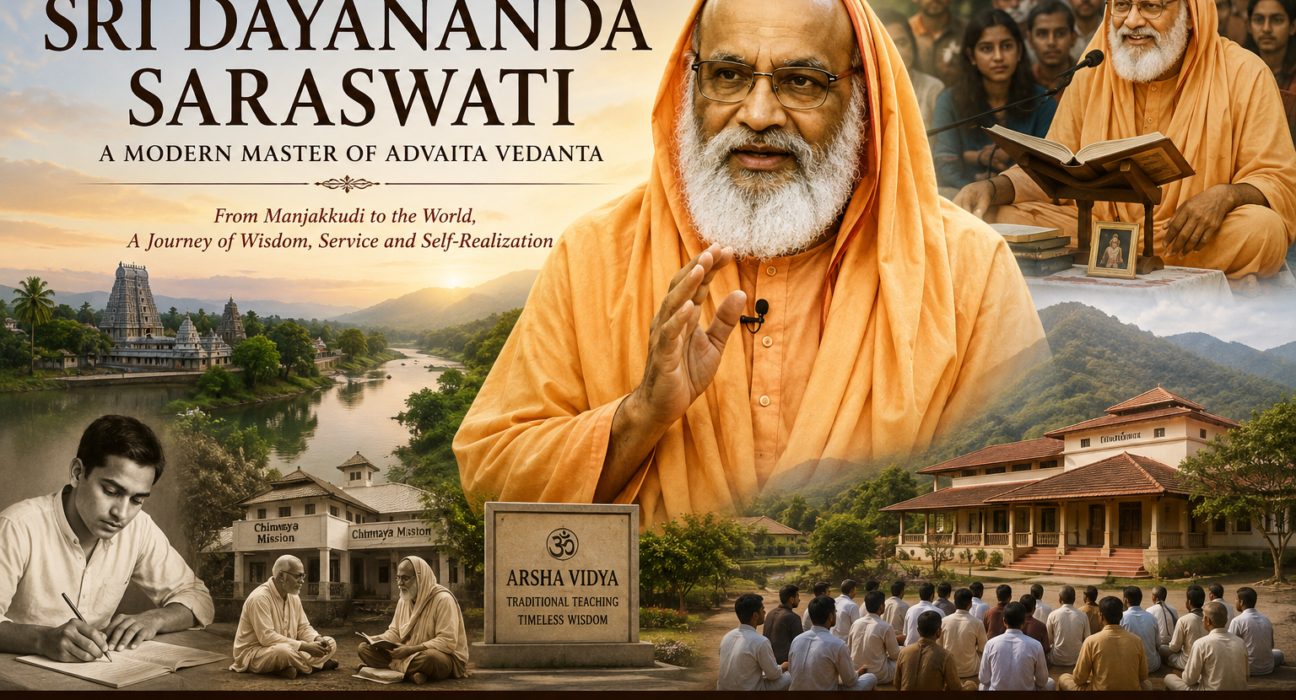
Sri Dayananda Saraswati: The Sage Who Revived Advaita Vedanta for the Modern World
There are spiritual masters who transform the lives of a few disciples, and there are rare visionaries whose influence transcends generations, cultures, and continents. Sri Dayananda Saraswati belongs to the latter.
At a time when the ancient wisdom of the Vedas and Upanishads was often misunderstood or confined to traditional circles, he emerged as one of the greatest exponents of Advaita Vedanta in the modern era. Through his profound scholarship, remarkable clarity of expression, and unwavering dedication to preserving the traditional teaching methodology, he brought the timeless message of Sanatana Dharma to seekers across the globe.
Born in a humble village on the banks of the sacred River Kaveri, his journey was not one of sudden enlightenment or miraculous events. Instead, it was a story of unwavering determination, selfless service, relentless study, deep compassion, and complete surrender to the pursuit of truth.
This is the inspiring life story of Sri Dayananda Saraswati, the teacher who dedicated every breath of his life to ensuring that the wisdom of the ancient rishis would continue to illuminate humanity for generations to come.
A Sacred Beginning in the Land of the Kaveri
Southern India has long been regarded as a cradle of spirituality. Flowing through this sacred landscape is the River Kaveri, affectionately called the Ganga of the South. Along her fertile banks flourished magnificent temples, enlightened saints, philosophers, poets, and great spiritual masters who shaped India’s religious and cultural heritage.
Among these revered places stands Kumbakonam, one of Tamil Nadu’s most sacred temple towns. Just a few miles away lies the peaceful village of Manjakkudi, a village surrounded by lush green fields and steeped in Vedic traditions.
It was here, in this spiritually vibrant atmosphere, that one of modern India’s greatest Vedanta teachers was born.
The family into which he was born was deeply rooted in devotion and righteousness. His grandfather, Mahalinga Iyer, was widely respected for his charity, humility, and unwavering devotion to Lord Shiva. Constantly chanting the sacred name of Shiva, he was known throughout the village for helping those in need without expecting anything in return.
These noble qualities naturally flowed into the next generation.
Mahalinga Iyer’s son, Gopala Iyer, married Smt. Valambal, and together they created a home where devotion, discipline, and compassion were not merely taught—they were lived every single day.
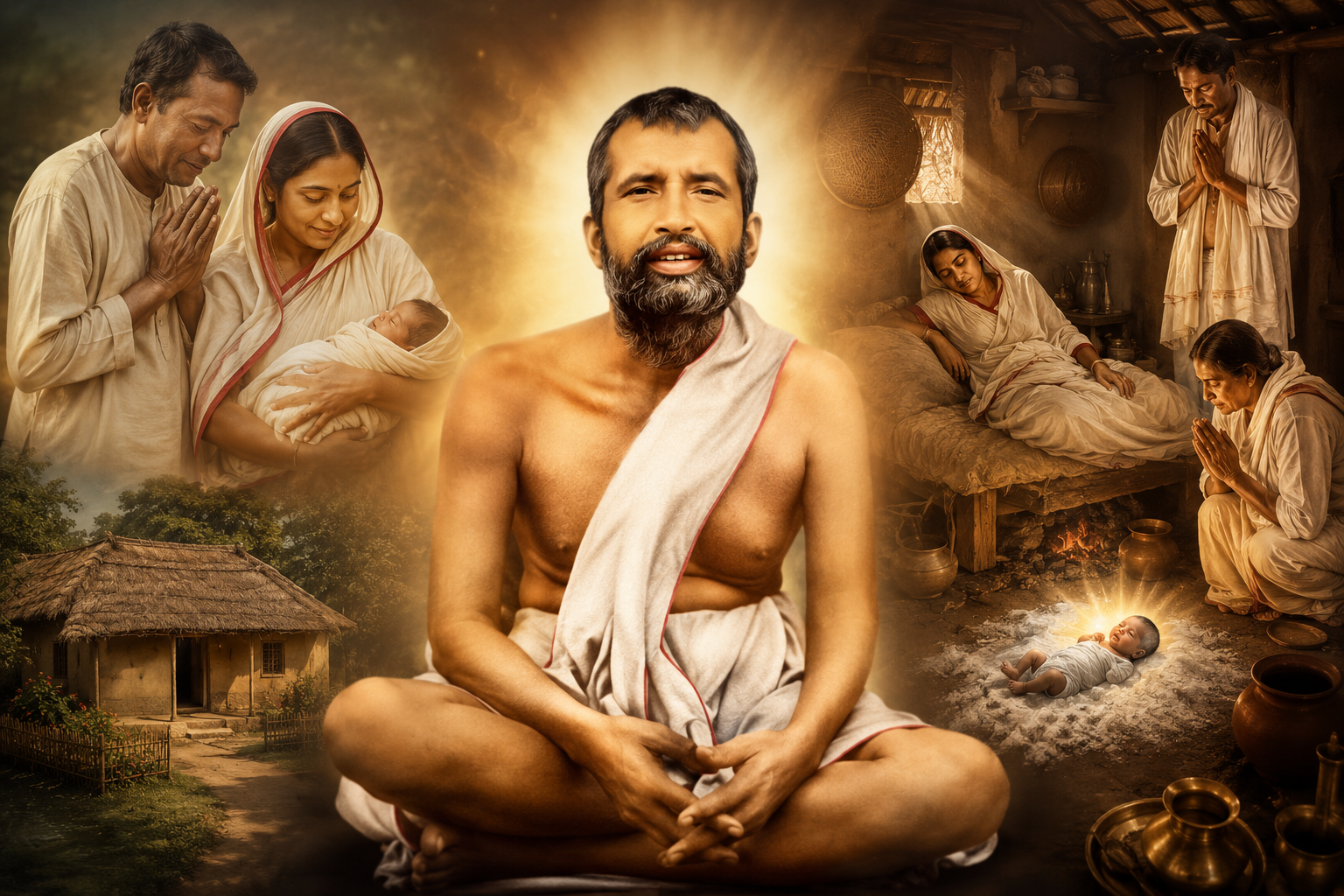
On 15 August 1930, their second son was born.
He was named Natarajan.
Few could have imagined that this child would one day become one of the world’s foremost teachers of Advaita Vedanta, inspiring thousands of seekers across continents.
A Childhood Filled with Compassion
Even during his earliest years, Natarajan displayed qualities that set him apart from other children.
Every morning before beginning his day, he would gather fresh flowers and lovingly offer them at the nearby Shiva temple. Worship was not a ritual imposed upon him by elders—it arose naturally from his heart.
He possessed an exceptionally sharp intellect, but what impressed everyone even more was his extraordinary compassion.
Whenever beggars came seeking food, the young boy would generously fill their bags with rice.
If someone questioned why he was giving away so much, his innocent reply reflected remarkable maturity:
“If they are hungry, how can a small handful ever be enough?”
His compassion extended beyond human beings.
If cattle wandered into the family’s fields to graze on crops, he could never bring himself to chase them away. Watching hungry animals satisfy their hunger mattered more to him than protecting the harvest.
Long before he became a spiritual teacher, compassion had already become the foundation of his character.
The Loss That Changed His Life
Life took a heartbreaking turn when Natarajan was only nine years old.
His father passed away unexpectedly, leaving the family devastated. His mother was overcome with grief, while the responsibility of raising several children suddenly became an overwhelming challenge.
One day, shortly after the funeral, relatives noticed young Natarajan playing with other children and questioned how he could possibly play at such a time.
Instead of answering emotionally, he quietly recited a verse from the great Tamil poet Avvaiyar, reminding them that no amount of mourning could bring back one who had departed.
Those present were astonished.
Even at such a tender age, he had begun to understand one of life’s deepest truths—the impermanence of worldly existence.
The wisdom that would later inspire thousands had already begun to reveal itself in the mind of a young village boy.
Growing Through Responsibility
Following his father’s death, financial hardship became an unavoidable reality.
The family struggled to make ends meet, and much of the responsibility eventually fell upon relatives, especially his widowed aunt, who lovingly cared for the children as though they were her own.
She was a deeply religious woman who observed numerous sacred vows and rituals throughout the year. Natarajan accompanied her in these observances, learning discipline, organisation, devotion, and the importance of selfless service.
As he grew older, responsibility naturally became a part of his daily life.
He supervised agricultural work, managed harvests, sold coconuts from the family farm, handled household expenses, and ensured that his mother and younger brothers were cared for.
Though still young, he never complained.
Duty itself became his first spiritual practice.
At the same time, another passion quietly grew within him—a deep longing to understand the eternal truths spoken of in the Upanishads and other sacred texts.
Whenever time permitted, he immersed himself in the study of Vedanta, unknowingly preparing for the mission that destiny had chosen for him.
A Young Man in Search of Knowledge
As the years passed, Natarajan’s responsibilities within the family continued to grow. While many young men of his age were occupied with dreams of careers and personal ambitions, his daily life revolved around supporting his widowed mother and younger brothers.
He supervised farming activities, managed harvests, sold coconuts from the family fields, paid taxes, and took care of household finances. Every task, no matter how ordinary, was carried out with sincerity and dedication.
Yet beneath this life of responsibility burned an unquenchable thirst for knowledge.
Whenever he found a moment of free time, he immersed himself in the Upanishads and other spiritual literature. The questions that occupied his mind were not about wealth or status, but about the purpose of life, the nature of the Self, and the eternal truth spoken of by the ancient sages.
Gradually, he realised that if he wished to support his family while expanding his own horizons, he needed to leave his village.
With his younger brothers now capable of handling much of the agricultural work, Natarajan made one of the most important decisions of his life.
He would travel to Madras (now Chennai) in search of employment.
It was a decision born not out of personal ambition, but out of responsibility toward his family and an eagerness to continue learning.
Chennai: A City That Opened New Doors
Moving from the peaceful surroundings of Manjakkudi to the bustling city of Madras exposed Natarajan to an entirely different world.
He stayed with relatives while searching for employment. Among them was an uncle whose influence would prove surprisingly significant.
Unlike most people of that period, his uncle spoke English fluently in everyday conversation. Hearing the language spoken so naturally fascinated the young Natarajan.
He recognised that English was far more than a foreign language—it was a bridge to knowledge and an instrument through which India’s spiritual heritage could one day reach the wider world.
Determined to master it, he began reading English newspapers, magazines, and literary classics. He studied the works of writers such as Shakespeare and Oliver Goldsmith with remarkable dedication.
He also learnt shorthand and typewriting, practical skills that greatly improved his employment prospects.
What began as an effort to build a career would eventually become one of the greatest strengths of his spiritual mission.
Years later, his command of English would allow him to explain the profound truths of Vedanta to audiences across Europe, North America, Australia, and many other parts of the world.
Lessons from Journalism
Natarajan’s dedication soon earned him a position with the publication Dharmika Hindu.
His responsibilities were remarkably diverse.
He wrote articles, edited manuscripts, supervised the printing process, coordinated publication schedules, and even distributed newspapers on his bicycle.
Rather than viewing any task as beneath him, he embraced every responsibility with enthusiasm.
These years became an unexpected training ground.
Working in journalism sharpened his communication skills, taught him organisational discipline, and showed him how to manage an institution efficiently.
Without realising it, he was acquiring abilities that would later prove invaluable when establishing international Vedanta organisations and teaching centres.
Every experience, however ordinary it seemed at the time, was quietly preparing him for a much greater purpose.
A Different Path Beckons
Like many young men of his generation, Natarajan also explored other career opportunities.
Along with a close friend, he applied for pilot training in the Indian Air Force.
Although he was not selected as a pilot, he joined the Ground Training Service, hoping it might lead to a meaningful career.
However, life there revealed a different reality.
Strict regulations prevented him from obtaining leave to perform his father’s annual Shraddha, a sacred duty that held deep significance in his family tradition.
The rigid environment left him deeply dissatisfied.
More importantly, he realised that external success alone could never fulfil the deeper calling within his heart.
After completing the necessary formalities, he chose to leave.
What appeared to be a career setback would ultimately become a blessing, redirecting him toward his true destiny.
Destiny Arrives in the Form of a Guru
Every seeker’s life reaches a moment when destiny introduces the teacher meant to guide them.
For Natarajan, that moment arrived in 1952.
Swami Chinmayananda, already becoming renowned for presenting the Bhagavad Gita and Upanishads in clear, modern language, was conducting a series of Jnana Yajnas in Madras.
One of Natarajan’s relatives, familiar with Swami Chinmayananda’s work, invited him to attend the lectures.
He accepted.
That single decision changed the course of his life forever.
The first sight of Swami Chinmayananda left a profound impression on him.
It was not merely the Swami’s radiant personality that captivated him, but the remarkable clarity with which he explained the deepest truths of Vedanta.
Ancient scriptures, often considered difficult and inaccessible, suddenly became alive, practical, and deeply relevant to everyday life.
For the first time, Natarajan saw a teacher capable of connecting timeless wisdom with the modern world.
Deep within his heart, he knew he had found the Guru he had been searching for.
A Disciple is Born
After that first meeting, Natarajan became one of Swami Chinmayananda’s most dedicated volunteers.
Whenever a Jnana Yajna was organised in Madras, he was among the first to arrive and the last to leave.
He prepared posters, distributed pamphlets, organised publicity campaigns, coordinated venues, and managed countless behind-the-scenes responsibilities.
No task was too small.
No effort was too great.
His only desire was that more people should hear his Guru’s teachings.
Swami Chinmayananda soon recognised the extraordinary qualities hidden within the quiet young man.
His intelligence, humility, organisational ability, and tireless dedication distinguished him from many others.
Over time, Swami Chinmayananda initiated him into spiritual practice through Mantra Diksha, and in 1955, entrusted him with the important responsibility of serving as the Secretary of the Chinmaya Mission.
For Natarajan, it was never a position of prestige.
It was simply another opportunity to serve his Guru and the timeless wisdom of Vedanta.
The Quiet Sacrifice
As Natarajan devoted more of his life to the Chinmaya Mission, another challenge quietly unfolded at home.
His mother wished to see him married and settled.
Like any loving parent, she dreamed of watching her eldest surviving son build a family of his own.
But Natarajan’s heart had already chosen a different path.
The call of spiritual life grew stronger with each passing day.
He did not wish to hurt his mother by openly rejecting her wishes. Instead, he gradually reduced the time he spent at home.
From early morning until late at night, he immersed himself in his work for the Mission. Often, he requested that his dinner simply be left outside, quietly eating alone before resting for the night.
It was his gentle way of preparing both himself and his family for the life he knew he was destined to embrace.
Without arguments, without confrontation, and without causing unnecessary pain, he slowly loosened the ties that bound him to worldly life.
The path of renunciation had already begun long before he formally took the vows of Sannyasa.
The Call of the Himalayas
By the mid-1950s, Natarajan had become one of the most trusted members of the Chinmaya Mission. His days were filled with organising spiritual programmes, assisting his Guru, and studying the scriptures whenever time permitted.
Yet, despite the satisfaction he found in service, he felt an unmistakable pull from within.
He longed for something deeper.
Listening to spiritual discourses had strengthened his understanding of Vedanta, but he wished to immerse himself completely in the traditional way of learning under great masters. His heart was drawn towards the Himalayas—the timeless abode of sages where generations of seekers had dedicated their lives to the pursuit of Self-knowledge.
Soon, destiny opened that very door.
A Journey to Uttarkashi
While preparing the English publication of Swami Chinmayananda’s commentary on the Bhagavad Gita, Natarajan accompanied his Guru to Uttarkashi, one of the most revered centres of spiritual learning in the Himalayas.
The journey was meant to assist in the publication work, but for Natarajan it became much more than a professional assignment.
It became a life-changing spiritual pilgrimage.
During his stay, he came into the presence of Swami Tapovan Maharaj, the illustrious Guru of Swami Chinmayananda and one of the greatest Himalayan sages of the twentieth century.
For nearly two months, Natarajan lived in the serene atmosphere of the ashram while helping with the publication work.
Surrounded by monks who had renounced everything in search of truth, he experienced a world completely different from the busy life of Madras.
The silence of the Himalayas, the sacred flow of the River Ganga, and the simplicity of the ascetics awakened something profound within him.
For the first time, he saw what it truly meant to dedicate one’s entire life to spiritual wisdom.
A Question That Echoed Within
When the work in Uttarkashi came to an end, Natarajan approached Swami Tapovan Maharaj to seek his blessings before returning south.
The great sage looked at him with affection and asked a simple question:
“Why go back? Why don’t you stay here?”
The question pierced straight into Natarajan’s heart.
He wanted nothing more than to remain in the Himalayas.
But another voice reminded him of the responsibilities he still carried.
His mother depended on him.
His younger brothers had not yet become fully independent.
With folded hands, he respectfully replied,
“I shall return next year.”
It was more than a courteous answer.
It was a promise to himself.
A promise that once his worldly duties were complete, he would dedicate his entire life to the pursuit of spiritual knowledge.
Completing His Final Responsibilities
Returning to Madras, Natarajan resumed his work with renewed determination.
This time, however, his priorities had become crystal clear.
He patiently ensured that every responsibility toward his family was fulfilled.
As his younger brothers matured and became capable of managing the household, he gradually stepped away from the obligations he had faithfully carried for so many years.
Only after making certain that his mother would be cared for and the family could stand on its own did he decide that the time had finally arrived.
He resigned from his employment.
He left behind financial security.
He walked away from a promising future in the worldly sense.
His destination was once again the Himalayas.
But this time, there would be no return.
The seeker had answered the call of destiny.
The Gift of Sannyasa
Years of discipline, selfless service, scriptural study, and unwavering devotion had prepared Natarajan for the defining moment of his life.
On the sacred occasion of Maha Shivaratri in February 1962, Swami Chinmayananda initiated him into the ancient order of Sannyasa.
The ceremony marked far more than the changing of robes.
It symbolised the complete renunciation of personal identity and worldly attachment in the pursuit of Brahman, the Absolute Reality.
The young man known as Natarajan now received a new name that would become respected throughout the spiritual world:
Swami Dayananda Saraswati.
From that day onward, every aspect of his life belonged to the service of Dharma and the teaching of Vedanta.
His mission had truly begun.
The Pain of Letting Go
News of his Sannyasa reached his family soon afterwards.
For his younger brother Srinivasan, the news was almost unbearable.
Natarajan had not merely been an elder brother.
After their father’s death, he had become a guide, protector, and provider—the pillar on whom the entire family had depended.
The thought that he had now renounced every worldly relationship overwhelmed him with grief.
He openly wept, wondering how their mother could endure such a loss.
His sorrow reflected the emotional cost that often accompanies the birth of a great spiritual life.
When one individual dedicates himself entirely to humanity, the family must also make a profound sacrifice.
A Mother’s Greatest Test
Before settling permanently in Rishikesh, Swami Dayananda decided to visit his mother in Manjakkudi one last time.
The meeting was deeply emotional.
She had endured widowhood, poverty, and countless hardships while raising her children.
Seeing her beloved son dressed in saffron robes filled her heart with conflicting emotions.
She was proud of his spiritual attainment, yet she also grieved as a mother.
To the world, he was now a monk.
To her, he would always remain her child.
Understanding her pain, Swami Dayananda gently consoled her.
He reminded her that her other sons would continue to care for her.
Then he spoke words that revealed the boundless compassion of an enlightened heart:
“Until now, you alone were my mother. From today, mothers throughout the world are my mothers.”
Those words were not spoken out of detachment from his family.
They were an expression of universal love.
His family had expanded beyond blood relations to embrace humanity itself.
With his mother’s blessings, he departed for Rishikesh, where the next chapter of his extraordinary life would unfold.
A Teacher Respected by All
Life in Rishikesh marked the beginning of Swami Dayananda Saraswati’s true spiritual mission.
Nestled on the banks of the sacred Ganga and surrounded by the majestic Himalayas, Rishikesh had long been a sanctuary for monks and seekers. Here, Swamiji immersed himself in intense scriptural study, contemplation, and teaching.
His gentle speech, disciplined life, humility, and profound understanding of Vedanta quickly earned him the respect of the monastic community.
Monks who found themselves caught in disagreements often approached him to help resolve their differences. Rather than taking sides, Swamiji listened patiently, understood each person’s perspective, and guided them towards harmony.
Others came seeking help for everyday difficulties. Some requested medicines for illness, while others simply wished to spend a few moments in his peaceful presence.
To Swamiji, no act of service was insignificant.
Whether explaining the Upanishads or handing a tablet to someone suffering from fever, every action was an expression of compassion.
Three Decades of Tireless Service
For nearly three decades, Swami Dayananda dedicated himself wholeheartedly to spreading the teachings of Vedanta through the Chinmaya Mission.
He travelled extensively, organised spiritual programmes, trained students, and taught wherever sincere seekers gathered.
The journey, however, was not always smooth.
As the organisation expanded, differences in opinion occasionally emerged among those involved in its activities. Some compared teachers, while others developed differing views about organisational matters.
Swamiji refused to become involved in divisions.
Instead, he treated everyone with equal kindness.
Those who disagreed with him were welcomed with the same warmth as those who supported him.
His concern was never personal recognition.
His only concern was that the wisdom of the scriptures should reach people without distraction or conflict.
Such was his maturity that even criticism never disturbed his inner peace.
Choosing Dharma Over Position
Over time, differences in approaches to teaching and organisational functioning gradually became more apparent.
According to the source script, these differences eventually began affecting the mission’s work and created unrest among some followers.
Swami Dayananda responded with characteristic dignity.
Rather than allowing disagreements to grow into conflict, he voluntarily stepped away from the organisation after completing a Brahmacharya training programme in California.
He informed the governing body of his decision respectfully and accepted the separation without bitterness.
There were no accusations.
No public disputes.
No attempt to create division.
His conduct reflected one of the central values he had always lived by:
Truth and Dharma must always stand above personal position or institutional identity.
The Birth of Arsha Vidya
Leaving an established organisation meant beginning again from the very beginning.
There were no large financial resources waiting for him.
No grand buildings.
No organisational machinery.
Only a handful of devoted students who believed deeply in his vision.
Together they worked patiently to establish a new centre dedicated to preserving the traditional method of teaching Vedanta exactly as it had been handed down through generations of teachers.
This institution became known as Arsha Vidya Peetham.
What started as a modest beginning gradually grew into one of the most respected centres for the systematic study of Advaita Vedanta.
Supporters came forward in different ways.
Some donated land.
Others contributed financially.
Many volunteered their time and skills.
Swamiji accepted every contribution with gratitude, never seeking luxury or personal comfort.
His dream was simple:
To ensure that the wisdom of the Vedas remained available to future generations in its pure and authentic form.
Carrying Vedanta Across the World
Once the foundations of Arsha Vidya had been established, Swami Dayananda expanded his teaching mission beyond India.
He travelled throughout the country conducting Jnana Yajnas, presenting the Upanishads, Bhagavad Gita, and other scriptures with remarkable clarity.
Soon, invitations began arriving from around the world.
He travelled to the United States, Canada, and many other countries, where thousands of spiritual seekers eagerly attended his lectures.
What made Swamiji unique was not merely his scholarship.
Many scholars possessed knowledge.
Few possessed the ability to communicate that knowledge with such clarity.
Complex philosophical concepts became accessible through his simple language, practical examples, humour, and logical explanations.
Students who had once considered Vedanta too difficult to understand found themselves deeply inspired.
Many dedicated years of their lives to studying under him.
Through these efforts, the ancient Guru-Shishya tradition quietly took root in many parts of the world.
Establishing Gurukulams
As the number of serious students increased, Swamiji recognised the need for centres where seekers could study the scriptures in the traditional residential system.
After careful consideration, a suitable location was found near Saylorsburg, Pennsylvania.
In January 1987, the Arsha Vidya Gurukulam was established there.
Students from many countries came to live, study, and immerse themselves in the teachings of Advaita Vedanta.
Yet Swamiji never forgot his homeland.
He believed that India also required institutions where the traditional method of teaching could flourish.
Eventually, a beautiful location was chosen amidst the tranquil hills near Coimbatore.
Surrounded by the Western Ghats, the Gurukulam became a sanctuary for scriptural study, meditation, and spiritual inquiry.
Over time, temples dedicated to Lord Dakshinamurti, Ganesha, Lord Shiva, and Lord Subrahmanya were established within the campus, creating an atmosphere where devotion and knowledge complemented one another beautifully.
A Vision Beyond Institutions
Swami Dayananda’s vision extended far beyond building ashrams and teaching scriptures.
He believed that preserving Sanatana Dharma required cooperation among the various Hindu traditions.
With great patience, he met religious leaders from different lineages and encouraged them to work together for the protection of India’s spiritual heritage.
The source script describes his efforts to bring together Hindu Acharyas on a common platform, emphasising unity, mutual respect, and the preservation of Dharma while avoiding unnecessary conflict with followers of other faiths.
He often reminded his disciples that spiritual work should never be driven by anger or hatred.
Dharma, he believed, must always be protected through wisdom, compassion, and respectful dialogue.
This broad and inclusive vision earned him the admiration of spiritual leaders across India.
Serving Society Through Education
For Swami Dayananda Saraswati, spirituality was never separate from service.
His concern extended to education, rural development, and social welfare.
According to the source script, the organisation Aim for Seva carried out educational and community service initiatives across India, while his birthplace of Manjakkudi benefited from educational institutions established through his inspiration.
His life demonstrated that true spirituality is not confined to meditation halls or temples.
It expresses itself through compassion, education, and service to humanity.
For Swamiji, serving people was another way of worshipping the Divine.
Simplicity, Wisdom, and an Everlasting Legacy
Despite becoming one of the most respected teachers of Advaita Vedanta in the world, Sri Dayananda Saraswati remained a man of remarkable simplicity.
Titles, recognition, and fame never altered the way he lived.
Whether addressing thousands in an international conference or speaking to a handful of students in a Gurukulam, his humility remained the same.
He believed that a teacher’s responsibility was not to impress people with scholarship, but to remove ignorance through clear understanding.
This philosophy became the hallmark of his teaching.
Making Vedanta Understandable
One of Swamiji’s greatest contributions was his unique style of teaching.
The scriptures of Vedanta are profound and often difficult for newcomers to understand. Yet Swamiji possessed an extraordinary gift.
He could explain the most subtle philosophical concepts using simple language, practical examples, stories, and gentle humour.
Students often remarked that subjects which had once seemed impossibly complex suddenly became crystal clear after listening to him.
He never encouraged blind belief.
Instead, he invited students to think, question, analyse, and understand.
For him, spirituality was never about emotion alone.
It was about knowledge that removes ignorance.
This ability to communicate timeless wisdom in a logical and accessible manner attracted seekers from every walk of life—students, professionals, scholars, scientists, and householders alike.
His Faith in the Younger Generation
Swami Dayananda had immense confidence in young people.
While many viewed modern youth with concern, he saw something very different.
He believed they were intelligent, energetic, and eager to learn.
According to the source script, he often observed that the younger generation possessed tremendous enthusiasm and intellectual ability. What they needed most was a deeper sense of responsibility.
He encouraged teachers and parents not to criticise young people but to help them recognise their own responsibilities and channel their abilities towards meaningful goals.
He acknowledged that this was not an easy task.
Yet he insisted it was one of the most important responsibilities of society.
His words continue to inspire educators and spiritual teachers even today.
A Life Dedicated to Sanatana Dharma
Every stage of Swami Dayananda Saraswati’s life reflected a single purpose.
He dedicated himself to preserving the authentic teaching tradition of the Vedas and Upanishads.
He trained hundreds of students.
He established Gurukulams in India and abroad.
He inspired educational and charitable initiatives.
He encouraged dialogue among spiritual leaders.
Above all, he ensured that the ancient wisdom of Advaita Vedanta remained available to sincere seekers throughout the world.
His life’s work demonstrated that Sanatana Dharma is not merely a collection of rituals or beliefs.
It is a living tradition of knowledge, enquiry, compassion, and self-discovery.
Mahasamadhi
After decades of tireless teaching and service to humanity, Sri Dayananda Saraswati attained Mahasamadhi on 23 September 2015 in Rishikesh.
For thousands of disciples around the world, it marked the end of a remarkable earthly journey.
His physical body was laid to rest with the honours traditionally accorded to a revered Sannyasi.
Although the Guru was no longer physically present, his teachings continued to guide seekers across continents through his books, recorded discourses, Gurukulams, and the countless students he had trained during his lifetime.
A Nation Pays Tribute
The impact of Sri Dayananda Saraswati’s work extended far beyond spiritual circles.
In recognition of his immense contribution to Indian philosophy, education, and culture, the Government of India posthumously honoured him with the Padma Bhushan in 2016.
It was a fitting tribute to a teacher who had spent his entire life serving society without seeking recognition.
For Swamiji, however, the greatest honour had always been something far simpler:
Seeing a student understand the truth of the scriptures.
That was the true reward for a lifetime dedicated to teaching.
Conclusion
The life of Sri Dayananda Saraswati reminds us that true greatness is measured not by fame or power, but by the wisdom one shares and the lives one transforms.
Born as Natarajan in the small village of Manjakkudi, he journeyed from the fertile banks of the Kaveri to the sacred Himalayas, carrying with him an unwavering thirst for knowledge and an unshakeable commitment to truth.
He fulfilled his responsibilities before embracing renunciation.
He mastered modern education without abandoning ancient wisdom.
He carried the timeless teachings of the Upanishads across continents while preserving the authenticity of the traditional Guru–Shishya lineage.
Through Arsha Vidya Gurukulams, countless lectures, books, charitable initiatives, and decades of dedicated teaching, he ensured that the wisdom of Advaita Vedanta would continue to illuminate seekers long into the future.
His life was never about building an institution around himself.
It was about preserving an eternal tradition.
Even today, years after his Mahasamadhi, his voice continues to echo through classrooms, ashrams, books, and the hearts of sincere seekers around the world.
The message he lived by remains timeless:
Knowledge alone removes ignorance, and through Self-knowledge, one discovers the freedom that has always existed within.
For generations to come, Sri Dayananda Saraswati will be remembered not merely as a scholar or monk, but as one of the greatest modern custodians of Sanatana Dharma and one of the finest teachers Advaita Vedanta has ever known