
Kamakhya Temple: The Sacred Shakti Peetha of Divine Feminine Power
Kamakhya Temple: The Mysterious Shakti Peetha Where the Divine Mother Is Worshipped Beyond Form
There are countless temples in India where devotees seek the blessings of the Divine Mother. Every shrine has its own history, every deity has its own glory, and every pilgrimage offers a unique spiritual experience.
Yet, whenever the question arises, “Which temple should one speak about? Which Goddess deserves to be understood beyond devotion?” one name repeatedly shines through the minds of spiritual seekers.
Kamakhya.
For years, countless devotees have wished to express the greatness of this sacred shrine, yet words often fall short. Perhaps that is because Kamakhya is not merely a temple that can be described—it is a spiritual experience that must be felt.
The Goddess worshipped here is not simply seen with the eyes.
She is experienced with the heart.
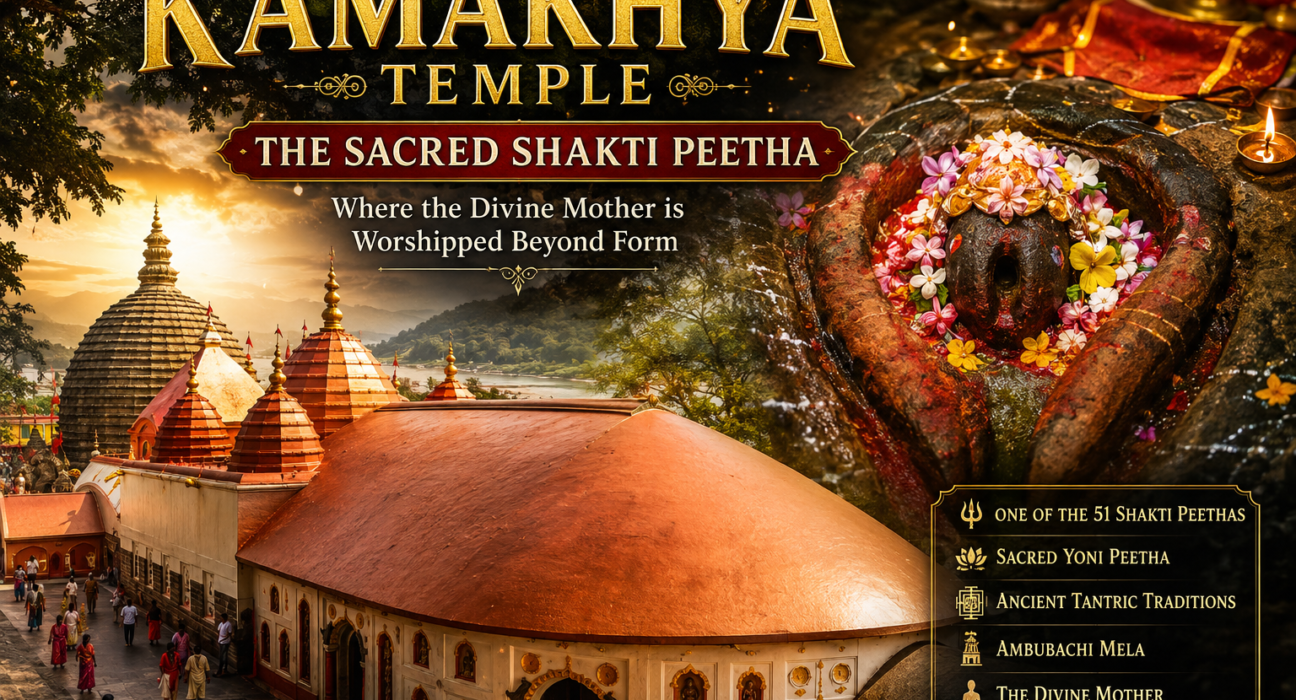
Perched atop the Nilachal Hill in Guwahati, Assam, the Kamakhya Temple is one of the most revered and mysterious Shakti Peethas in India. Unlike most temples dedicated to the Divine Mother, Kamakhya has no magnificent idol or sculpted image representing the Goddess.
Instead, devotees descend into a small cave where a naturally formed rock, continuously bathed by an underground spring, is worshipped as the sacred embodiment of the Divine Feminine.
To some, it is only a stone.
To millions of devotees, it represents the very source of creation.
The mystery of life itself.
A Temple Unlike Any Other
The first visit to Kamakhya surprises almost every pilgrim.
Those expecting a towering idol decorated with jewels quickly realise that this temple is unlike any other in India.
There is no grand murti standing inside the sanctum.
No beautifully carved image waiting to receive worship.
Instead, the heart of the temple lies beneath the ground.
Devotees walk down a narrow stone passage into a naturally formed cave.
There, inside the dimly lit sanctum, rests a cleft in a rock, constantly nourished by a natural underground spring.
This sacred rock is worshipped as the Yoni of Adi Shakti—the eternal source of creation.
For devotees, this is not merely a symbol.
It is the living presence of the Divine Mother herself.
Kamakhya teaches a profound truth.
The Divine does not always reveal itself through form.
Sometimes, the highest reality is beyond form altogether.
The Sacred Shakti Peetha
The spiritual significance of Kamakhya is deeply connected to one of Hinduism’s most powerful legends.
According to the ancient tradition of the Shakti Peethas, Goddess Sati immolated herself during the great sacrifice conducted by her father, Daksha.
Overwhelmed by grief, Lord Shiva carried her body across the universe in a dance of cosmic sorrow.
To restore balance, Lord Vishnu released his Sudarshana Chakra, which divided Sati’s body into many sacred parts.
Wherever these sacred parts fell, powerful centres of Divine Feminine energy emerged.
These places came to be known as the Shakti Peethas.
Among all of them, Kamakhya occupies a unique position.
It is traditionally believed to be the place where the Yoni—the creative source of life—fell upon the earth.
For this reason, Kamakhya is regarded not merely as a temple of worship, but as a celebration of creation itself.
It honours fertility.
It honours motherhood.
It honours womanhood.
Above all, it honours Shakti—the primordial energy through which the universe comes into existence.
The Living Presence of the Goddess
One of the most remarkable aspects of Kamakhya is that devotees do not feel as though they are standing before an idol.
Many describe an entirely different experience.
The cave itself feels alive.
The silence seems to breathe.
The cool air carries an indescribable stillness.
There is a sense that the Goddess is not confined to a single object of worship.
She fills the entire space.
The stone beneath one’s feet.
The water flowing through the cave.
The silence.
The darkness.
Even the very air feels charged with an unseen presence.
It is this experience that has inspired countless saints, yogis, and seekers to describe Kamakhya not as a place where God resides, but as a place where Divine Consciousness itself is felt.
The Spiritual Path of Tantra
Kamakhya is also one of the world’s most important centres of Tantric worship.
The word Tantra is often misunderstood.
Many people associate it with mystery, fear, or occult practices.
In reality, Tantra is a profound spiritual tradition that seeks to transform ordinary human consciousness into direct spiritual experience.
Rather than rejecting the energies of life, Tantra teaches that every aspect of existence can become a means of spiritual awakening when approached with discipline, wisdom, and proper guidance.
Because of this tradition, the rituals performed at Kamakhya differ significantly from those seen in many other temples.
Some practices may appear unfamiliar to visitors.
However, they are rooted in centuries-old Tantric traditions that have been preserved by generations of priests and spiritual practitioners.
To devotees, these rituals are not expressions of superstition.
They are sacred methods of invoking the Divine Mother in accordance with an ancient spiritual lineage.
A Temple That Must Be Experienced
Many pilgrims arrive at Kamakhya carrying only one desire.
Not to ask for wealth.
Not to seek power.
But simply to experience the presence of the Divine Mother.
They wish to stand inside the sanctum.
Offer a silent prayer.
Close their eyes.
And allow themselves to be embraced by a peace that words cannot describe.
Those who have visited often say that the temple changes something within them.
Negative thoughts begin to fade.
The restless mind becomes quiet.
An unexpected silence settles in the heart.
It is as though the Goddess speaks—not through words, but through an experience that cannot easily be explained.
Perhaps that is why so many devotees return again and again.
Not because they saw something extraordinary.
But because they felt something extraordinary.
Ambubachi Mela: When the Goddess Rests
Among all the festivals celebrated at Kamakhya, none is more significant than the Ambubachi Mela.
Each year, during a specific period, the temple closes for several days.
According to long-standing temple tradition, this period marks the annual menstrual cycle of the Divine Mother.
During these days, regular worship inside the sanctum is suspended.
When the temple reopens, thousands of devotees gather to receive the blessings associated with this sacred occasion.
For devotees, the festival is a profound reminder that the processes of nature are sacred and that creation itself is an expression of the Divine Feminine.
It is one of the reasons Kamakhya occupies such a unique place among India’s sacred temples.
The Universal Mother
Kamakhya is not worshipped merely as a powerful Goddess.
She is worshipped as the Mother of all existence.
People arrive carrying different burdens.
Some seek relief from suffering.
Some pray for strength.
Some come with broken hearts.
Others arrive searching for answers they cannot find anywhere else.
Yet devotees believe that the Divine Mother does not judge those who come before her.
She does not measure their past.
She does not weigh their mistakes.
Her joy lies simply in the fact that they have come.
For a mother never turns away her child.
Conclusion
Kamakhya is far more than an ancient temple hidden in the hills of Assam.
It is one of the most profound spiritual centres in India—a place where devotion, Tantra, philosophy, and the Divine Feminine come together in a way unlike anywhere else in the world.
There is no magnificent idol.
No elaborate image.
Only a sacred rock, an eternal spring, and a silence that speaks directly to the soul.
Perhaps that is the greatest lesson Kamakhya offers.
The Divine is not always found in grand forms or magnificent temples.
Sometimes, the deepest spiritual experience is discovered in stillness.
In surrender.
In silence.
And when a devotee truly opens their heart, Kamakhya is no longer a temple on a distant hill.
She becomes a living presence within.
From that moment onward, the pilgrimage never truly ends, because the Divine Mother continues to reside—not only upon Nilachal Hill—but within the heart of every sincere seeker.