
Neem Karoli Baba: Complete Biography, Miracles, Teachings, Ashrams & Legacy

Neem Karoli Baba: The Extraordinary Saint Who Transformed Millions Through Love and Compassion
There are saints whose names remain confined to the regions where they lived, and then there are those whose presence transcends time, geography, language, and religion. Neem Karoli Baba belongs to the latter.
Even today, decades after his Mahasamadhi, thousands of devotees travel to his ashrams in the Himalayan foothills, hoping to experience the same indescribable peace that countless seekers found in his presence. His devotees include humble villagers, wandering monks, renowned scholars, musicians, business leaders, and some of the most influential personalities of the modern world. Yet what makes his life truly remarkable is that he never sought fame, established a religious movement, or claimed to possess supernatural powers.
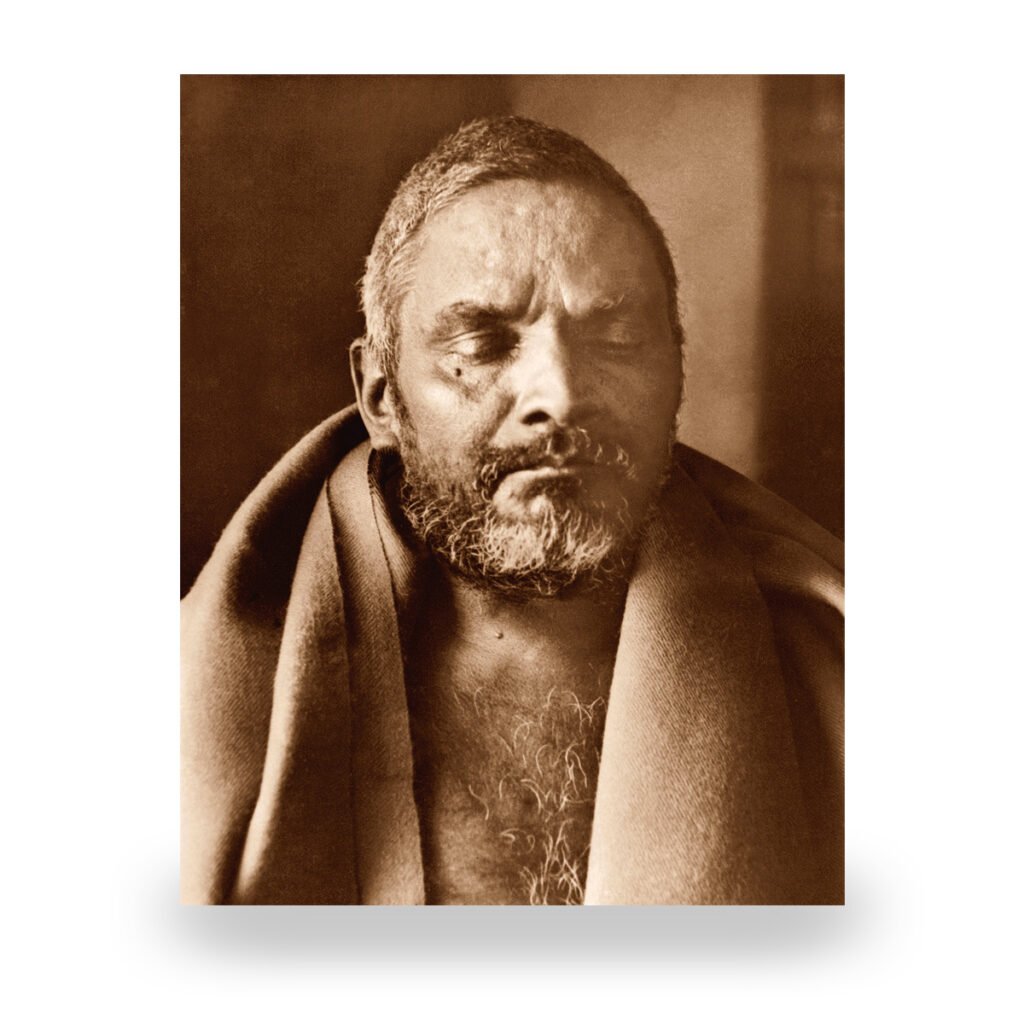
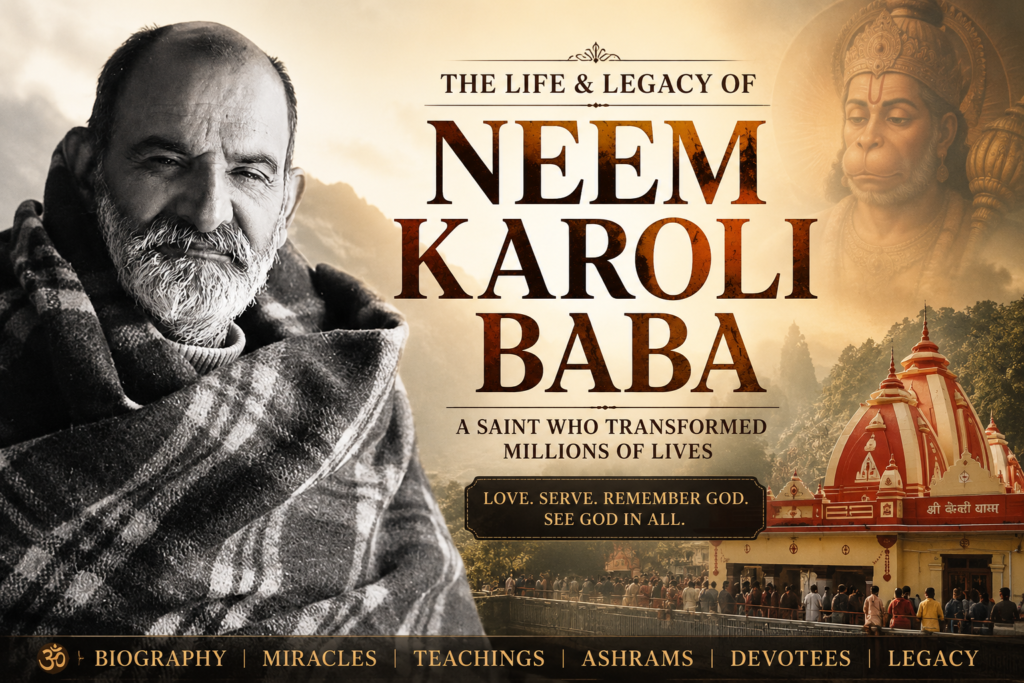
Wrapped in a simple cotton blanket, with an ever-present smile that reflected childlike innocence, Neem Karoli Baba looked more like an ordinary village elder than a revered spiritual master. There were no elaborate robes, no royal procession of disciples, and no attempt to project himself as a miracle worker. Those who met him, however, often left convinced that they had encountered someone far beyond ordinary human understanding. His words carried an inexplicable authority, his touch comforted broken hearts, and his silent presence transformed lives in ways that logic could scarcely explain.
To his devotees, he was not merely a saint but a living manifestation of Lord Hanuman—the embodiment of unwavering devotion, limitless compassion, and selfless service. While Baba himself never encouraged such claims, countless incidents from his life strengthened this belief among those who knew him.
Yet the story of Neem Karoli Baba did not begin in an ashram or atop a Himalayan mountain. Like every human life, it began quietly in a small village, long before the world would know his name.
Birth of a Saint
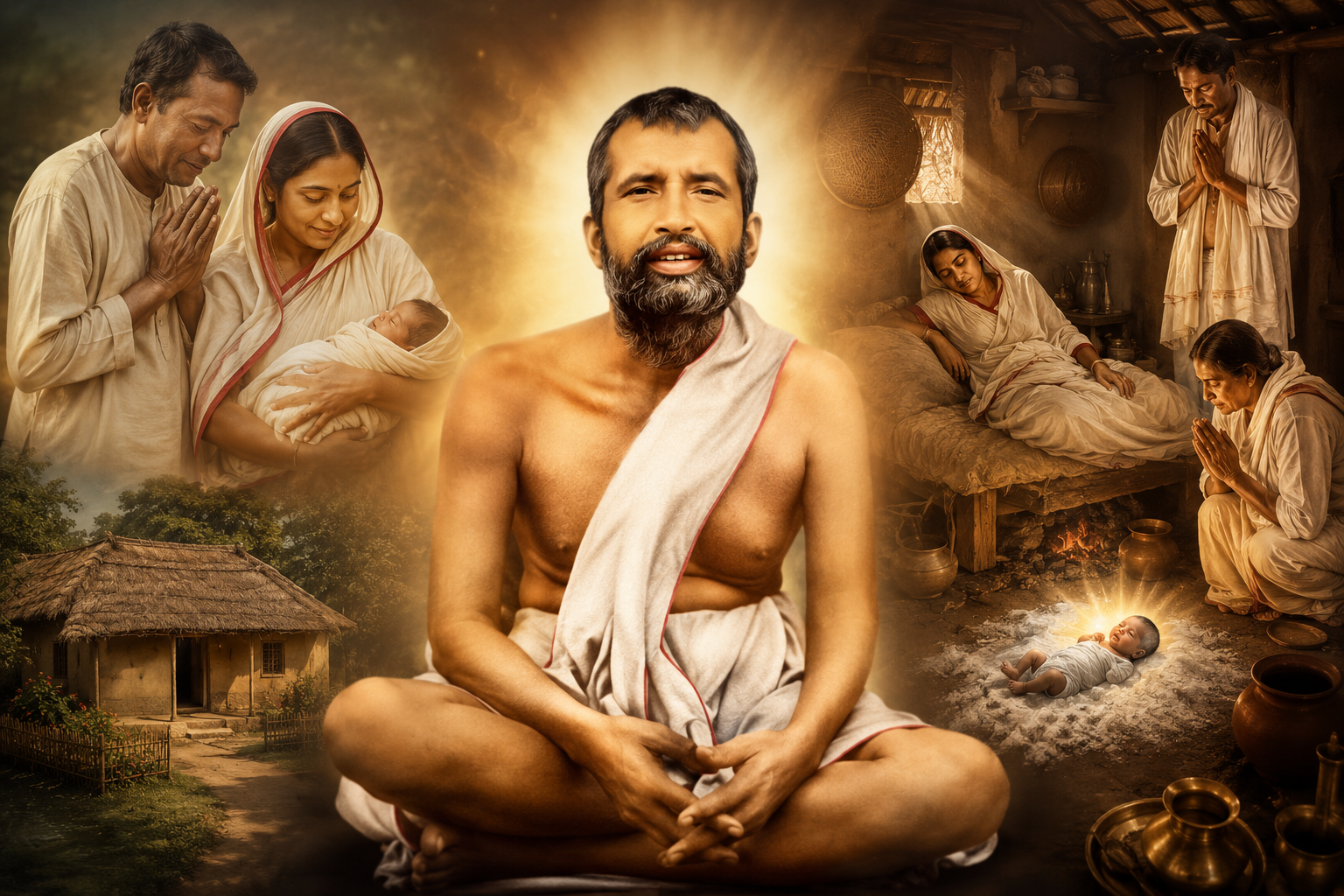
Around the turn of the twentieth century, in the peaceful village of Akbarpur in Uttar Pradesh’s Firozabad district, a child was born into the respected zamindar family of Sri Durga Prasad Sharma and Smt. Kausalya Devi. According to the traditional accounts preserved by his devotees, his birth took place during the auspicious Shukla Paksha Ashtami in September 1900. Although nothing outwardly distinguished this newborn from other children, elders in the family sensed that destiny had reserved an extraordinary future for him.
As was customary in many Indian households of that era, the child’s horoscope was shown to renowned astrologers. Their predictions astonished everyone present. They declared that the boy would one day become widely revered, that countless people would bow before him with devotion, and that material scarcity would never touch his life. The family celebrated these auspicious forecasts, unaware that the child would eventually inspire millions across the world.
Although these predictions filled the household with hope, the young boy’s childhood unfolded very differently from what anyone had imagined.
A Childhood Marked by Loss
Behind every great spiritual life lies an experience that quietly reshapes the soul.
For the young boy who would later become Neem Karoli Baba, that experience came painfully early. When he was only eight years old, he lost his mother. The comfort, affection, and security that only a mother’s presence can provide vanished from his life almost overnight.
History offers many examples of saints whose inner journey began not through comfort but through suffering. Personal loss often awakens questions that ordinary success cannot answer. Why does life change so suddenly? What truly endures? Is there a reality beyond birth and death?
Whether these questions arose in the young boy’s mind is something no historical record can confirm. The documentary script does not describe his inner thoughts during this period. Yet the early loss of his mother remains one of the defining events of his childhood, shaping the path that would eventually lead him away from the ordinary life expected of him.
Marriage According to Tradition
In early twentieth-century India, child marriage was an accepted social custom in many communities. Families considered it a natural part of life, long before children reached adulthood.
Following these traditions, the young boy was married at around twelve years of age to a girl named Subh Shriram Baiti. Like countless marriages of that era, it was arranged by the family according to prevailing customs rather than personal choice.
To everyone around him, it appeared that his life would now follow the familiar path of a respectable householder. But destiny had other plans.
Only a few days after the wedding, something extraordinary happened.
Without informing his family, without making any public announcement, and without leaving any clue about his destination, the young groom quietly walked away from home.
No one knew where he had gone.
No one knew why he had left.
The family searched, villagers speculated, and time passed in silence.
Years would go by before they saw him again.
A Journey into the Unknown
In the spiritual traditions of India, there exists an ancient practice that has shaped the lives of countless saints and yogis. Before a seeker could be entrusted with higher spiritual knowledge, the guru would often send the disciple away—not for days or months, but for years.
The purpose was simple yet profound.
True spiritual wisdom cannot be inherited, purchased, or learned from books alone. It must be discovered through direct experience, unwavering discipline, and complete surrender.
Many aspirants were instructed to travel to sacred places such as Kashi, Kedarnath, Badrinath, or the remote Himalayas, where they would spend years in meditation, austerity, silence, and self-realization before returning to their guru. In many traditions, this period of intense spiritual discipline lasted twelve years.
Whether Neem Karoli Baba consciously followed this ancient tradition remains unknown. What is remarkable, however, is the striking similarity between these practices and the mysterious disappearance that followed his marriage.
For nearly twelve years, he remained away from his family.
Where he travelled…
Whom he met…
Who initiated him into the highest spiritual practices…
What tapas he performed…
None of these questions have been answered with certainty.
Unlike many saints whose lives were carefully documented by disciples, Neem Karoli Baba left behind almost no record of this crucial phase of his life. Even his closest devotees later admitted that very little was known about these years. It is perhaps one of the greatest mysteries surrounding his life.
Yet fragments of his journey survive through the memories of those who encountered him.
The Young Monk Who Refused Recognition
According to accounts preserved by devotees, the wandering ascetic first travelled westward into Rajasthan before eventually reaching Rajkot in present-day Gujarat. There he found shelter in a small ashram, not as an honoured guest or celebrated saint, but as an ordinary seeker devoted to service.
Life in traditional Indian ashrams has never been about comfort. Every task, no matter how ordinary, is considered an act of worship. Cleaning the premises, serving food, collecting water, tending to animals, and assisting fellow seekers are all regarded as spiritual practices that dissolve the ego.
The young ascetic embraced this way of life wholeheartedly.
He neither sought attention nor displayed extraordinary abilities. Instead, he quietly immersed himself in selfless service.
His humility, discipline, and devotion soon attracted the attention of the head of the ashram. Although still very young, he displayed a maturity rarely seen even among experienced monks. Impressed by his character, the Mahant reportedly made an unexpected announcement—he wished to appoint the young seeker as his successor.
For many, such an honour would have been the fulfilment of a lifetime’s ambition.
For him, it became another reason to leave.
Walking Away from Power
The Mahant’s decision was not welcomed by everyone.
Some senior members of the ashram were unhappy that such a young ascetic had been chosen to lead the institution. Disagreements began to emerge, and the atmosphere slowly grew tense.
Most people, when offered authority and respect, fight to keep them.
Neem Karoli Baba did the exact opposite.
Rather than allowing conflict to grow in his name, he quietly walked away from the ashram.
He made no attempt to defend himself.
He claimed no position.
He sought no followers.
This decision would become a defining pattern throughout his life. Whenever fame, wealth, prestige, or authority approached him, he simply moved on.
His purpose was never to build an empire.
It was to deepen his communion with the Divine.
The Saint Beside the Pond
Leaving Rajkot behind, the wandering monk travelled to Bhavania, a village in Gujarat’s Morbi district. Near the Ramabai Ashram stood a quiet pond surrounded by nature, far removed from the noise of human activity.
There he chose to continue his spiritual practices.
Day after day, villagers noticed the young ascetic sitting motionless on the banks of the pond. Hours would pass, yet he remained completely absorbed in meditation.
His stillness itself became a source of wonder.
People who came to fetch water or tend to their daily work would often pause for a moment, watching the silent monk immersed in a world invisible to others.
Gradually, the villagers began referring to him as Talaiya Baba—”the Baba of the Pond,” a name inspired by the place where he spent most of his time in meditation.
Unlike many who might have welcomed growing admiration, he felt uncomfortable whenever crowds gathered around him.
For him, solitude was not loneliness.
It was the natural environment in which the soul listened most clearly to God.
As more villagers came seeking blessings, he quietly prepared to leave once again.
Without ceremony or announcement, Talaiya Baba disappeared from Bhavania, continuing the journey that would eventually lead him to a small village in Uttar Pradesh.
That village was called Neem Karori.
There, the wandering ascetic would receive the name by which the world would know him forever.
The Village That Changed His Name Forever
When the wandering ascetic finally arrived at a quiet village in the Farrukhabad district of Uttar Pradesh, nothing suggested that this place would become inseparably linked with his identity for generations to come.
The village was called Neem Karori.
Until then, he had lived like a true deshantari—a spiritual wanderer with no permanent home. From one village to another, from one sacred place to the next, he travelled without possessions, expectations, or attachment. But after years of constant movement, he chose to remain in Neem Karori for a while, seeking nothing more than a peaceful place for meditation.
The villagers welcomed the quiet sadhu with warmth and respect.
At first, they knew very little about him. He neither introduced himself nor spoke of his past. Yet there was something about his presence that drew people towards him. They began approaching him with the ordinary struggles of village life—illnesses, financial hardships, family disputes, failed harvests, and personal sorrows.
He listened patiently.
He never delivered lengthy sermons.
Often, he would simply utter a few words of reassurance or offer his blessings before sending them away.
To the amazement of the villagers, his words began coming true with remarkable accuracy. Families who had almost given up hope found unexpected solutions to their problems. Those who came burdened with despair returned with renewed courage. Word spread rapidly that the mysterious sadhu possessed an extraordinary spiritual power.
A Cave Beneath the Earth
As the number of visitors increased, the villagers realised that the saint longed for solitude far more than public attention.
Wanting to protect his privacy while allowing him to continue his spiritual practices undisturbed, they decided to build him an underground meditation cave.
Unlike an ordinary dwelling, this cave was constructed below the surface of the earth, providing complete silence and isolation from the outside world. It became his place of meditation, contemplation, and spiritual absorption.
Baba spent most of his day inside the cave.
So complete was his withdrawal from worldly activity that villagers rarely saw him emerge. According to local accounts, he would leave the cave only under the cover of darkness. Even for the simplest physical needs, people hardly ever witnessed him coming outside during daylight hours.
To those around him, it appeared as though he lived almost entirely in another dimension—present among them, yet inwardly absorbed in a reality beyond ordinary perception.
Later, one of his devoted followers named Govardhan offered land approximately two hundred metres away, where another underground cave was constructed. This second cave would later become an important landmark associated with Baba’s life and still exists today as a place of reverence for devotees.
The Hanuman Temple Above the Cave
The new cave carried a special significance.
Instead of treating it merely as a place for personal meditation, Baba had a Hanuman temple constructed directly above it. The temple reflected the deep devotion to Lord Hanuman that would later become one of the defining aspects of his spiritual legacy.
The day the idol was consecrated marked a visible transformation in Baba’s appearance.
Until then, he had worn only a simple loincloth and allowed his hair to grow long like many wandering ascetics. After the temple’s consecration, however, he shaved his head and began dressing in a long, plain cotton cloth wrapped around his body.
It was an appearance of complete simplicity.
No ornaments.
No symbols of authority.
No attempt to appear extraordinary.
Ironically, it was this very simplicity that made him unforgettable.
The Saint Who Played Like a Child
As Baba gradually spent more time outside the cave, the villagers came to know a side of him that few would expect from an enlightened master.
He loved children.
He laughed easily.
He joked with young people.
He even joined them in their games.
For those unfamiliar with India’s spiritual traditions, such behaviour might seem unusual. Many imagine saints as solemn figures who remain detached from ordinary life.
Neem Karoli Baba shattered that image completely.
To him, spirituality did not mean withdrawing from joy. Innocence itself was a form of divine expression.
The children adored him, and he became one of their own.
Yet even in these playful moments, extraordinary incidents began to unfold.
During games of hide-and-seek, the children could never remain hidden from Baba. No matter where they concealed themselves—in the fields, behind trees, or among the village pathways—he found them almost instantly.
When it was Baba’s turn to hide, however, the game became something entirely different.
The children searched everywhere.
They climbed trees.
They ran through fields.
They looked behind every wall and every bush.
Yet they could never find him.
Then, without warning, he would suddenly appear elsewhere, smiling as though nothing unusual had happened.
On several occasions, children watched him standing on the top of one tree. By the time they climbed up to reach him, he would somehow be seen on the top of another tree nearby.
No one ever witnessed him jumping from one tree to another.
He simply… appeared.
The villagers could offer no explanation.
Mysteries in the Village Pond
The village pond where people gathered for their daily baths became the setting for yet another series of unexplained events.
While bathing alongside the villagers, Baba would suddenly disappear beneath the water.
Minutes passed.
Sometimes much longer.
Just as people began fearing the worst, he would calmly emerge from the pond as though nothing unusual had happened.
To those around him, these were not performances intended to attract followers.
They were simply natural expressions of a spiritual state they could neither understand nor explain.
With every passing day, the affection and reverence of the villagers deepened.
More people began visiting the humble cave.
More lives were quietly transformed.
Among the growing number of devotees was a poor bird catcher named Gopal, whose devotion to Baba would soon lead to one of the most extraordinary experiences recorded in his life.
Gopal’s Extraordinary Vision
Among the many villagers who came to revere Baba, one devotee stood out for the simplicity of his heart rather than the wealth of his possessions.
His name was Gopal.
He earned a modest living by catching birds and selling them in the local markets. By every worldly measure, he was a poor man. Yet what he lacked in material wealth, he possessed in abundance through unwavering devotion.
Every day, before beginning his work, Gopal would visit Baba’s cave to seek his blessings. Even though his earnings were meagre, he made it a point to bring fresh milk or a few fruits as an offering whenever he could. It was his way of expressing gratitude to the saint who had become the centre of his life.
Baba, however, had established one strict rule.
No one was to enter his meditation cave without his explicit permission.
The instruction was not given out of pride or secrecy. Those who lived near him understood that the cave was not merely a place of residence but a sacred space where he spent long hours immersed in profound states of meditation. Disturbing such practices, Baba believed, could have consequences that ordinary people were unable to comprehend.
The Day Gopal Forgot Baba’s Instruction
One day, carrying a vessel of fresh milk for Baba, Gopal arrived at the cave.
Believing that Baba would be pleased to receive the offering immediately, he absent-mindedly forgot the instruction he had heard so many times before. Without asking for permission, he quietly stepped inside the cave.
The moment his eyes adjusted to the dim light, he froze.
Before him sat Baba in deep meditation.
But it was not Baba’s posture that left him speechless.
Coiled around Baba’s body were several large cobras.
Their bodies rested across his shoulders, wrapped around his torso, and encircled him as though they were protecting rather than threatening him. Baba remained perfectly still, completely absorbed in meditation, untouched by fear or danger. The scene reminded Gopal of the traditional depictions of Lord Shiva seated in absolute serenity with serpents adorning his body.
For a brief moment, Gopal could neither move nor breathe.
The vessel of milk slipped from his trembling hands and shattered on the ground.
Overwhelmed with terror, he stumbled out of the cave before collapsing unconscious outside its entrance.
A Touch That Restored Consciousness
The sound of the falling vessel brought Baba out of his meditation.
He walked calmly out of the cave and found Gopal lying unconscious on the ground.
Instead of expressing anger, Baba gently lifted the frightened devotee, placed his head upon his lap, and spoke with compassion.
“This is why I asked everyone not to enter the cave without my permission.”
There was no punishment.
No harsh rebuke.
Only a quiet explanation.
Baba then lovingly stroked Gopal’s head. Almost immediately, Gopal regained consciousness. The fear that had overwhelmed him moments earlier disappeared, replaced by an indescribable sense of peace.
For Gopal, the incident became far more than a frightening experience.
It revealed that the saint he worshipped lived in complete harmony with nature. Creatures that inspired fear in ordinary people appeared perfectly at ease in Baba’s presence, as though they recognised something beyond the limitations of human understanding.
“Will You Let Me Starve?”
The villagers witnessed many incidents during Baba’s stay in Neem Karori, but one particular event remained etched in their memories for years.
One day, for reasons no one could explain, no devotee brought food to Baba.
As the hours passed, he looked towards the Hanuman idol and spoke with the affection of someone addressing a beloved companion rather than offering a formal prayer.
“So… are you going to let me starve today?”
To an outsider, the words might have sounded playful.
To Baba’s devotees, they reflected the intimate relationship he shared with Lord Hanuman.
Within a short time, several villagers unexpectedly arrived carrying plates filled with fruits, milk, and freshly prepared food. None of them had coordinated with one another, yet each had independently felt compelled to bring offerings that day.
The coincidence astonished everyone present.
Those close to Baba often remarked that he was not merely a devotee of Hanuman.
To them, he was Hanuman in human form.
Whether one accepted that belief or not, incidents like these only strengthened the devotion of those who witnessed them.
The Train That Refused to Leave
Among the many stories associated with Neem Karoli Baba, one incident would eventually make him famous far beyond the boundaries of the village itself.
It began on what seemed to be an ordinary journey.
On the sacred days of Ekadashi and Purnima, Baba regularly travelled to the Ganges for a holy bath. On one such occasion, he was accompanied by Gopal and another devotee. As they approached the railway station, the train they intended to board had already begun to move, nearly two hundred metres ahead of them.
Gopal assumed they had missed it.
There was no possibility of catching a train that had already departed.
Yet the impossible happened.
Just moments after leaving the platform, the train came to a complete halt.
It was not a scheduled stop.
There was no visible obstruction on the tracks.
The engine had simply stopped moving.
Baba continued walking at his usual unhurried pace. Only after he calmly boarded the train did it begin moving again, as though nothing unusual had occurred.
Neither Gopal nor the other devotee could understand what they had just witnessed.
At that time, Baba was still relatively unknown outside the local community. There was no reason for the driver to wait for him, and no evidence that railway staff even recognised the wandering saint.
Yet news of the mysterious incident spread quickly throughout the surrounding villages, becoming one of the earliest events that established Baba’s extraordinary reputation.
What no one realised then was that an even more astonishing railway incident would soon occur—one that would forever connect the name of a small village with the saint the world would come to know as Neem Karoli Baba.
The Incident That Gave the Saint His Name
The mysterious train that paused long enough for Baba to board became a cherished memory among the villagers, but it was another railway incident that would immortalise his name across India.
By this time, the wandering saint had become a familiar figure in and around Neem Karori village. Yet outside the region, he was still unknown. He travelled like any other ascetic, carrying almost nothing with him and expecting no special treatment.
One day, Baba boarded a first-class railway compartment on a train travelling from Neem Karori towards Farrukhabad. His appearance, however, did not match what railway officials expected of a first-class passenger.
Wrapped in simple clothing and looking like an ordinary village sadhu, he attracted the attention of an Anglo-Indian ticket inspector. Convinced that such a man could not possibly possess a valid first-class ticket, the inspector ordered Baba to get down at the next station.
Baba offered no argument.
He did not protest.
He did not attempt to defend himself.
Without saying a word, he quietly stepped off the train and sat peacefully on the platform.
A Train That Would Not Move
Confident that the matter had been settled, the railway staff completed the departure procedures.
The guard waved the green flag.
The engine roared to life.
Steam billowed into the air.
Everything appeared perfectly normal.
Except for one thing.
The train refused to move.
The driver tried again.
Nothing happened.
Railway employees rushed to inspect the engine.
Every mechanical component appeared to be functioning correctly.
The engine continued running.
Pressure was normal.
There was no visible damage.
Yet the wheels remained completely motionless.
Minutes turned into an hour.
The hour stretched into two.
Passengers grew impatient.
Railway officials became increasingly anxious.
How could a perfectly functioning train refuse to move?
For experienced railway personnel, it was an inexplicable situation.
Every possible technical inspection was carried out.
Still, no fault could be found.
The Realisation
Among the railway staff were a few local employees who recognised the saint sitting quietly on the platform.
Unlike the ticket inspector, they knew who he was.
Whispers spread among them.
Could the train’s mysterious refusal to move have something to do with the sadhu who had just been forced to disembark?
Though hesitant, they finally approached Baba with folded hands.
“Baba… would you please allow the train to leave?”
Baba looked at them with a gentle smile.
“You asked me to get down,” he replied calmly.
“Now you are asking me to make the train move.”
The embarrassed officials attempted to justify their actions.
“But Baba… you did not have a ticket.”
Without speaking further, Baba reached into his cloth and calmly produced a perfectly valid first-class railway ticket.
The officials stood speechless.
The very assumption on which they had humiliated him proved to be completely false.
The Moment Everything Changed
Realising their mistake, the railway staff apologised sincerely and respectfully invited Baba back onto the train.
He accepted their apology without the slightest trace of anger or resentment.
There was no lecture.
No expression of superiority.
No demand for punishment.
He simply climbed back into the compartment and took his seat.
The moment he settled inside…
The train moved.
Instantly.
Without hesitation.
As though nothing had ever been wrong.
Those who witnessed the event were left with only one conclusion.
The train had not been stopped by a mechanical failure.
It had waited for the saint.
Whether one interprets the incident as divine intervention, an unexplained coincidence, or a miracle is a matter of personal faith. What is beyond doubt is that the story spread rapidly across northern India and became one of the defining episodes in Baba’s life.
From Lakshman Das Baba to Neem Karoli Baba
Until this period, people knew him by several different names.
Some called him Talaiya Baba, remembering the years he spent meditating beside the village pond in Gujarat.
Others addressed him as Lakshman Das Baba, the name by which many devotees had come to recognise him.
After the extraordinary railway incident, however, something changed.
People increasingly began referring to him by the name of the village where the event had taken place.
“He is the Baba from Neem Karori.”
Gradually, the description became a name.
Neem Karori Baba.
In time, this simple village name travelled far beyond Uttar Pradesh. It crossed state boundaries, reached every corner of India, and eventually became known throughout the world.
Today, millions recognise him by that name, while few realise that it originated from a quiet village and an unforgettable railway incident that transformed an anonymous wandering saint into one of the most beloved spiritual figures of modern India.
Yet fame never altered Baba.
Even as stories of his miracles spread from village to village, he remained as detached from wealth and recognition as he had always been. In fact, the next chapter of his life would reveal something even more remarkable—not the miracles he performed, but the complete indifference he showed towards gold, riches, and material possessions.
A Saint Beyond Wealth and Possessions
As stories of the mysterious saint from Neem Karori spread across northern India, people from every walk of life began travelling long distances to seek his blessings. Among them were farmers, merchants, government officials, scholars, ascetics, and wealthy landowners. Some came searching for spiritual guidance, while others hoped that Baba’s blessings would solve the difficulties that had burdened their lives for years.
Many arrived with offerings.
Some brought fruits and milk.
Others offered blankets, food, or clothes.
The wealthy, however, often believed that the greatest way to honour a saint was through expensive gifts.
Baba repeatedly demonstrated that true spirituality could never be measured by the value of material offerings.
The Silver Plate Filled with Gold
In 1935, a prosperous businessman travelled to Neem Karori with an extraordinary offering.
In the presence of Govardhan and several other devotees, he respectfully placed before Baba a beautifully crafted silver plate filled with gold coins. It was a gift that most religious institutions of that era would have gratefully accepted.
The assembled devotees watched eagerly.
Many silently hoped Baba would receive the offering.
Some even imagined how such wealth could benefit the ashram and its followers.
To everyone’s surprise, Baba looked at the offering only briefly before refusing it altogether.
There was no discussion.
No negotiation.
No expression of gratitude for the gift.
He simply declined it.
His decision puzzled almost everyone present.
For the wealthy donor, the refusal was unexpected.
For some devotees, it was deeply disappointing.
A few even wished Baba had accepted the gold so that it might later be distributed among them.
Yet Baba remained completely unaffected by their expectations.
Gold held no attraction for someone who had already renounced every form of worldly attachment.
A Test of Human Nature
Only a few days later, another wealthy devotee arrived in Neem Karori with an offering of a very different kind.
He had brought thirty large cans of pure ghee for a sacred yajna that was to be performed on the upcoming full moon day. Hoping to personally hand the offering to Baba, he travelled to the ashram with great devotion.
Unfortunately, Baba was not there.
He had gone to Farrukhabad to bathe in the holy waters of the Ganges.
What happened during his absence revealed far more about human nature than about Baba himself.
Some of the devotees who had secretly desired the earlier gold offering saw an opportunity.
Instead of welcoming the visitor, they began speaking disrespectfully about Baba. They discouraged the wealthy man from waiting, belittled the saint, and urged him to leave the ashram with all the ghee he had brought.
Whether they acted out of jealousy, greed, or personal frustration, the documentary script does not say.
But their actions deeply wounded the spirit of the community Baba had quietly nurtured.
Seeing Without Being Present
Although Baba was physically many kilometres away in Farrukhabad, his devotees believed he was fully aware of everything unfolding at the ashram.
When he returned, he immediately confronted those responsible.
No one had informed him.
No messenger had arrived.
Yet he spoke as though he had witnessed the entire incident with his own eyes.
Deeply saddened by what had taken place, Baba made a decision that shocked his followers.
He announced that he would abandon the annual yajna.
More importantly, after living in Neem Karori for nearly eighteen years, he decided to leave the village altogether.
The village that had given him his name would no longer be his home.
For Baba, spiritual life could never flourish where greed overshadowed sincerity.
His departure was not an act of anger.
It was a quiet reminder that the purity of intention mattered more than the grandeur of rituals.
Life on the Banks of the Ganges
After leaving Neem Karori, Baba settled for some time at Kilaghat in Fatehgarh, on the banks of the sacred River Ganges.
The setting suited him perfectly.
Far from crowds and worldly distractions, he once again embraced a simple life rooted in meditation, service, and compassion.
Unlike many ascetics who maintained distance from everyday village life, Baba naturally became part of the local community.
He spoke with ordinary villagers.
He blessed children.
He cared for visitors.
He even kept a small number of cows.
The villagers noticed something remarkable about these animals.
The cows appeared to respond to Baba’s words with unusual obedience, following his instructions with an affection that amazed those who witnessed it.
To Baba, however, this was not extraordinary.
His compassion extended equally to people, animals, and every form of life.
Those who lived near him often remarked that creatures instinctively trusted him, as though recognising a kindness beyond ordinary human behaviour.
A Growing Circle of Devotees
During his stay at Kilaghat, Baba’s reputation continued to spread.
Among those who sought his blessings were soldiers serving in the Indian Army, many of whom later became devoted followers.
One particularly significant visitor was Colonel J. C. McKenna, a Westerner who initially held a dismissive view of Indian saints and ascetics.
His encounter with Baba profoundly altered that perception. What began with scepticism gradually transformed into deep respect and devotion.
It was the beginning of a remarkable chapter in Baba’s life.
His influence was no longer confined to villages and towns of northern India.
Soon, seekers from across the country—and eventually from around the world—would begin searching for the quiet saint whose greatest miracle was not controlling trains or foreseeing events, but awakening love, faith, and inner transformation in the hearts of those who met him.
A Saint Without Boundaries
As the years passed, Neem Karoli Baba became increasingly difficult to associate with any single place.
He had left Neem Karori behind, but he had not settled anywhere permanently. Instead, he continued travelling from one town to another, responding not to schedules or invitations, but to an inner calling that only he seemed to understand.
His presence began to be felt across northern India.
From Bareilly and Haldwani to Almora, Nainital, Kanpur, Lucknow, Vrindavan, Allahabad, Delhi, Shimla, and even Madras (now Chennai), stories of the quiet saint spread through word of mouth. Remarkably, this happened in an era without television, social media, or organized publicity.
People simply told one another:
“There is a saint unlike any other.”
No Advertisement, Yet Millions Came
Most spiritual movements grow through preaching.
Some spread through books.
Others through institutions.
Neem Karoli Baba needed none of these.
He never appointed people to promote him.
He never travelled to attract followers.
He never claimed to be a guru in the conventional sense.
Yet people continued to arrive.
Some travelled hundreds of kilometres after hearing a single story from a friend. Others came after dreams, unexplained inner experiences, or recommendations from someone whose life had been transformed after meeting Baba.
His reputation spread naturally because those who encountered him rarely left unchanged.
Beyond Religion
One of the most remarkable aspects of Neem Karoli Baba’s life was the extraordinary diversity of those who came seeking his blessings.
Unlike many spiritual teachers who were associated primarily with one religious tradition or social group, Baba attracted people from every background imaginable.
Hindus came to him.
Muslims came to him.
Sikhs sought his blessings.
Christians found comfort in his presence.
Even those who described themselves as atheists felt drawn towards him.
Baba never asked anyone to change their religion.
He never insisted that visitors adopt a particular philosophy or ritual.
His message was far simpler.
Love.
Serve.
Remember God.
These principles required no conversion and recognised no boundaries of caste, nationality, language, or faith.
Perhaps that is why people from completely different worlds felt equally at home in his presence.
Devotees from Every Walk of Life
As Baba’s influence expanded, his circle of devotees grew to include some of India’s most respected personalities.
Among them were former Presidents of India, distinguished judges, celebrated poets, university professors, industrialists, and musicians. Each arrived with different questions, different struggles, and different expectations.
Yet they all left speaking about the same thing.
Not miracles.
Not philosophy.
But an overwhelming experience of unconditional love.
For scholars, Baba represented wisdom that could not be found in books.
For artists, he became a source of creative inspiration.
For administrators and political leaders, he embodied humility despite possessing immense spiritual influence.
For ordinary villagers, he remained simply “Baba”—the compassionate saint who listened without judgment.
The Western World Discovers Neem Karoli Baba
By the middle of the twentieth century, Baba’s influence had begun crossing India’s borders.
Among the earliest Western seekers drawn to him was Professor Ram Dass, whose encounter with Baba would profoundly shape modern spirituality in the West. Through his writings and lectures, Baba’s message reached thousands of spiritual seekers across Europe and North America.
Soon, musicians such as Krishna Das and Jai Uttal also became devoted followers, carrying the devotional traditions they experienced in Baba’s presence to audiences around the world.
Public health pioneer Dr. Larry Brilliant likewise counted Baba among the greatest influences of his life.
These disciples would later become important bridges between India’s spiritual traditions and the modern Western world.
The Saint Who Inspired Silicon Valley
Perhaps no aspect of Neem Karoli Baba’s legacy has attracted more global attention than his unexpected connection with some of the world’s leading technology entrepreneurs.
According to the documentary source, Steve Jobs travelled to Baba’s Kainchi Dham Ashram during one of the most difficult periods of his life. Although Baba had already attained Mahasamadhi by then, Jobs spent time at the ashram seeking clarity and inner direction. The experience, devotees believe, helped him return with renewed purpose, eventually leading Apple into one of the most transformative periods in its history.
Years later, another young entrepreneur found himself facing uncertainty.
His company was struggling.
Its future appeared unclear.
Steve Jobs reportedly encouraged him to visit the same ashram.
That entrepreneur was Mark Zuckerberg.
Following Jobs’ advice, Zuckerberg travelled to Kainchi Dham, where he spent time in quiet reflection before returning to continue building what would eventually become one of the world’s largest technology companies. The documentary further notes that Zuckerberg later spoke about this visit during a public interaction with Indian Prime Minister Narendra Modi.
Whether one views these journeys as spiritual pilgrimages or moments of personal reflection, they illustrate a remarkable truth.
A saint who had spent most of his life walking through small Indian villages had, without ever intending it, touched the lives of some of the most influential innovators of the modern age.
His ashram had become a destination not only for devotees but also for individuals searching for clarity at life’s most critical crossroads.
By the 1940s, however, Baba’s spiritual work was entering an entirely new phase. His time in Nainital would lead to the establishment of Hanuman temples and ashrams that continue to welcome thousands of devotees every year, preserving his message of love and selfless service for future generations.
The Hills That Became His Sanctuary
By the early 1940s, Neem Karoli Baba had begun spending increasing amounts of time in the picturesque hill town of Nainital. Nestled amidst the Kumaon Himalayas, the region offered the solitude he cherished while also becoming a place where countless devotees could seek his guidance.
It did not take long for the residents of Nainital to recognise that Baba was no ordinary wandering monk.
Whenever word spread that he had arrived in town, people would leave their homes, shops, and workplaces just to catch a glimpse of him. They were not drawn by grand discourses or public miracles. They came because being in his presence brought a profound sense of peace that words could scarcely describe.
The House Filled with Joy
One remarkable observation was shared repeatedly by those who lived in Nainital.
Baba never announced where he intended to stay.
Sometimes he would spend a few hours in a devotee’s home.
Occasionally he would remain overnight.
At other times he would leave without warning.
Yet people soon discovered an unusual way of finding him.
They simply looked for the house overflowing with laughter, happiness, and an atmosphere of indescribable bliss.
“That is where Baba must be,” they would say.
His presence transformed the emotional atmosphere of an entire household. Families who had been burdened by worry suddenly found themselves laughing together. Anxiety gave way to serenity. Visitors often felt as though an invisible current of joy filled the room.
For Baba’s devotees, this was among his greatest miracles—not the suspension of natural laws, but the quiet transformation of the human heart.
A Life of Simplicity
Although many devotees eagerly invited Baba into their homes, he rarely stayed indoors for long.
Most of his time was spent in the quiet hills approximately two kilometres outside the town, in an isolated area known as Manora.
There, surrounded by forests and mountain air, he immersed himself in meditation and silence.
His way of living often astonished those around him.
On some nights, rather than accepting the comfort of a bed, Baba would sleep upon roadside stone walls or other simple outdoor places.
Concerned devotees frequently chose to remain awake beside him throughout the night, unwilling to leave their beloved Baba alone.
The following morning they would return to their regular duties without feeling exhausted. Many later described experiencing an unusual freshness and energy after spending the night in Baba’s presence, despite having had little or no sleep.
Building Temples, Not Institutions
The early 1950s marked another important chapter in Baba’s spiritual mission.
Until then, he had primarily travelled from place to place, offering guidance wherever he went.
Now he began establishing sacred spaces that would continue serving devotees long after his physical lifetime.
The first of these was a Hanuman temple at Manora, which Baba named Hanumangarh.
Over the following decade, more temples and ashrams were established in places including Bhumiyadhar, Kainchi, Kakrighat, Vrindavan, Kanpur, Lucknow, Shimla, and Delhi. These centres gradually became spiritual homes for thousands of seekers from across India and abroad.
Yet Baba’s attitude towards these institutions remained remarkably detached.
He deeply respected every temple that was built.
He ensured that each one became a place of worship, service, and devotion.
But he never regarded them as personal possessions.
Once a temple or ashram was completed, Baba typically entrusted its administration to local charitable trusts rather than retaining personal control.
This reflected one of the defining characteristics of his life.
He built places where people could experience God.
He never built an empire around himself.
A Haven for Women Devotees
In the social climate of mid-twentieth-century India, many women faced restrictions that limited their participation in spiritual life. Pilgrimage and extended stays at religious centres were often difficult due to prevailing social customs.
Neem Karoli Baba quietly challenged these limitations.
Recognising the needs of women devotees, he arranged special facilities within his ashrams so they could stay comfortably and participate fully in spiritual activities.
What made Baba unique was the way different women experienced their relationship with him.
Some saw him as their Guru.
Others felt he was a loving father.
Many regarded him as an affectionate brother.
Some even experienced him as a caring son.
Whatever form that relationship took, it was always rooted in trust, respect, and unconditional love. Women became active participants in the daily life of his ashrams, contributing to every aspect of their functioning and helping preserve the spirit of service that Baba encouraged.
Service Before Spirituality
For Neem Karoli Baba, feeding the hungry was not separate from worship—it was worship itself.
Every day, visitors who arrived at his ashrams were served meals without distinction. No one was asked about their caste, wealth, education, or social standing before receiving food.
Before returning home, devotees were often given prasadam to take with them, extending the spirit of generosity beyond the walls of the ashram.
Travelling monks and wandering ascetics were also cared for with equal compassion.
They received food, blankets, and financial assistance whenever needed. Baba believed that those who had dedicated their lives to spiritual pursuit should never be left unsupported.
Interestingly, despite the continuous flow of visitors and the daily distribution of food and resources, Baba never seemed concerned about shortages.
His devotees often recalled the prediction made at the time of his birth—that material resources would never fail him.
Looking back, many felt that the prophecy had quietly fulfilled itself throughout his life.
For Baba, however, abundance was never measured by how much one possessed.
True abundance lay in one’s willingness to give.
A Householder Who Lived Like a Sage
To many who met Neem Karoli Baba for the first time, he appeared to be a wandering monk who had completely renounced worldly life. His simplicity, detachment, and constant movement from one place to another naturally led people to assume that he had embraced traditional monastic life.
The truth, however, was quite different.
Neem Karoli Baba was not a monk in the conventional sense.
He was a Grihastha Yogi—a realized master who, despite attaining the highest spiritual state, remained connected to family life. He had a wife, two sons, and a daughter. Yet his responsibilities toward his family never prevented him from embracing humanity itself as his larger family.
This aspect of Baba’s life carries an important message.
Spiritual realization is not reserved only for those who renounce the world. One can fulfil worldly responsibilities while remaining completely unattached inwardly. Baba’s life demonstrated that enlightenment is not determined by external appearances but by the purity of one’s consciousness.
Always on the Move
From the early 1950s until the final days of his earthly life, Baba continued travelling between the many temples and ashrams established under his guidance.
Although devotees everywhere longed for him to remain permanently in one place, he never did.
He might stay for a few days.
Sometimes a few weeks.
Occasionally longer.
But sooner or later, he would quietly leave and continue his journey elsewhere.
Wherever he went, his way of life remained unchanged.
He lived with astonishing simplicity.
He accepted only what was necessary.
His greatest concern was never his own comfort but the welfare of those who came seeking his blessings.
People left his presence not because he had promised to solve all their problems, but because he had given them something far more valuable—hope.
Transforming Lives Without Force
One of the most remarkable features of Neem Karoli Baba’s approach was the complete absence of judgment.
His devotees came from every section of society.
Some were deeply spiritual.
Others struggled with addictions.
Some lived disciplined lives.
Others carried habits that society considered undesirable.
Yet Baba welcomed them all equally.
Many spiritual teachers attempt to transform people by first demanding strict discipline.
Neem Karoli Baba chose another path.
He rarely instructed anyone to abandon bad habits immediately.
He did not lecture people about their shortcomings.
He did not shame them.
Instead, he simply allowed them to remain in his presence.
His love accomplished what fear never could.
Over time, many devotees discovered that destructive habits gradually disappeared on their own. Their priorities changed naturally, not because they had been forced to change, but because they no longer desired the lives they once lived.
For Baba, genuine transformation always began from within.
Awakening the Wisdom Already Within
Baba often reminded people that every human being is born with divine wisdom.
According to him, spiritual knowledge is not something imported from outside. It already exists within every person, waiting to be awakened.
He believed that God had placed this inner wisdom in all human beings from birth.
The role of a true Guru was not to create wisdom but to remove the ignorance that concealed it.
Whether he was speaking to a saint, an atheist, a criminal, or a devoted seeker made little difference.
In every individual, Baba saw the same divine potential.
He often compared spirituality to planting a seed.
The Guru plants the seed.
Time, grace, and sincere living allow it to germinate.
Eventually it grows into a mighty tree, bearing the fruits of wisdom and compassion.
The pace may differ for each person, but the possibility exists within everyone.
This simple understanding explains why Baba never rejected anyone who approached him.
He saw not who they were at that moment, but who they could one day become.
Love Beyond Social Barriers
Many ascetics traditionally maintained a strict distance from women, believing that physical separation was necessary for spiritual discipline.
Neem Karoli Baba’s behaviour was entirely different.
He interacted with women with the same natural affection and innocence that he showed towards men, children, and the elderly.
Sometimes he would jokingly hold a devotee’s hand.
At other times he might affectionately pinch someone’s nose, creating laughter among those gathered around him.
There was never the slightest trace of impropriety in these interactions.
Those present experienced only the warmth of a father, a grandfather, or a loving elder.
Both men and women freely bowed at his feet.
Devotees often spoke about something they found impossible to explain.
Merely sitting near Baba seemed to fill the mind with peaceful thoughts.
His touch, his smile, even his silence appeared to communicate a love that words could never fully express.
“The Whole World Is My Family”
Perhaps no teaching captures Neem Karoli Baba’s vision more beautifully than the way he saw humanity itself.
He never divided people into strangers and relatives.
To him, every person belonged to one universal family.
He addressed his devotees with the affection of a parent speaking to beloved children.
Rather than saying “I,” Baba often referred to himself as “we,” reflecting the complete absence of personal ego in his speech. Even when devotees addressed him informally, he responded only with kindness and compassion.
On one occasion, Baba explained this universal vision in simple yet profound words.
The entire universe, he said, is one family.
Love is the force that binds every member of that family together.
His own blood relatives were never separate from anyone else; they were simply part of this greater family created by God. In fact, many devotees remained unaware that Baba even had biological relatives until after his Mahasamadhi.
He expressed this philosophy even more directly:
“The whole universe is my home. Everyone living in it belongs to me. Every woman is my mother or sister. Every man is my father or brother. This is all God’s family.”
Rather than searching for God in a single form or image, Baba encouraged people to recognise the Divine in every living being. For him, seeing God everywhere was the highest form of worship.
This vision of universal love became the foundation of everything he taught—and it remains the reason millions continue to feel connected to him long after his physical departure.
The final chapter of his earthly journey was now approaching, but even his Mahasamadhi would become another profound mystery, leaving devotees with questions that continue to inspire faith and wonder to this day.
The Final Journey
By 1973, Neem Karoli Baba had spent decades travelling across India, guiding seekers, establishing temples, feeding the hungry, comforting the distressed, and quietly transforming lives through his presence. He had never sought recognition, yet his name had become synonymous with compassion and unconditional love.
To his devotees, he seemed tireless.
He travelled constantly.
He met thousands of people.
He rarely spoke about himself.
And he gave little indication that his earthly journey was nearing its end.
Then, in September 1973, the final chapter of his life began to unfold.
The Last Visit to Vrindavan
On 11 September 1973, Baba travelled from Kainchi Dham to his ashram in Vrindavan, accompanied by his younger son, Shri Dharma Narain Sharma. For those around him, it appeared to be another ordinary journey—one among the many he had undertaken throughout his life.
No one realised they were witnessing his final pilgrimage.
Baba had spent years moving from one ashram to another, never remaining attached to any single place. Now, the Vrindavan Ashram would become the sacred site where he would lay aside his physical body.
Mahasamadhi
At the Vrindavan Ashram, Neem Karoli Baba consciously left his mortal body and entered Mahasamadhi.
In the yogic tradition, Mahasamadhi is not regarded as an ordinary death. It is understood as the conscious departure of a realized master who has completed the purpose of his earthly life.
For devotees, Baba had not “died.”
He had simply withdrawn from physical form.
His presence, they believed, continued to guide those who remembered him with faith and devotion.
A Life That Remained a Mystery Until the End
One of the striking aspects of Neem Karoli Baba’s life is that mystery surrounded him from beginning to end.
His early years remain largely undocumented.
His twelve-year spiritual journey is still unknown.
Many of the remarkable incidents associated with him defy ordinary explanation.
According to the documentary script, even the events surrounding his Mahasamadhi are described as profound mysteries that continue to puzzle devotees.
Perhaps this was fitting.
A man who never attempted to explain himself left the world in the same quiet and mysterious manner in which he had lived.
“Who Was He, Really?”
After Baba’s Mahasamadhi, tributes poured in from devotees across India.
Among them was a statement attributed in the documentary source to the former Governor of Uttar Pradesh, K. M. Munshi, expressing the sense of wonder that surrounded Baba’s life.
He observed that no one truly knew where Baba had come from, where he had gone, or even what his original name had been. Whatever people understood about him, he suggested, had come only through Baba’s own grace.
Those words capture something essential about Neem Karoli Baba.
Despite the thousands of people who met him…
Despite the countless stories told about him…
Despite the many books written in his honour…
He remains, in many ways, an unsolved mystery.
A Legacy That Continues to Inspire
More than half a century has passed since Neem Karoli Baba entered Mahasamadhi.
Yet his influence has only grown stronger.
Every year, thousands of pilgrims visit Kainchi Dham, Vrindavan Ashram, and the many temples established under his guidance. They come from every corner of India and from countries across the world.
Some seek answers.
Some seek healing.
Some seek peace.
Others simply come to sit quietly in places where Baba once walked.
His teachings remain remarkably simple.
Love everyone.
Serve everyone.
Remember God.
Feed the hungry.
Help those in need.
See the Divine in every living being.
These are not complicated philosophies requiring years of study.
They are timeless truths that anyone can begin practising immediately.
Perhaps that explains why Neem Karoli Baba continues to inspire people from vastly different cultures, religions, and generations.
He did not ask people to become his followers.
He encouraged them to become better human beings.
The Saint Who Belonged to the World
Looking back upon the life of Neem Karoli Baba, one is struck not merely by the stories of miracles or the admiration of famous personalities, but by the extraordinary simplicity with which he lived.
He refused wealth.
He avoided power.
He walked away from prestige.
He welcomed saints and sceptics alike.
He treated kings and labourers with the same affection.
He saw no difference between religions.
He recognised no boundaries of caste, nationality, or social status.
His life reminds us that true greatness is not measured by the number of followers one gathers, but by the number of hearts one touches.
Whether one regards Neem Karoli Baba as a great saint, an enlightened master, an incarnation of Lord Hanuman, or simply an extraordinary human being, his legacy continues to illuminate the path of countless spiritual seekers.
Some lives are remembered because they changed history.
Others are remembered because they changed people.
Neem Karoli Baba did both.